
In the case of night operations, the site should first determine whether the target is a continuous transport, short-term suspension or a temporary stop during peak periods. Port machine overhauls, production equipment in place, electrical installation of the warehouse and replacement of airfield facilities involving car hanging, tracked lifting aids, cranes, pumps and hydraulic support equipment, while retrogressive legs are concentrated and may vary with the angle of the crane arm, with the potential to reduce the stability of the ground hole, slope distance and eccentric receptivity. When targets, vehicles and vulnerable positions are matched, key points are not overstretched or missed; the practical implementation principle is to enhance border marking, lighting, suture visibility and command position at night.
In order to determine whether night work is performed, a spot should be set up rather than just a few photographs. In particular, there is a need to review the long-term parking of vehicles in order to form a partially sunk parking belt, as the surface is dry and does not represent a continuous carrying of the lower part. The project information should also include the maximum daily traffic, the length of vehicle stay, the direction of handling and the drainage route during the wet salt fog. For troughs, inspection wells and underground facilities, the prohibited support or need to be reinforced should be indicated in the road map.
Road-paving boards are responsible for spreading wheel pressure and leg mats for expanding static support areas, which cannot be replaced by one another. For this scenario, the size and thickness of the cushions must be determined on the basis of the maximum retroactivity of the legs, the permitted ground-based load and the performance of the mat material. 30 mm could be included as an option and compared with other thickness, subject to the simultaneous validation of plate sizes, connection structures, grass-roots stratification and number of passages. The labelling of 50 to 80 tons of products does not mean that all the same vehicles are available on the ground, and ground conditions remain the determining factor.
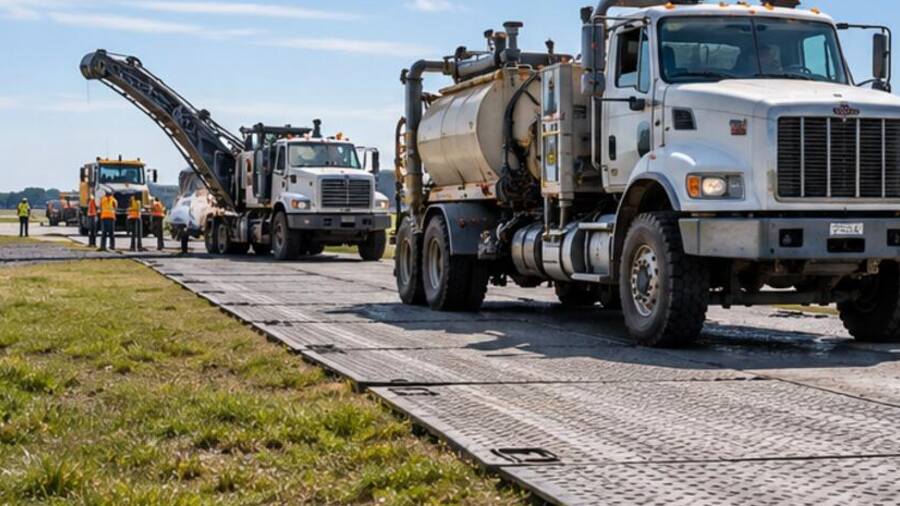
The sequence of laying would allow for the advance from the stable entrance to the area of operations. First, water and high differentials are processed, then the first plate is located; the subsequent plate is consistent in the direction of the texture and check if the seams form the steps. The ramp, turn and brake points shall increase the horizontal constraints or the width of the coverage. For this project, the key action could be “the immediate discontinuation of the slurry when it is found to be coming out of the seam” and the completion time and the results of the review could be recorded by a dedicated person.
Temporary roads cannot be paved for long. Vehicle brakes, loading overloading and water stowing can gradually change the support under the plate, and surfaces may appear flat and may have created gaps. The site should be inspected before and after peak traffic, after damp salt fog and when the route is changed. In the event of a sinking, the ground and drainage should be checked before deciding whether to change or replace the panels, so as to avoid covering up the problem by filling the panels.
In the case of a large-scale equipment-stuffing mission carried out on a limited industrial site, the site could be divided into five areas for entry, straight, turn, operation and recovery during maintenance repairs. The entry point is responsible for vehicle reconciliation, maintaining continuous coverage of the straight-line segment, increasing the outer width of the turn-band, separate validation of the operating segment and completion of clean bundles in the recovery area. This simulation programme is used to illustrate the methodology and is not a client-specific performance; it can help the project team to recycle the panels to the next stage and keep a record of the number of maintenances and the length of breaks.
Three products may be used in this category at the same time, but the boundaries of the use are clear: road-painted service vehicle routes, leg-past services are centrally supported, and carboard services are applied to bulk discharges. In particular, UHMWPE skateboards need to check the material particle size, water content rate, temperature, impact and car shape. No product could compensate for the error, and the configuration list should be deleted from the field mission.
In addition to the total area, the request shall provide information on indoor and external temperature and chemical contamination, as well as information on the country, duration, conditions of handling, packing and port of destination. Compared suppliers can check the documentation, size difference, surface routing, connector, piece weight, effective area coverage, cabinet list and batch retroactive. The whole container shall be purchased in advance to confirm the discharge equipment. The final programme, which involves the safety of the ground, assembly or operation of the airport, must be approved by the project professional.
Need for further evaluation of the actual project?
Applications, sizes, quantities, site photographs or drawings and delivery destinations are sent, on which we can identify more suitable products and processing programmes.







