
When processing the width of the route, the “where to go, what to go, how many times a day” is written as a verifiable on-site condition. Port machine overhauls, production equipment in place, warehouse mechanical and electrical installation and replacement of airport facilities often include car hanging, tracked hoisting support equipment, car hanging, pumper and hydraulic support equipment, while the impact of tyre exposure and low-speed rotations is ignored by the whole tonnage. The more reliable conclusion is that the width should cover both the wheel, the rotation, car demand and the side safety balance, and then determine the combination of pavement, leg mat or local grass-roots treatment.
On-site measurements cover construction belts that are refilled in layers after temporary excavation, recording weak ranges, slopes, drainage directions and underground pipes. Changes in the water-bearing state and in the car tracks should be observed before and after the heatstorm. Mobile equipment will need to provide the whole vehicle with its own weight, full load weight, a single axle load, tyre size, turn radius and projected duration; the crane will also need to provide the maximum reversibility of the leg and leg extension. Data sources and measurement dates should also be recorded to avoid different versions.
Road-paving boards are responsible for spreading wheel pressure and leg mats for expanding static support areas, which cannot be replaced by one another. For this scenario, the size and thickness of the cushions must be determined on the basis of the maximum retroactivity of the legs, the permitted ground-based load and the performance of the mat material. 30 mm could be included as an option and compared with other thickness, subject to the simultaneous validation of plate sizes, connection structures, grass-roots stratification and number of passages. The labelling of 50 to 80 tons of products does not mean that all the same vehicles are available on the ground, and ground conditions remain the determining factor.
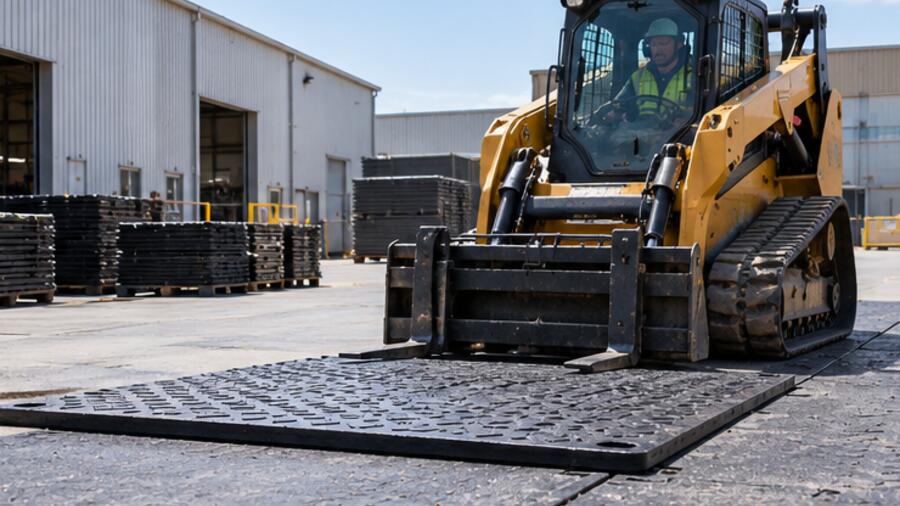
The fast-track installation still requires the retention of basic processes: drainage, debarment, peace-building, positioning, connection and trial passage. The plates remain continuous in line segments, leaving sufficient width at the intersections and outside areas; and they are to be removed from the rigid surface interface. Project leaders should arrange for “drain drainage before rain” and prepare cleaning tools, while specifying the conditions for decommissioning to prevent irregularity from being left to the next group during rush hours.
Maintenance staff can divide the straight-line, turn-out, waiting areas and support points into different levels of inspection. The straight-line sections focus on the sutures and the tracks, turn around and look for lateral shifts, wait areas to see long-term static sinking, and support points to check whether the pads and the ground are sunk. Shorter check intervals after rain or when the traffic suddenly increases; any plate-side rise, loose connection or grass-roots plasma should trigger decommissioning.
In a simulation plan for a large-scale equipment hoisting mission to be completed on a limited industrial field, the area to be released during the entry preparation phase was used: the area to be completed for grass-roots processing and plate connection was opened and the unaccepted area remained isolated. Each region designates a person responsible for the inspection and uses a number corresponding to the photograph. This example does not represent a specific project commitment, but allows the team to focus on the softest 20 metres as a maintenance segment. If the records show repeated maintenance at the same location, they should be re-analysed back to the ground and transport organization.
If the transport chain contains coal, ore, wet soil or food, self-release efficiency may be assessed as an independent subject. Car skateboards help to reduce the adhesiveness of certain materials, but prior to installation, the lining thickness, scalables, bolts or presses and tail door motion space should be confirmed. If there is no need for bulk discharges, there is no need to add the subparagraph; the procurement programme should be consistent with the use.
The procurement list should give suppliers a real view of the work, with the expectation that the due date and the order of arrival would be data that would need to be added to this section. The remaining information includes vehicle and leg loads, ground photographs and sizes, projected number of vehicles, number of days of use, colour trails, destination port and desired period. A comparison of the quotations should be converted to a valid area coverage and complete connection system and not only a single block price; the acceptance and inspection criteria should also be included in the document before the next list.
Need for further evaluation of the actual project?
Applications, sizes, quantities, site photographs or drawings and delivery destinations are sent, on which we can identify more suitable products and processing programmes.







