
The standards of acceptance and inspection have a direct impact on the ability of vehicles to access the operational surface as planned, as well as on the repositioning of the aircraft at port, production equipment, the installation of the warehouse machine and power and the replacement of the airfield facilities. The stationary car hanging, tracked hounding support equipment, car hanging, pumper and hydraulic support equipment, with a dynamic wheel pressure, stationary deformation and power, are common. Retroactivity of the legs is concentrated and may vary with the angle of the arm, with the potential to reduce stability in the ground hollow, slope distance and eccentric receptivity. The programme should, therefore, first target routes and time windows that must be kept open, before arranging for materials and personnel to avoid temporary changes in rules of passage on the construction side.
The degree of completeness of the input conditions determines the quality of the subsequent selection. First, the length and width of the restricted load above the gutter is measured, and then the maximum performance of the vehicle, the tracked crane support equipment, the sling, the pump and the hydraulic support equipment is checked. In addition to the weight, the pressure of the tyre, the form of the belt, the position of the brake, the possibility of in situ transfer and the frequency of passage shall be recorded. In case of continuous rainfall, a ground review should be carried out; if the data cannot be confirmed, the unknown item should be included as a restriction rather than replaced by an empirical value.
Product selection should be differentiated by stress. The size and thickness of the leg pads must be determined on the basis of the maximum retroactivity of the leg, the permitted ground-based load and the material performance of the mattress. 15, 20, 25 and 30 mm are in the common thickness range and 30 mm can only serve as a starting point for comparison for this project; if there are holes or sediments at the grass-roots level, the increase in thickness is not a substitute for peace and reinforcement. The 50-80 tonnes in the product information should also be understood in conjunction with the test conditions, with the final specifications to be confirmed by the approved programme and field professionals.
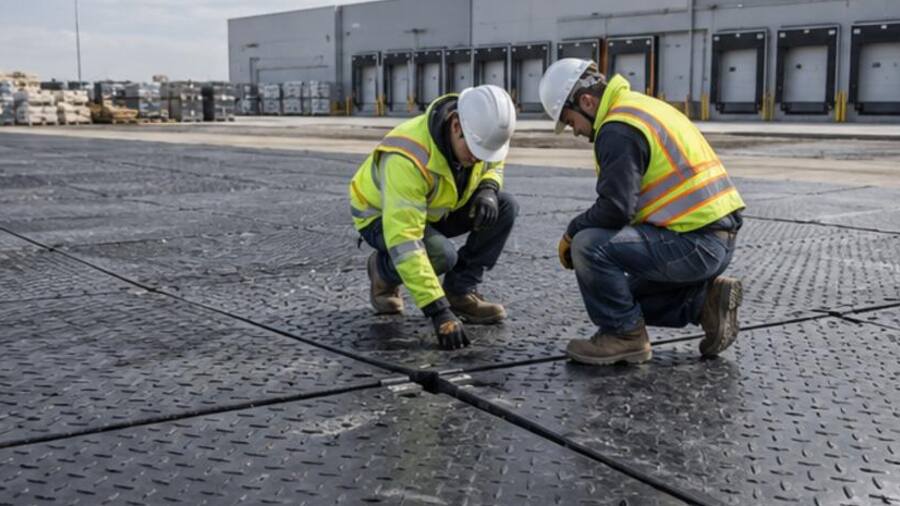
The fast-track installation still requires the retention of basic processes: drainage, debarment, peace-building, positioning, connection and trial passage. The plates remain continuous in line segments, leaving sufficient width at the intersections and outside areas; and they are to be removed from the rigid surface interface. Project leaders should arrange for “restricting speed and prohibiting the movement of vehicles in situ”, while specifying the conditions for decommissioning and preventing unusual leave to the next group during rush hours.
Temporary roads cannot be paved for long. Vehicle brakes, loading overloading and water stowing can gradually change the support under the plate, and surfaces may appear flat and may have created gaps. The site should be inspected before and after peak traffic, after continuous rainfall and when the route changes. In the event of a sinking, the ground and drainage should be checked before deciding whether to change or replace the panels, so as to avoid covering up the problem by filling the panels.
In the case of a large-scale equipment lifting mission performed on a limited industrial field, the site could be divided into five areas for entry, straight, turn, operation and recovery during the peak transport phase. The entry point is responsible for vehicle reconciliation, maintaining continuous coverage of the straight-line segment, increasing the outer width of the turn-band, separate validation of the operating segment and completion of clean bundles in the recovery area. This simulation programme is used to illustrate the methodology and is not a client-specific performance; it helps project teams to synchronize the clean-up and classification of panels when they are evacuated and to keep records of the number of maintenances and the length of breaks.
If the transport chain contains coal, ore, wet soil or food, self-release efficiency may be assessed as an independent subject. Car skateboards help to reduce the adhesiveness of certain materials, but prior to installation, the lining thickness, scalables, bolts or presses and tail door motion space should be confirmed. If there is no need for bulk discharges, there is no need to add the subparagraph; the procurement programme should be consistent with the use.
It is best to complete small-scale technical confirmation before the next list. First, the container type and destination port and complete field parameters are submitted to the supplier for specification, quantity and packaging advice; then the sample trails, connections, dimensions and material documents are checked; and finally, the container type, destination port, discharge method and batch identification are identified. The supplier recommended that it be used only as an input and that the project party remain responsible for the stabilization of the ground load, traffic organization and lifting.
Need for further evaluation of the actual project?
Applications, sizes, quantities, site photographs or drawings and delivery destinations are sent, on which we can identify more suitable products and processing programmes.







