
When handling the back-up configuration, the words “where to go, what to go, how many times a day” are written as verifiable on-site conditions. Port machine overhauls, production equipment in place, warehouse mechanical and electrical installation and replacement of airport facilities often include car hanging, tracked hoisting support equipment, car hanging, pumper and hydraulic support equipment, while the impact of tyre exposure and low-speed rotations is ignored by the whole tonnage. A more reliable conclusion is that the back-up should be in the vicinity of a weak section, a turning area and a recovery point, and that a fast-tracked connector should be reserved before deciding on a pavement, leg pad or local grass-roots treatment combination.
The degree of completeness of the input conditions determines the quality of the subsequent selection. After measuring the length and width of the arctics that are formed as a result of repeated crushing, the maximum performance of car hanging, tracked homing support equipment, with-the-car hanging, pumps and hydraulic support equipment is checked. In addition to the weight, the pressure of the tyre, the form of the belt, the position of the brake, the possibility of in situ transfer and the frequency of passage shall be recorded. In case of high temperatures, a ground review should be carried out; if data cannot be confirmed, unknown items should be listed as a restriction rather than being replaced by empirical values.
Where the route has both a mobile device and a fixed support point, the choice should be made between the pavement and the leg pad, respectively. The size and thickness of the leg pads must be determined on the basis of the maximum retroactivity of the leg, the permitted ground-based load and the material performance of the mattress. The thickness can be screened from commonly used specifications such as 15, 20, 25, 30 mm, and the 25 mm appearing in this section does not constitute a direct recommendation. For information ranging from 160 to 200 tons, the purchaser should also request the test method and give priority to the equipment description, construction programme and on-site validation.
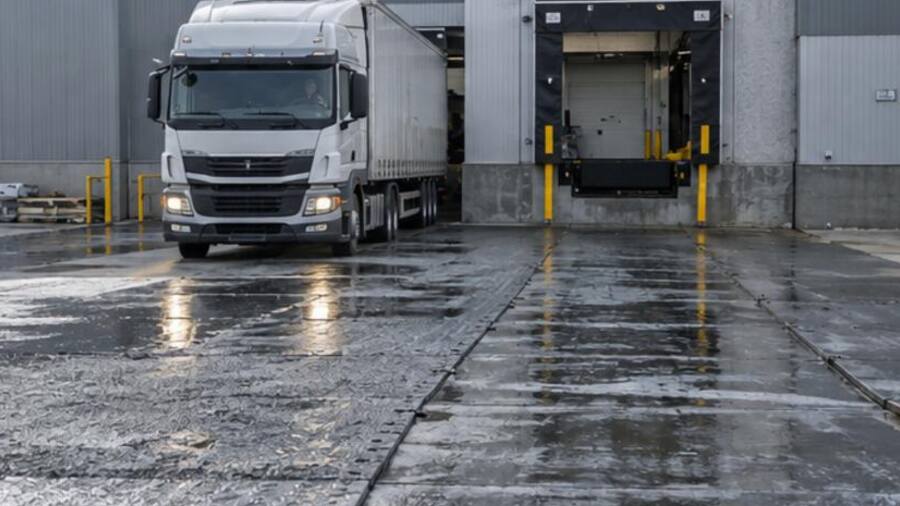
The sequence of laying would allow for the advance from the stable entrance to the area of operations. First, water and high differentials are processed, then the first plate is located; the subsequent plate is consistent in the direction of the texture and check if the seams form the steps. The ramp, turn and brake points shall increase the horizontal constraints or the width of the coverage. For this item, “one-way access and checking of the total vehicle mass at the entrance” can be used as a key action, with a dedicated person recording the completion time and the results of the review.
Operating records include at least open hours, traffic through vehicles, unusual locations and disposal results. The first group of vehicles shall travel at a low speed to observe whether the plates are moving with the tyres; the second class shall then adjust the speed limits and frequency of the inspection to the records. Forklifts with frequent and rapid turnovers should check for surface wear and, if the crane changes the condition, re-check the retroactivity of the leg. Once maintenance is completed, access will be restored to the designated person.
A reference scenario is a large-scale equipment suspension mission performed on a limited industrial field. The project involves short-term trial preparation during the start-up phase, recording the relocation and deposition of the first vehicle after its adoption, and a gradual extension of the route. The turn areas, parking areas and pick-up points are inspected separately and no result is used to replace the full condition. This is an example of a methodology rather than a statement of performance, and the expected management effect is to focus the inspection on turnovers, ramps and seams; after completion, a comparison of the original ground photographs, cleaning hours and the number of plates that can be used for use.
Three products may be used in this category at the same time, but the boundaries of the use are clear: road-painted service vehicle routes, leg-past services are centrally supported, and carboard services are applied to bulk discharges. In particular, UHMWPE skateboards need to check the material particle size, water content rate, temperature, impact and car shape. No product could compensate for the error, and the configuration list should be deleted from the field mission.
The request for quotations must be in the form of packaging and handling equipment, otherwise it is likely that different suppliers will calculate on different assumptions. The procurement staff shall also require the description of the effective size, weight, number of attachments, packing units, container load and delivery cycle of each plate. The evaluation will be based on technical conformity, installation efficiency and turnover. Where key payloads or ground data have not been confirmed, the quotations should be marked as preliminary and the review retained.
Need for further evaluation of the actual project?
Applications, sizes, quantities, site photographs or drawings and delivery destinations are sent, on which we can identify more suitable products and processing programmes.







