
Quantities are accounted for in terms of “where to go, what to go, how many times a day” as a verifiable on-site condition. Port machine overhauls, production equipment in place, warehouse mechanical and electrical installation and replacement of airport facilities often include car hanging, tracked hoisting support equipment, car hanging, pumper and hydraulic support equipment, while the impact of tyre exposure and low-speed rotations is ignored by the whole tonnage. A more reliable conclusion is that the quantity is calculated on the basis of net coverage, staggering, wide turns, back-up ratio and turn-off batches, followed by a decision on the combination of pavement boards, leg pads or local grass-roots processes.
The survey forms can be completed by the four columns of ground, equipment, route and time. Landlines indicate old sites with visible ups and downs and nearby drainage vents; equipment bar lists vehicle weights, cargo weights, axles and tyre specifications; route bar sizes take a clean width, slopes and turn radius; and time bar indicates high temperature storms and shift arrangements. If a crane is present, it should be based on the retroactivity of the leg in the manufacturer ' s worksheet, and it cannot be rated as a ground load.
The selection is based on the calculation of the local pressure and the examination of whether the plate remains continuous at the grass-roots level. The size and thickness of the leg pads must be determined on the basis of the maximum retroactivity of the leg, the permitted ground-based load and the material performance of the mattress. The common thickness ranges from 15 mm to 30 mm, and this option can first assess 15 mm and then adjust it through a trial preparation or project accounting. The so-called 80 to 120-ton carrier should have a clear test boundary and cannot be cited separately from the distance, temperature, payload distribution and safety factor.
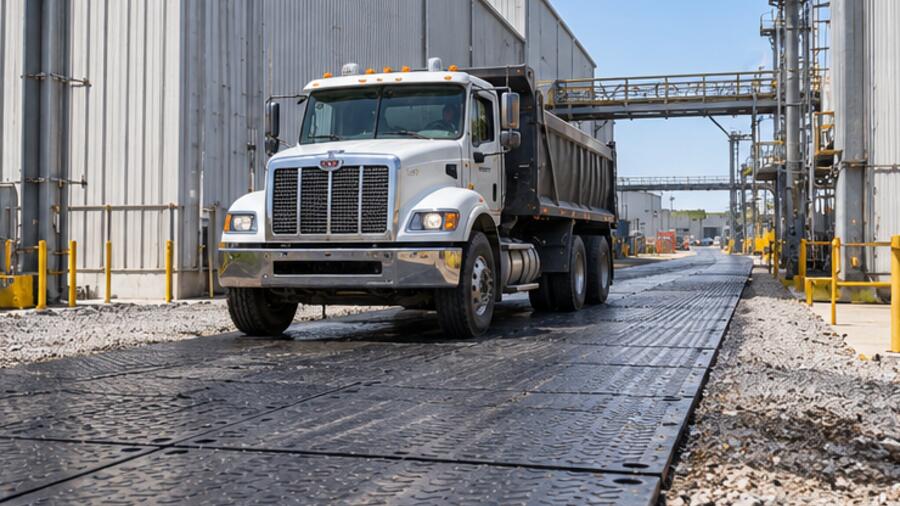
When the plates arrive at the site, the quantity, the connector and the crane are checked and the goods are discharged by route number. Upon completion of the grass-roots level, the vehicle entrance is prepared in sub-sections, and the level and edge support is checked at each stage of completion. The leg area of operation shall be separated from the area of passage. The inclusion in the installation programme of the "Setting of portable lighting for night shift teams" would allow field personnel to convert abstract requirements into actionable.
Temporary roads cannot be paved for long. Vehicle brakes, loading overloading and water stowing can gradually change the support under the plate, and surfaces may appear flat and may have created gaps. The site should be inspected before and after peak traffic, after high temperatures and when the route changes. In the event of a sinking, the ground and drainage should be checked before deciding whether to change or replace the panels, so as to avoid covering up the problem by filling the panels.
In the case of a large-scale equipment-stuffing mission performed on a limited industrial field, the site could be divided into five areas at the entrance preparation stage, straight ahead, turn, operate and recover. The entry point is responsible for vehicle reconciliation, maintaining continuous coverage of the straight-line segment, increasing the outer width of the turn-band, separate validation of the operating segment and completion of clean bundles in the recovery area. The simulation programme is used to illustrate the methodology and is not a client-specific performance; it can help the project team to separate temporary suspension points from the main traffic route and leave a record of the number of maintenances and the length of breaks.
The bulk material project will also examine car car stickers, impact and wear. The UHMWPE car skateboard can improve offloading when materials, temperature and car structure are appropriate, but it is necessary to confirm fixation, thermal condensation, the end door gap and cleaning methods; it is not a substitute for the safe offloading procedure. If the project does not involve a self-loading vehicle, the budget should be focused on physical access and support points and not add irrelevant configurations to complete product portfolios.
In order to obtain a comparable offer, the purchaser should harmonize the request for quotations to at least specify the type of ground, water-bearing state and capacity allowed, route size, vehicle condition, ground condition and project time. Vendors are required to respond to material plates, sheeting, single weight, connection, packaging, containerization and quantity and quality documents. If the project is purchased on a containerized basis, the capability of the forklift or forklift on site or forklift is also confirmed. All safety-related selections are based on the equipment manual and the approval programme.
Need for further evaluation of the actual project?
Applications, sizes, quantities, site photographs or drawings and delivery destinations are sent, on which we can identify more suitable products and processing programmes.







