
The answer to how industrial equipment suspension supports the establishment of a record of use should start with the course of operation rather than with a fixed specification. Establish numbering, location, pass, damage and maintenance records for each batch to facilitate turnover management. There are different pressures on tires, axle loads and the way in which they are carried, as well as on the power and power installations of the port, and the replacement of the airport facilities, which usually include both car hanging, tracked cranes, cranes and hydraulic support equipment. Retroactivity of the legs is concentrated and may vary with the angle of the arm, with the potential to reduce stability in the ground hollow, slope distance and eccentric receptivity. The project team shall first delineate the main corridor, the waiting areas, the loading and unloading points and the emergency export, and then the boundary shall be confirmed jointly by the construction, logistics and security authorities.
The degree of completeness of the input conditions determines the quality of the subsequent selection. First, the length and width of the softened shoulder close to the drains are measured, and then the maximum performance of the vehicle suspension, the tracked lifting aids, the sling, the pump and the hydraulic support equipment is checked. In addition to the weight, the pressure of the tyre, the form of the belt, the position of the brake, the possibility of in situ transfer and the frequency of passage shall be recorded. Short and heavy rainfall should be supplemented by a ground review; if data cannot be confirmed, unknown items should be included as a limitation rather than replaced by empirical values.
Material parameters should serve the field rather than be propaganda figures. The size and thickness of the leg pads must be determined on the basis of the maximum retroactivity of the leg, the permitted ground-based load and the material performance of the mattress. The project allows for the comparison of 20 mm and the adjacent specification of the single mass, rigidity, laying efficiency and number of containers, as well as for the reconciliation of the links to the surface. Between 120 and 160 tonnes are initial sifts only; ground-based and support designs should be completed first when an underground hole, weak shoulder or hanger overload exists.
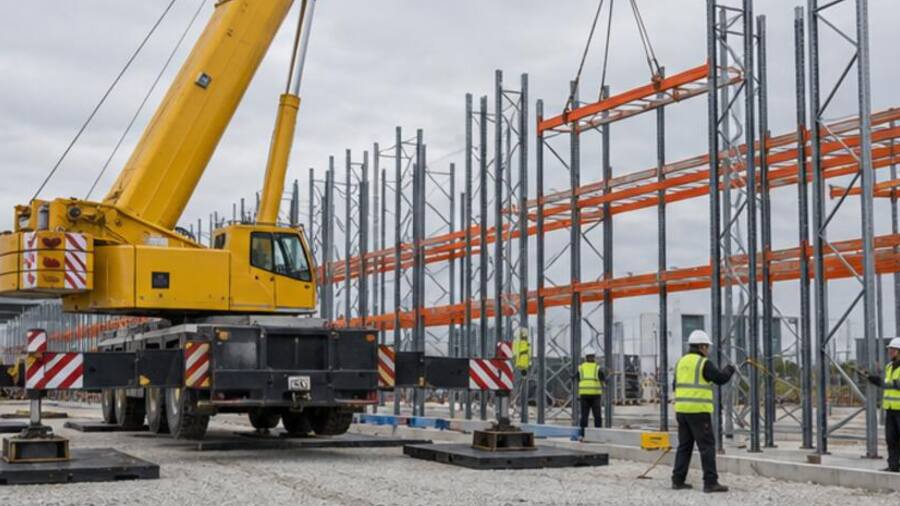
When the plates arrive at the site, the quantity, the connector and the crane are checked and the goods are discharged by route number. Upon completion of the grass-roots level, the vehicle entrance is prepared in sub-sections, and the level and edge support is checked at each stage of completion. The leg area of operation shall be separated from the area of passage. The inclusion in the installation programme of a “review of the original ground state at the end of the project” would allow field personnel to convert abstract requirements into actionable.
Maintenance staff can divide the straight-line, turn-out, waiting areas and support points into different levels of inspection. The straight-line sections focus on the sutures and the tracks, turn around and look for lateral shifts, wait areas to see long-term static sinking, and support points to check whether the pads and the ground are sunk. Shorter check intervals after rain or when the traffic suddenly increases; any plate-side rise, loose connection or grass-roots plasma should trigger decommissioning.
In a simulation plan for large-scale equipment hoisting tasks to be performed on a limited industrial field, the evacuation site recovery phase involves the zonal release of areas that have completed grass-roots processing and plate connectivity, while unaccepted areas remain isolated. Each region designates a person responsible for the inspection and uses a number corresponding to the photograph. This example does not represent a specific project commitment, but allows the team to avoid sharing a fuzzy load assumption with different equipment. If the records show repeated maintenance at the same location, they should be re-analysed back to the ground and transport organization.
The bulk material project will also examine car car stickers, impact and wear. The UHMWPE car skateboard can improve offloading when materials, temperature and car structure are appropriate, but it is necessary to confirm fixation, thermal condensation, the end door gap and cleaning methods; it is not a substitute for the safe offloading procedure. If the project does not involve a self-loading vehicle, the budget should be focused on physical access and support points and not add irrelevant configurations to complete product portfolios.
The request for quotations shall provide, in addition to the total area, a back-up ratio and on-site maintenance conditions, with an indication of the country, duration, conditions of handling, packing and port of destination. Compared suppliers can check the documentation, size difference, surface routing, connector, piece weight, effective area coverage, cabinet list and batch retroactive. The whole container shall be purchased in advance to confirm the discharge equipment. The final programme, which involves the safety of the ground, assembly or operation of the airport, must be approved by the project professional.
Need for further evaluation of the actual project?
Applications, sizes, quantities, site photographs or drawings and delivery destinations are sent, on which we can identify more suitable products and processing programmes.







