
For drainage protection, the site should first determine the target of access: whether it is a continuous transport, short-term suspension or a temporary stop during peak periods. Port machine overhauls, production equipment in place, electrical installation of the warehouse and replacement of airfield facilities involving car hanging, tracked lifting aids, cranes, pumps and hydraulic support equipment, while retrogressive legs are concentrated and may vary with the angle of the crane arm, with the potential to reduce the stability of the ground hole, slope distance and eccentric receptivity. When targets, vehicles and vulnerable positions are matched, they are laid in such a way that key points are not overstretched or missed; the practical implementation principle is that water under the plate weakens the grass-roots level and takes the finer, and the drainage direction must be preserved and the export can be cleared.
The survey forms can be completed by the four columns of ground, equipment, route and time. The surface column indicates the transition period between the grassland and the hardened road surface and the adjacent drainage vent; the equipment column lists the vehicle ' s own weight, cargo weight, number of axes and tyre specifications; the route column takes a clean width, slope and turn radius; and the time column describes the wet salt fog and the shift schedule. If a crane is present, it should be based on the retroactivity of the leg in the manufacturer ' s worksheet, and it cannot be rated as a ground load.
Product selection should be differentiated by stress. The size and thickness of the leg pads must be determined on the basis of the maximum retroactivity of the leg, the permitted ground-based load and the material performance of the mattress. 15, 20, 25 and 30 mm are in the common thickness range and 25 mm can only serve as a starting point for comparison for this project; if there are holes or sediments at the grass-roots level, the increase in thickness is not a substitute for peace and reinforcement. The 160 to 200 tonnes in the product information should also be understood in conjunction with the test conditions, with the final specifications to be confirmed by the approved programme and field professionals.
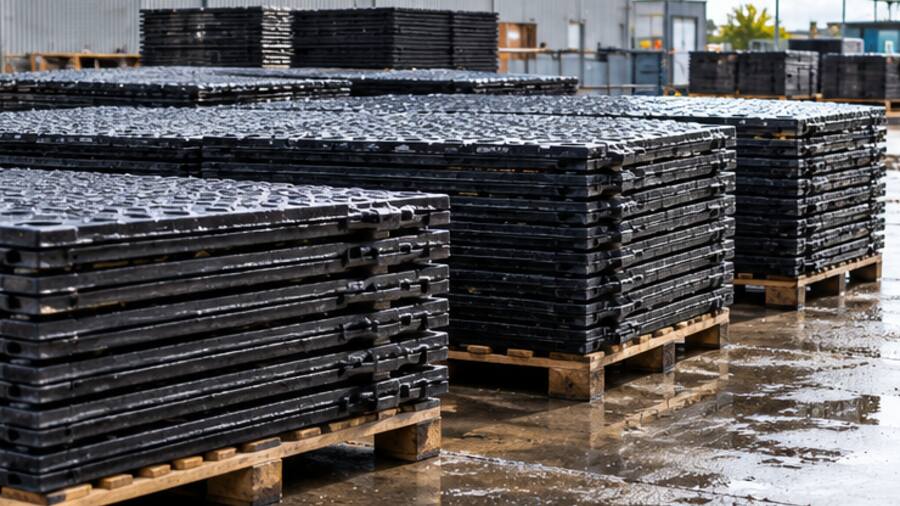
Pre-installation to remove sharp waste, loose rock and mobile mud, and to purge and level the ground. The plates were set up in the main direction and were sewd to avoid the deep path and to check the wells and legs. The turn and reverse areas are to be slightly wider and the connectors are to be locked as required. The site should also put in place a “set-down of the ramp” and include this requirement at the end of the shift and in the traffic organization chart.
Maintenance staff can divide the straight-line, turn-out, waiting areas and support points into different levels of inspection. The straight-line sections focus on the sutures and the tracks, turn around and look for lateral shifts, wait areas to see long-term static sinking, and support points to check whether the pads and the ground are sunk. Shorter check intervals after rain or when the traffic suddenly increases; any plate-side rise, loose connection or grass-roots plasma should trigger decommissioning.
In a simulation plan for large-scale equipment hoisting tasks to be completed on a limited industrial field, the maintenance overhaul phase involves the zonal release of areas that have completed grass-roots processing and plate connections, with unaccepted areas remaining isolated. Each region designates a person responsible for the inspection and uses a number corresponding to the photograph. This example does not represent a specific project commitment, but allows the team to keep the load and load while the vehicle remains stable. If the records show repeated maintenance at the same location, they should be re-analysed back to the ground and transport organization.
Auxiliary equipment also affects the overall programme. A leg pad is required to accompany a vehicle, a forklift is required to focus on tyre contact, and a bulk vehicle may require a slab. The suitability of the UHMWPE liner depends on the work temperature, the chemical environment, the material impact and the car structure, and the manufacturer provides the installation requirements. Each product should be matched to specific equipment in the project form to avoid the use of the same parameter across uses.
The maximum reversibility of the crane leg must be present in the request for quotations, otherwise it is likely that the different suppliers will base their calculations on different assumptions. The procurement staff shall also require the description of the effective size, weight, number of attachments, packing units, container load and delivery cycle of each plate. The evaluation will be based on technical conformity, installation efficiency and turnover. Where key payloads or ground data have not been confirmed, the quotations should be marked as preliminary and the review retained.
Need for further evaluation of the actual project?
Applications, sizes, quantities, site photographs or drawings and delivery destinations are sent, on which we can identify more suitable products and processing programmes.







