
Forklift cranes and engineering equipment operations cannot be answered with single-product parameters on how to select the thickness of the pavement. Project leaders need to look at the flow organization, ground support and maintenance capacity at the same time; the thickness should not be limited to the total weight of the vehicle, but combined with axle load, tyre contact, grass-roots support and the number of times passed. When forklifts, vehicle cranes, forklifts, high-altitude operators and equipment transporters enter the port area, logistics parks, factories and warehouses on a cross-section, problems with turnovers, ramps, seams and waiting positions on routes may arise earlier than normal straight-line segments and should be individually marked on drawings.
The survey forms can be completed by the four columns of ground, equipment, route and time. Ground bars indicate areas and adjacent drains of the soil within the perimeter of the airport that are sensitive to the soil; equipment columns specify the vehicle ' s own weight, cargo weight, number of axes and tyre specifications; route bars take a clean width, slope and turn radius; and time bars describe short-term heavy rainfall and shift arrangements. If a crane is present, it should be based on the retroactivity of the leg in the manufacturer ' s worksheet, and it cannot be rated as a ground load.
Where the route has both a mobile device and a fixed support point, the choice should be made between the pavement and the leg pad, respectively. The pavements address the continuous movement of mobile devices and the spread of pressure at static support points through the slabs, which need to be accounted for separately. The thickness can be screened from commonly used specifications such as 15, 20, 25, 30 mm, and the 15 mm appearing in this section does not constitute a direct recommendation. For information on ranges of 80 to 120 tons, the purchaser should also request a test method and give priority to the equipment description, construction programme and on-site validation.
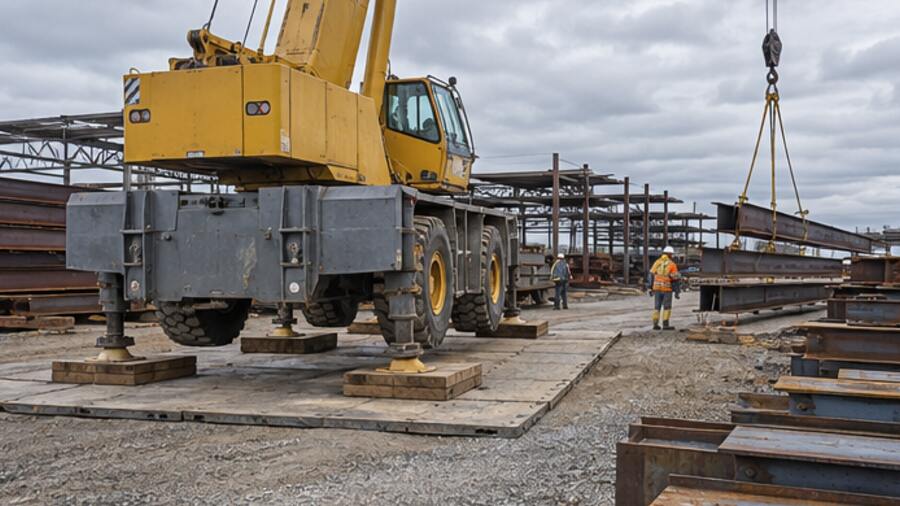
The fast-track installation still requires the retention of basic processes: drainage, debarment, peace-building, positioning, connection and trial passage. The plates remain continuous in line segments, leaving sufficient width at the intersections and outside areas; and they are to be removed from the rigid surface interface. Project leaders should arrange for “early re-routing in accordance with weather forecasts”, while specifying the conditions for decommissioning, so as to prevent irregularity from being left to the next group during rush hours.
Maintenance staff can divide the straight-line, turn-out, waiting areas and support points into different levels of inspection. The straight-line sections focus on the sutures and the tracks, turn around and look for lateral shifts, wait areas to see long-term static sinking, and support points to check whether the pads and the ground are sunk. Shorter check intervals after rain or when the traffic suddenly increases; any plate-side rise, loose connection or grass-roots plasma should trigger decommissioning.
For an industrial installation area, where forklift transport is carried out in conjunction with mobile cranes, the maintenance and overhaul phase may be established as an independent inspection node. On-site identification of vehicle lists and weather is followed by a check of drainage, connections and borders; if any conditions change, release is suspended and the road map updated. This scenario is used only to illustrate how the project is organized and focuses on the accumulation of comparable data for subsequent projects. It should also record the number of inputs, the time of laying, the time of stoppage, the location of maintenance and the condition of the ground after the evacuation site.
The bulk material project will also examine car car stickers, impact and wear. The UHMWPE car skateboard can improve offloading when materials, temperature and car structure are appropriate, but it is necessary to confirm fixation, thermal condensation, the end door gap and cleaning methods; it is not a substitute for the safe offloading procedure. If the project does not involve a self-loading vehicle, the budget should be focused on physical access and support points and not add irrelevant configurations to complete product portfolios.
It is best to complete small-scale technical confirmation before the next list. First, the method of connection and the need to lay tools and complete on-site parameters for suppliers to give specifications, quantities and packaging advice; then to check sample trails, connections, dimensions and material documents; and finally to confirm container type, destination port, discharge method and batch identification. The supplier recommended that it be used only as an input and that the project party remain responsible for the stabilization of the ground load, traffic organization and lifting.
Need for further evaluation of the actual project?
Applications, sizes, quantities, site photographs or drawings and delivery destinations are sent, on which we can identify more suitable products and processing programmes.







