
When handling cross-cutting operations, “where to go, what to go, how many times a day” is written as a verifiable on-site condition. Cross-operating traffic in port areas, logistics parks, factories and warehouses often consists of forklifts, car hangings, forklifts with stretching arms, high-altitude operating vehicles and equipment transport vehicles, with the impact of tyre exposures and low-speed rotations being ignored by the whole tonnage. The more reliable conclusion is that forklifts, trucks and cranes should be routed and in waiting areas, and who should be given priority access, and then decide on a combination of pavements, leg mats or local grass-roots treatment.
The degree of completeness of the input conditions determines the quality of the subsequent selection. First, the length and width of the loose grass-roots after the winter freeze is measured, and then the maximum performance of forklifts, car hangings, forklifts with stretch arms, high-altitude operating vehicles and equipment transport vehicles is checked. In addition to the weight, the pressure of the tyre, the form of the belt, the position of the brake, the possibility of in situ transfer and the frequency of passage shall be recorded. In case of cryogenic freezing, a ground review should be carried out; if the data cannot be confirmed, the unknown item should be classified as a restriction and not replaced by an empirical value.
Where the route has both a mobile device and a fixed support point, the choice should be made between the pavement and the leg pad, respectively. The pavements address the continuous movement of mobile devices and the spread of pressure at static support points through the slabs, which need to be accounted for separately. The thickness can be screened from commonly used specifications such as 15, 20, 25, 30 mm, and the 15 mm appearing in this section does not constitute a direct recommendation. For information on ranges of 80 to 120 tons, the purchaser should also request a test method and give priority to the equipment description, construction programme and on-site validation.
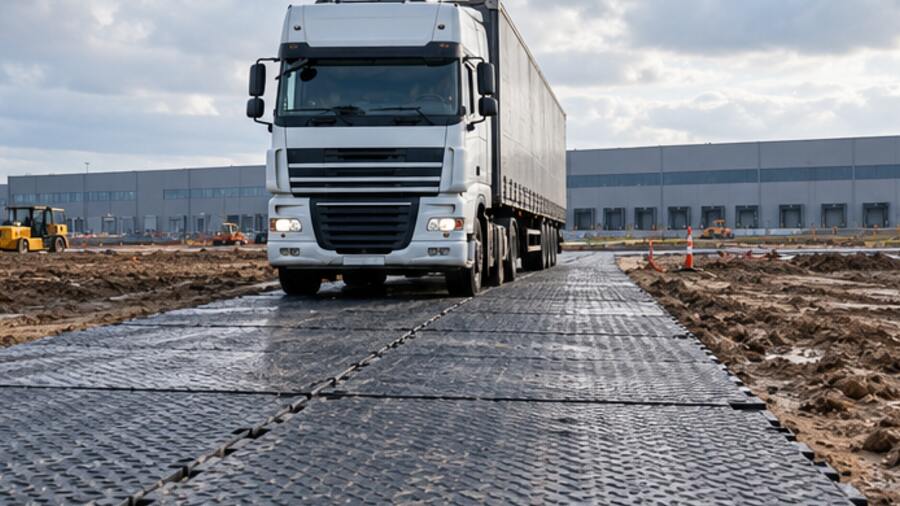
The sequence of laying would allow for the advance from the stable entrance to the area of operations. First, water and high differentials are processed, then the first plate is located; the subsequent plate is consistent in the direction of the texture and check if the seams form the steps. The ramp, turn and brake points shall increase the horizontal constraints or the width of the coverage. For this project, a “low-speed test and post-exit check for the first heavy vehicle” could be used as a key action, with the completion time and results recorded by the dedicated person.
Temporary roads cannot be paved for long. Vehicle brakes, loading overloading and water stowing can gradually change the support under the plate, and surfaces may appear flat and may have created gaps. The site should be checked before and after peak traffic, after cryogenic freezing and when the route changes. In the event of a sinking, the ground and drainage should be checked before deciding whether to change or replace the panels, so as to avoid covering up the problem by filling the panels.
In a simulation plan of the industrial equipment installation area, which is being carried out in conjunction with the mobile crane, the peak transport phase involves the zonal release of the area where the ground-based treatment and the plate link have been completed, with the unaccepted area remaining isolated. Each region designates a person responsible for the inspection and uses a number corresponding to the photograph. This example does not represent a specific project commitment, but allows the team to separate the temporary post from the main traffic route. If the records show repeated maintenance at the same location, they should be re-analysed back to the ground and transport organization.
In the integrated site, different problems were solved by the pavement, leg mats and carboards. Vehicle traffic is supported by a continuous focus on the maximum retroactivity of the leg and the friction and adhesion of material from the surface of the vehicle. If MHMWPE skateboards are used, thermal stretches should be set aside and fixed systems checked; if relevant material is not available at the site, they should be removed from the list and the investment targeted.
In order to obtain comparable quotations, the purchaser should harmonize the request for quotations to at least indicate quality documents, batch retroactive and acceptance methods, route sizes, vehicle condition, ground condition and project time. Vendors are required to respond to material plates, sheeting, single weight, connection, packaging, containerization and quantity and quality documents. If the project is purchased on a containerized basis, the capability of the forklift or forklift on site or forklift is also confirmed. All safety-related selections are based on the equipment manual and the approval programme.
Need for further evaluation of the actual project?
Applications, sizes, quantities, site photographs or drawings and delivery destinations are sent, on which we can identify more suitable products and processing programmes.







