
When handling installation movements, “where to go, what to go, how many times a day” is written as a verifiable on-site condition. Cross-operating traffic in port areas, logistics parks, factories and warehouses often consists of forklifts, car hangings, forklifts with stretching arms, high-altitude operating vehicles and equipment transport vehicles, with the impact of tyre exposures and low-speed rotations being ignored by the whole tonnage. The more reliable conclusion is that the area of installation is to be linked to the vehicle release plan to avoid connecting personnel to the plates in unseparated traffic, and then to decide on the combination of pavement, leg pads or local grass-roots treatment.
In order to determine whether the installation schedule can be implemented, the site should be set up at a point rather than taking only a few photographs. In particular, there is a need to review the sculpture base, which is uneven, since the drying of the surface does not represent a continuous carrying of the next. The project information shall also include the maximum daily traffic, the length of vehicle stay, the direction of handling and the drainage route during the cryogenic thaw. For troughs, inspection wells and underground facilities, the prohibited support or need to be reinforced should be indicated in the road map.
Material parameters should serve the field rather than be propaganda figures. The pavements address the continuous movement of mobile devices and the spread of pressure at static support points through the slabs, which need to be accounted for separately. The project compares 30 mm and the number of block weights, rigidity, laying efficiency and containers with the adjacent specifications, and cross-checks the links to the surface. 50-80 tonnes are only primary sifts; ground-based and support designs should be completed first when an underground hole, weak shoulder or hanger overload exists.
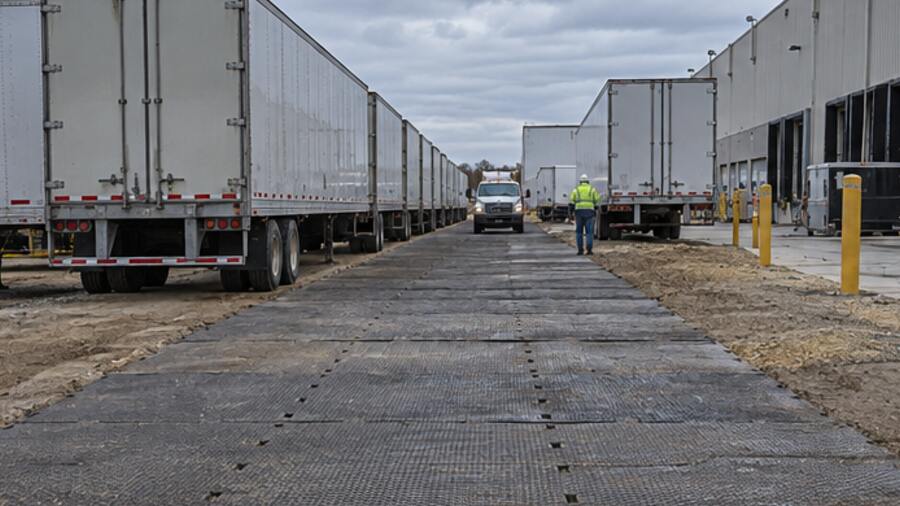
Pre-installation to remove sharp waste, loose rock and mobile mud, and to purge and level the ground. The plates were set up in the main direction and were sewd to avoid the deep path and to check the wells and legs. The turn and reverse areas are to be slightly wider and the connectors are to be locked as required. The “restriction of speed and prohibition of in situ movement of vehicles” should also be implemented on the ground and this requirement should be included at the end of the shift and in the traffic organization chart.
Maintenance staff can divide the straight-line, turn-out, waiting areas and support points into different levels of inspection. The straight-line sections focus on the sutures and the tracks, turn around and look for lateral shifts, wait areas to see long-term static sinking, and support points to check whether the pads and the ground are sunk. Shorter check intervals after rain or when the traffic suddenly increases; any plate-side rise, loose connection or grass-roots plasma should trigger decommissioning.
For an industrial installation area where a forklift transport is carried out at the same time as a mobile crane, the peak transport phase may be established as an independent inspection node. On-site identification of vehicle lists and weather is followed by a check of drainage, connections and borders; if any conditions change, release is suspended and the road map updated. This scenario is used only to illustrate how the project is organized, with a focus on the softest 20 metres as the focus of the maintenance segment. It should also record the number of inputs, the time of laying, the time of stoppage, the location of maintenance and the condition of the ground after the evacuation site.
Three products may be used in this category at the same time, but the boundaries of the use are clear: road-painted service vehicle routes, leg-past services are centrally supported, and carboard services are applied to bulk discharges. In particular, UHMWPE skateboards need to check the material particle size, water content rate, temperature, impact and car shape. No product could compensate for the error, and the configuration list should be deleted from the field mission.
The procurement list should allow suppliers to see the real situation, in which the size of the car, the type of material and the temperature of the work are data that need to be highlighted. The remaining information includes vehicle and leg loads, ground photographs and sizes, projected number of vehicles, number of days of use, colour trails, destination port and desired period. A comparison of the quotations should be converted to a valid area coverage and complete connection system and not only a single block price; the acceptance and inspection criteria should also be included in the document before the next list.
Need for further evaluation of the actual project?
Applications, sizes, quantities, site photographs or drawings and delivery destinations are sent, on which we can identify more suitable products and processing programmes.







