
For comparison with suppliers, the site should first determine whether the goal of access is continuous transport, short-term suspension, or temporary parking during peak periods. Cross-operating operations in port areas, logistics parks, factories and warehouses involve forklifts, car hangings, forklifts with scalding arms, high-altitude operating vehicles and equipment transport vehicles, while forklift tyres are exposed to small areas, with a concentrated retrogression of the legs of the crane, and two types of equipment cannot be based solely on the full tonnage of the vehicle. When targets, vehicles and vulnerable locations are matched, key points will not be overstretched or left out; the practical implementation principle is that materials, structures, connections, effective coverage, containerization and quality documents should be more covered.
The degree of completeness of the input conditions determines the quality of the subsequent selection. First, the length and width of the construction belts, which are to be filled back in layers after the temporary excavation, are to be measured, and then the maximum works of the forklift, car hanging, forklift forklift for a stretcher arm, high-altitude operating vehicles and equipment transport vehicles are to be checked. In addition to the weight, the pressure of the tyre, the form of the belt, the position of the brake, the possibility of in situ transfer and the frequency of passage shall be recorded. In case of high temperatures, a ground review should be carried out; if data cannot be confirmed, unknown items should be listed as a restriction rather than being replaced by empirical values.
The selection is based on the calculation of the local pressure and the examination of whether the plate remains continuous at the grass-roots level. The pavements address the continuous movement of mobile devices and the spread of pressure at static support points through the slabs, which need to be accounted for separately. The common thickness ranges from 15 mm to 30 mm, and this option can first assess 30 mm and then adjust it through trial preparation or project accounting. The so-called 50-80-ton carrier should have a clear test boundary and cannot be cited separately from the distance, temperature, payload distribution and safety factor.
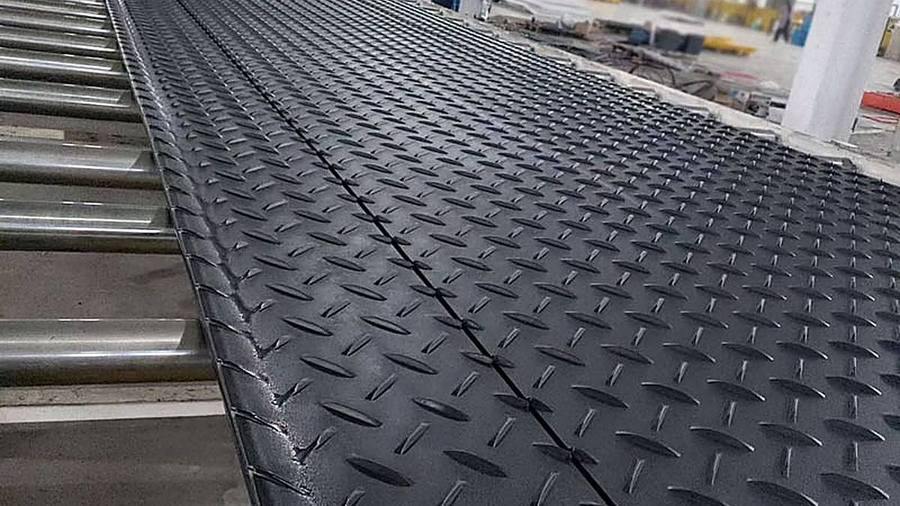
The construction staff should first seal the belts and confirm that no vehicles enter, then clear the floors and tablets. Do not leave the seams in the softest position, and do not let the edges remain open for long periods. Cleaning and installation of sandstones when the link is pierced, so that the connector is not fully in place. Following the completion of a period of low-speed trial traffic and the implementation of the “management of the hanger area separately from the continuous driveway”, the next section will be opened only after eligibility.
Maintenance staff can divide the straight-line, turn-out, waiting areas and support points into different levels of inspection. The straight-line sections focus on the sutures and the tracks, turn around and look for lateral shifts, wait areas to see long-term static sinking, and support points to check whether the pads and the ground are sunk. Shorter check intervals after rain or when the traffic suddenly increases; any plate-side rise, loose connection or grass-roots plasma should trigger decommissioning.
For an industrial equipment installation area where a forklift transport is carried out in conjunction with a mobile crane, the extraction site recovery phase may be established as an independent inspection node. On-site identification of vehicle lists and weather is followed by a check of drainage, connections and borders; if any conditions change, release is suspended and the road map updated. This scenario is used only to illustrate the way in which the project is organized, with a focus on revolving the sheeting to the next stage. It should also record the number of inputs, the time of laying, the time of stoppage, the location of maintenance and the condition of the ground after the evacuation site.
If the transport chain contains coal, ore, wet soil or food, self-release efficiency may be assessed as an independent subject. Car skateboards help to reduce the adhesiveness of certain materials, but prior to installation, the lining thickness, scalables, bolts or presses and tail door motion space should be confirmed. If there is no need for bulk discharges, there is no need to add the subparagraph; the procurement programme should be consistent with the use.
The expected delivery and arrival sequences must be present in the request for quotations, otherwise it is likely that different suppliers will calculate on different assumptions. The procurement staff shall also require the description of the effective size, weight, number of attachments, packing units, container load and delivery cycle of each plate. The evaluation will be based on technical conformity, installation efficiency and turnover. Where key payloads or ground data have not been confirmed, the quotations should be marked as preliminary and the review retained.
Need for further evaluation of the actual project?
Applications, sizes, quantities, site photographs or drawings and delivery destinations are sent, on which we can identify more suitable products and processing programmes.







