
Quantities accounting has a direct impact on the ability of vehicles to access the area of operations as planned, on the intersection of port areas, logistics parks, factories and warehouses. Forklifts, forklifts, forklifts, high-altitude operating vehicles and equipment transporters, which are common in the field, have different dynamic voltage, stationary outlay and power. Forklift tyres are exposed to a small area, with a concentrated retrogression of the legs of the crane, and the two types of equipment cannot be based only on the full tonnage of the vehicle. The programme should, therefore, first target routes and time windows that must be kept open, before arranging for materials and personnel to avoid temporary changes in rules of passage on the construction side.
In order to determine whether quantitative accounting is to be implemented, a site-site monitoring point should be set up, rather than just a few photographs. In particular, the boundary between old concrete and new landfills is to be reviewed, as drying of the surface does not mean continuous carrying of the lower part. The project information should also include the maximum daily traffic, the length of vehicle stay, the direction of handling and the drainage route during the wet salt fog. For troughs, inspection wells and underground facilities, the prohibited support or need to be reinforced should be indicated in the road map.
Where the route has both a mobile device and a fixed support point, the choice should be made between the pavement and the leg pad, respectively. The pavements address the continuous movement of mobile devices and the spread of pressure at static support points through the slabs, which need to be accounted for separately. The thickness can be screened from commonly used specifications such as 15, 20, 25, 30 mm, and the 15 mm appearing in this section does not constitute a direct recommendation. For information on ranges of 80 to 120 tons, the purchaser should also request a test method and give priority to the equipment description, construction programme and on-site validation.
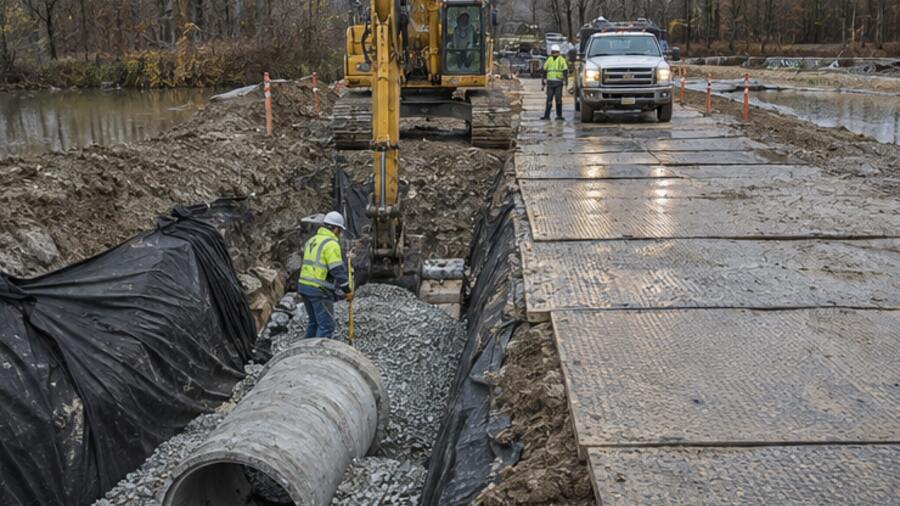
The construction staff should first seal the belts and confirm that no vehicles enter, then clear the floors and tablets. Do not leave the seams in the softest position, and do not let the edges remain open for long periods. Cleaning and installation of sandstones when the link is pierced, so that the connector is not fully in place. A low-speed test pass was completed and a “add a column of plates to the outside of the turn” was implemented before the next segment was opened.
Operating records include at least open hours, traffic through vehicles, unusual locations and disposal results. The first group of vehicles shall travel at a low speed to observe whether the plates are moving with the tyres; the second class shall then adjust the speed limits and frequency of the inspection to the records. Forklifts with frequent and rapid turnovers should check for surface wear and, if the crane changes the condition, re-check the retroactivity of the leg. Once maintenance is completed, access will be restored to the designated person.
Assuming an increase in the number of traffic during the installation phase of an industrial equipment installation, which is carried out in conjunction with a mobile crane, managers can first freeze the change of route before classifying the problems into four categories: ground, slabs, vehicles and movement control. Weak positions are reinforced, damage plates are replaced, vehicles are limited in speed, and one-way access is introduced for peak hours. The example does not correspond to the true customer, but shows how the shoulder of the original repeater is integrated into the continuous coverage and how the on-site judgement can be converted into the next reusable list of items.
If the transport chain contains coal, ore, wet soil or food, self-release efficiency may be assessed as an independent subject. Car skateboards help to reduce the adhesiveness of certain materials, but prior to installation, the lining thickness, scalables, bolts or presses and tail door motion space should be confirmed. If there is no need for bulk discharges, there is no need to add the subparagraph; the procurement programme should be consistent with the use.
The request for quotations shall include, in addition to the total area, a project schedule and plate turnover plan, specifying the country, duration, conditions of handling, mode of packaging and port of destination. Compared suppliers can check the documentation, size difference, surface routing, connector, piece weight, effective area coverage, cabinet list and batch retroactive. The whole container shall be purchased in advance to confirm the discharge equipment. The final programme, which involves the safety of the ground, assembly or operation of the airport, must be approved by the project professional.
Need for further evaluation of the actual project?
Applications, sizes, quantities, site photographs or drawings and delivery destinations are sent, on which we can identify more suitable products and processing programmes.







