
The “where to go, what to walk, how many times a day” is first written as a verifiable on-site condition when processing the usage records. Cross-operating traffic in port areas, logistics parks, factories and warehouses often consists of forklifts, car hangings, forklifts with stretching arms, high-altitude operating vehicles and equipment transport vehicles, with the impact of tyre exposures and low-speed rotations being ignored by the whole tonnage. The more reliable conclusion is that the numbering, location, passage, damage and maintenance records for each batch will facilitate turnover management and then decide on the combination of pavement, leg pads or local grass-roots processing.
The project team could complete a joint pedal survey before the vehicle enters the site, focusing on the discharge areas, low discharge points, ramps and available car space as a result of bulk contamination. The retroactivity of the legs of the vehicle ' s axial load, the exterior dimensions, the minimum convective radius and the equipment for the suspension was then collected. Low-temperature freezing may change the state at the grass-roots level, so measurement results need to be date- and weather-specific. All parameters should be consolidated in the same version of the road map and equipment list.
Product selection should be differentiated by stress. The pavements address the continuous movement of mobile devices and the spread of pressure at static support points through the slabs, which need to be accounted for separately. 15, 20, 25 and 30 mm are within the common thickness range and 20 mm can only serve as a starting point for comparison for this project; if there are holes or sediments at the grass-roots level, the increase in thickness will not be a substitute for peace and reinforcement. The 120 to 160 tonnes in the product information should also be understood in conjunction with the test conditions, with the final specifications to be confirmed by the approved programme and field professionals.
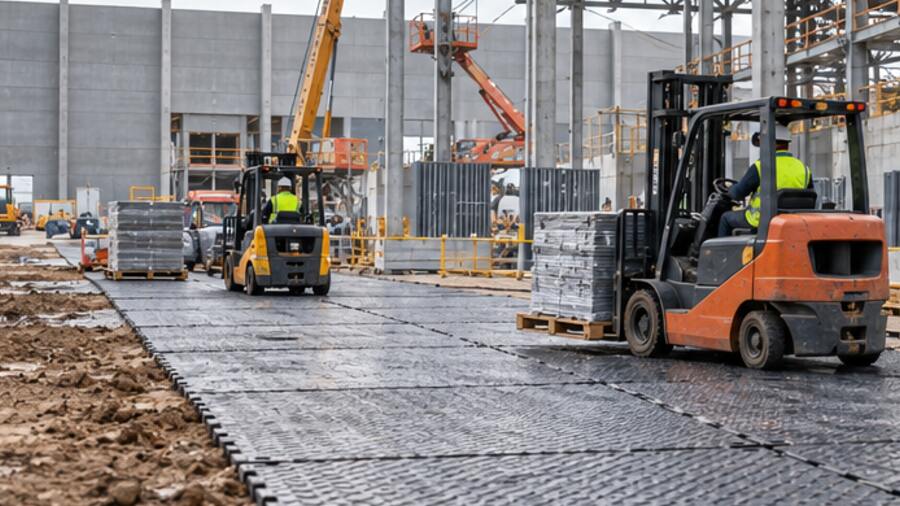
The construction staff should first seal the belts and confirm that no vehicles enter, then clear the floors and tablets. Do not leave the seams in the softest position, and do not let the edges remain open for long periods. Cleaning and installation of sandstones when the link is pierced, so that the connector is not fully in place. A low-speed test of access after a period of completion and the implementation of “place the spare parts near the weak zone” before opening the next section.
Following the opening of access, the focus of the inspection was on the continued support under the plate. The first heavy vehicle passes by to check for high seams, peripheries, mudslides and planks; the shift is repeated after weather changes. The pressure of contact of the forklift ' s solid-heart wheel differs significantly from the concentrated static of the crane ' s legs, and anomalies should be detected first in isolation before being drained, evened or replaced, and the subsequent flow of the vehicle cannot continue to magnify the damage.
In the case of industrial equipment installation areas, where a forklift transport is carried out in conjunction with mobile cranes, the site can be divided into five areas for entry, straight, turn, operation and recovery during the peak transport phase. The entry point is responsible for vehicle reconciliation, maintaining continuous coverage of the straight-line segment, increasing the outer width of the turn-band, separate validation of the operating segment and completion of clean bundles in the recovery area. This simulation programme is used to describe the methodology and is not a client-specific performance; it can help the project team to position the problem sheets by number and leave a record of the number of maintenances and interruptions.
If the transport chain contains coal, ore, wet soil or food, self-release efficiency may be assessed as an independent subject. Car skateboards help to reduce the adhesiveness of certain materials, but prior to installation, the lining thickness, scalables, bolts or presses and tail door motion space should be confirmed. If there is no need for bulk discharges, there is no need to add the subparagraph; the procurement programme should be consistent with the use.
It is best to complete small-scale technical confirmation before the next list. First, the size and quantity of tyres or belts and complete field parameters are submitted, allowing the supplier to provide specifications, quantities and packaging advice; then the sample texture, connection holes, size differences and material documents are checked; and finally the container type, destination port, discharge method and batch identification are identified. The supplier recommended that it be used only as an input and that the project party remain responsible for the stabilization of the ground load, traffic organization and lifting.
Need for further evaluation of the actual project?
Applications, sizes, quantities, site photographs or drawings and delivery destinations are sent, on which we can identify more suitable products and processing programmes.







