
When dealing with the thickness option, “where to go, what to go, how many times a day” is written as a verifiable on-site condition. The flow of vehicles to and from equipment relocation workshops, production line retrofitting areas and plant premises often consists of forklifts, trajectories, hydraulic modular vehicles, equipment loaders and small cranes, with the impact of tyre exposure and low-speed rotations being ignored by the whole tonnage. The more reliable conclusion is that the thickness cannot be seen solely in the total weight of the vehicle, but in combination with axle load, tyre contact, grass-roots support and the number of times passed, and then decide on the combination of pavement, leg pads or local grass-roots treatment.
The degree of completeness of the input conditions determines the quality of the subsequent selection. The length and width of the transition period between the grassland and the hardened surface are first measured, and the maximum works of forklifts, traverse arms, hydraulic modular vehicles, equipment loaders and small cranes are checked. In addition to the weight, the pressure of the tyre, the form of the belt, the position of the brake, the possibility of in situ transfer and the frequency of passage shall be recorded. In case of damp salt fog, a ground review should be carried out; if the data cannot be confirmed, the unknown item should be classified as a restriction and not replaced by an empirical value.
Where the route has both a mobile device and a fixed support point, the choice should be made between the pavement and the leg pad, respectively. Appropriate pavements of surfaced roads can isolate tyres from the floor, and a calculator leg pad should be used below a crane or equipment jack. The thickness can be screened from commonly used specifications such as 15, 20, 25, 30 mm, and the 25 mm appearing in this section does not constitute a direct recommendation. For information on ranges of 80 to 120 tons, the purchaser should also request a test method and give priority to the equipment description, construction programme and on-site validation.
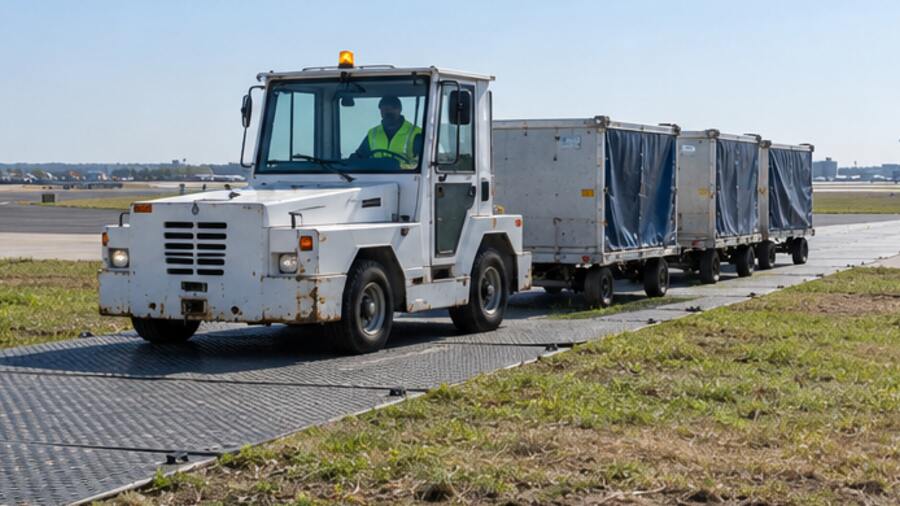
Pre-installation to remove sharp waste, loose rock and mobile mud, and to purge and level the ground. The plates were set up in the main direction and were sewd to avoid the deep path and to check the wells and legs. The turn and reverse areas are to be slightly wider and the connectors are to be locked as required. The “placement of a commanding officer to control a meeting and a back-up” should also be implemented at the site, and this requirement should be included in the pre-shift and traffic organization chart.
Following the opening of access, the focus of the inspection was on the continued support under the plate. The first heavy vehicle passes by to check for high seams, peripheries, mudslides and planks; the shift is repeated after weather changes. The pressure of contact of the forklift ' s solid-heart wheel differs significantly from the concentrated static of the crane ' s legs, and anomalies should be detected first in isolation before being drained, evened or replaced, and the subsequent flow of the vehicle cannot continue to magnify the damage.
A reference scenario is a route for the relocation of equipment through normal production areas. The project involves short-term trial preparation during the recovery phase of the evacuation site, recording the relocation and deposition of the first vehicle after its adoption, and a gradual extension of the route. The turn areas, parking areas and pick-up points are inspected separately and no result is used to replace the full condition. This is an example of a methodology rather than a statement of performance, and the expected management effect is to focus the inspection on turnovers, ramps and seams; after completion, a comparison of the original ground photographs, cleaning hours and the number of plates that can be used for use.
In the integrated site, different problems were solved by the pavement, leg mats and carboards. Vehicle traffic is supported by a continuous focus on the maximum retroactivity of the leg and the friction and adhesion of material from the surface of the vehicle. If MHMWPE skateboards are used, thermal stretches should be set aside and fixed systems checked; if relevant material is not available at the site, they should be removed from the list and the investment targeted.
The procurement list should allow suppliers to see the real situation, with the maximum resonance of the crane leg being the data that needs to be added to this section. The remaining information includes vehicle and leg loads, ground photographs and sizes, projected number of vehicles, number of days of use, colour trails, destination port and desired period. A comparison of the quotations should be converted to a valid area coverage and complete connection system and not only a single block price; the acceptance and inspection criteria should also be included in the document before the next list.
Need for further evaluation of the actual project?
Applications, sizes, quantities, site photographs or drawings and delivery destinations are sent, on which we can identify more suitable products and processing programmes.







