
In the event of a recovery from rain, the site should first determine whether the target is a continuous transport, a short-term suspension or a temporary stop during peak periods. Equipment relocation workshops, production line retrofitting areas and factory entrances involve forklifts, traverse arms, hydraulic modular vehicles, equipment loaders and small cranes, while wheeling, metal belts, fallers and in situ shifts may cause injury to coatings, broken seams or permanent marks in vulnerable areas. When targets, vehicles and vulnerable locations are matched, the scope is not too large or missing critical points; the practical implementation principle is first to drain and close the softest sections of the road, pending continuous support at the grass-roots level.
The degree of completeness of the input conditions determines the quality of the subsequent selection. First, the length and width of the surface-hard, but empty, lower-tangular lawn is measured, and then the maximum works of forklifts, traverse arms, hydraulic modular vehicles, equipment loaders and small cranes are checked. In addition to the weight, the pressure of the tyre, the form of the belt, the position of the brake, the possibility of in situ transfer and the frequency of passage shall be recorded. In case of continuous rainfall, a ground review should be carried out; if the data cannot be confirmed, the unknown item should be included as a restriction rather than replaced by an empirical value.
The selection is based on the calculation of the local pressure and the examination of whether the plate remains continuous at the grass-roots level. Appropriate pavements of surfaced roads can isolate tyres from the floor, and a calculator leg pad should be used below a crane or equipment jack. The common thickness ranges from 15 mm to 30 mm, and this option can first assess 15 mm and then adjust it through a trial preparation or project accounting. The so-called 160 to 200-ton carrier should have a clear test boundary and cannot be cited separately from the distance, temperature, payload distribution and safety factor.
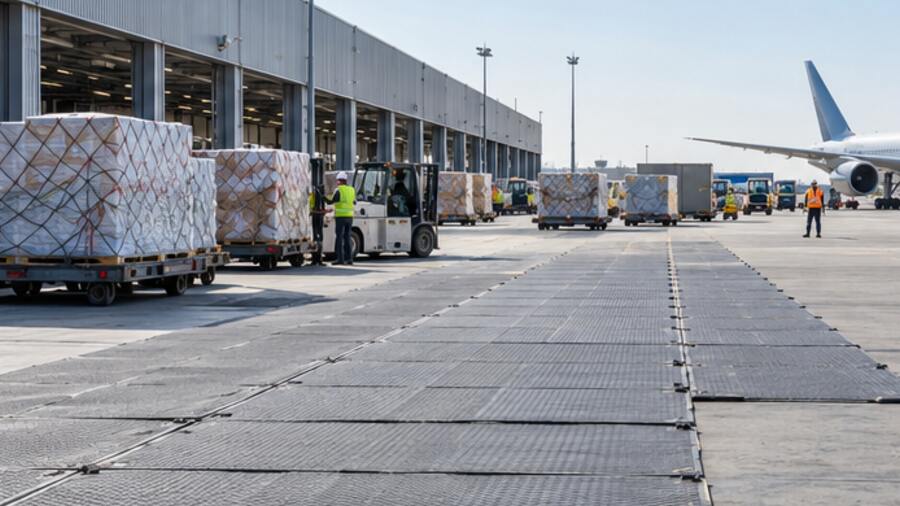
The sequence of laying would allow for the advance from the stable entrance to the area of operations. First, water and high differentials are processed, then the first plate is located; the subsequent plate is consistent in the direction of the texture and check if the seams form the steps. The ramp, turn and brake points shall increase the horizontal constraints or the width of the coverage. For this item, the key action could be to “add a column of sheeting to the side of the turn” and to record the completion time and the results of the review.
Temporary roads cannot be paved for long. Vehicle brakes, loading overloading and water stowing can gradually change the support under the plate, and surfaces may appear flat and may have created gaps. The site should be inspected before and after peak traffic, after continuous rainfall and when the route changes. In the event of a sinking, the ground and drainage should be checked before deciding whether to change or replace the panels, so as to avoid covering up the problem by filling the panels.
Assuming an increase in traffic during the installation phase of equipment that passes through the normal production area, managers can first freeze the change of route before classifying the problems into four categories: ground, plates, vehicles and movement control. Weak positions are reinforced, damage plates are replaced, vehicles are limited in speed, and one-way access is introduced for peak hours. The example does not correspond to the true customer, but shows how the supplier ' s offer is based on uniform parameters and how the on-site judgement is converted into a reusable list for the next project.
If the transport chain contains coal, ore, wet soil or food, self-release efficiency may be assessed as an independent subject. Car skateboards help to reduce the adhesiveness of certain materials, but prior to installation, the lining thickness, scalables, bolts or presses and tail door motion space should be confirmed. If there is no need for bulk discharges, there is no need to add the subparagraph; the procurement programme should be consistent with the use.
It is best to complete small-scale technical confirmation before the next list. First, the maximum gross vehicle load is submitted with a single axle load and complete field parameters, allowing the supplier to give specifications, quantities and packing suggestions; then the sample trails, connections, dimensions and material documents are checked; and finally the container type, destination port, method of discharge and batch identification are identified. The supplier recommended that it be used only as an input and that the project party remain responsible for the stabilization of the ground load, traffic organization and lifting.
Need for further evaluation of the actual project?
Applications, sizes, quantities, site photographs or drawings and delivery destinations are sent, on which we can identify more suitable products and processing programmes.







