
In the processing of the request for quotation parameters, the words “where to go, what to go, how many times in a day” are written as verifiable on-site conditions. The flow of vehicles to and from equipment relocation workshops, production line retrofitting areas and plant premises often consists of forklifts, trajectories, hydraulic modular vehicles, equipment loaders and small cranes, with the impact of tyre exposure and low-speed rotations being ignored by the whole tonnage. The more reliable conclusion is that the valid request for quotations requires at least vehicle, payload, ground, route size, quantity and destination port information, followed by a decision on the combination of pavement, leg pads or local grass-roots processing.
On-site measurements cover the boundary between old concrete and new backfills and record weak ranges, slopes, drainage directions and underground pipes. The wet salt fog should be followed by a change in the water-bearing state and the car trail, respectively. Mobile equipment will need to provide the whole vehicle with its own weight, full load weight, a single axle load, tyre size, turn radius and projected duration; the crane will also need to provide the maximum reversibility of the leg and leg extension. Data sources and measurement dates should also be recorded to avoid different versions.
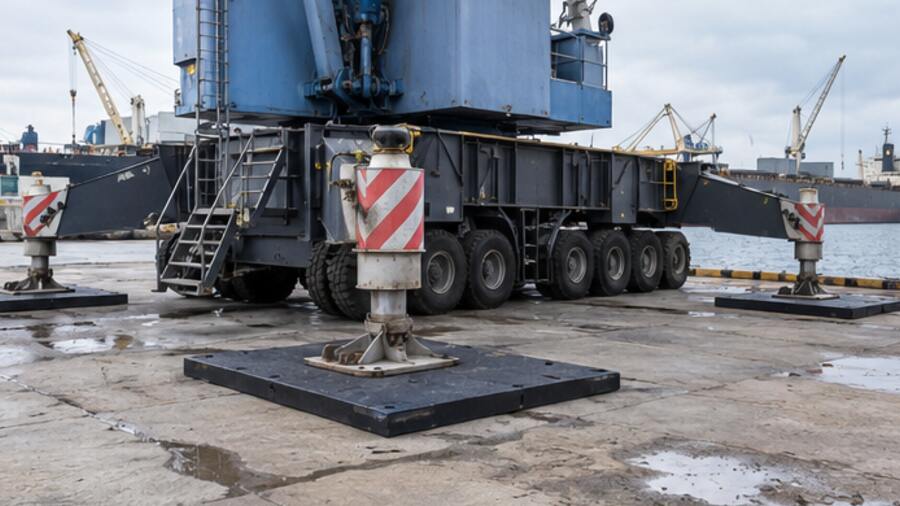
Road-paving boards are responsible for spreading wheel pressure and leg mats for expanding static support areas, which cannot be replaced by one another. For this scenario, a properly paved pavement with a lined surface can isolate the tyre from the floor and the crane or equipment should use the calculated leg pad below the jack. 15 mm could be included as an option and compared with other thickness, provided that the size of the plate, the connection structure, the base level and the number of passages were verified. The labelling of 160 to 200 tons of products does not mean that all the same vehicles are available on the ground, and ground conditions remain the determining factor.
The construction staff should first seal the belts and confirm that no vehicles enter, then clear the floors and tablets. Do not leave the seams in the softest position, and do not let the edges remain open for long periods. Cleaning and installation of sandstones when the link is pierced, so that the connector is not fully in place. A low-speed test pass was completed and the next section was only opened after the implementation of a “soft-cleaning tool to protect the panel-lined road”.
The day-to-day management will include vehicle behaviour in the inspection. Speed-limiting, prohibition of in-situ movement, fixed reverse routes and placement of commanders are often more effective than simply adding plates. The inspectors should touch or step on the suspicious seams, check the links and take photographs to locate them. Where there are repeated shifts, the width of the road, the turn radius and the grass-roots level should be re-evaluated, rather than the continuous consolidation of the same position.
In a simulation plan for the relocation of equipment through the normal production area, the evacuation site recovery phase involves the zonal release of areas that have completed grass-roots treatment and plate connections, with unaccepted areas remaining isolated. Each region designates a person responsible for the inspection and uses a number corresponding to the photograph. This example does not represent a specific project commitment, but allows the team to separate the temporary post from the main traffic route. If the records show repeated maintenance at the same location, they should be re-analysed back to the ground and transport organization.
The bulk material project will also examine car car stickers, impact and wear. The UHMWPE car skateboard can improve offloading when materials, temperature and car structure are appropriate, but it is necessary to confirm fixation, thermal condensation, the end door gap and cleaning methods; it is not a substitute for the safe offloading procedure. If the project does not involve a self-loading vehicle, the budget should be focused on physical access and support points and not add irrelevant configurations to complete product portfolios.
It is best to complete small-scale technical confirmation before the next list. The project was first submitted in phases with the plan and complete field parameters, and the supplier was given specifications, quantities and packing suggestions; then the sample trails, links, dimensions and material documents were checked; and the container type, destination port, discharge method and batch identification were finally confirmed. The supplier recommended that it be used only as an input and that the project party remain responsible for the stabilization of the ground load, traffic organization and lifting.
Need for further evaluation of the actual project?
Applications, sizes, quantities, site photographs or drawings and delivery destinations are sent, on which we can identify more suitable products and processing programmes.







