
The answer to how ground protection at the plant workshop is designed to design the demolition and recycling process should start with the course of operation rather than with a fixed specification. Recovery should be carried out in reverse at the end of the portal, while cleaning, checking, sorting and binding should be completed. Equipment relocation workshops, production line retrofitting areas and factory entrances are usually accompanied by forklifts, trajectories, hydraulic modular vehicles, equipment loaders and small cranes, with different pressures on tyres, axles and shifts. Wheel pressure, metal belts, fallers and in-situ shifts may cause injury to coats, crush stitches or leave permanent marks in vulnerable areas. The project team shall first delineate the main corridor, the waiting areas, the loading and unloading points and the emergency export, and then the boundary shall be confirmed jointly by the construction, logistics and security authorities.
On-site measurements are to cover the ground level of rubble with uneven pressure and record weak ranges, slopes, drainage directions and underground pipes. The water-bearing state and changes in the car tracks should be observed before and after the cryogenic freeze. Mobile equipment will need to provide the whole vehicle with its own weight, full load weight, a single axle load, tyre size, turn radius and projected duration; the crane will also need to provide the maximum reversibility of the leg and leg extension. Data sources and measurement dates should also be recorded to avoid different versions.
Product selection should be differentiated by stress. Appropriate pavements of surfaced roads can isolate tyres from the floor, and a calculator leg pad should be used below a crane or equipment jack. 15, 20, 25 and 30 mm are in the common thickness range and 30 mm can only serve as a starting point for comparison for this project; if there are holes or sediments at the grass-roots level, the increase in thickness is not a substitute for peace and reinforcement. The 120 to 160 tonnes in the product information should also be understood in conjunction with the test conditions, with the final specifications to be confirmed by the approved programme and field professionals.
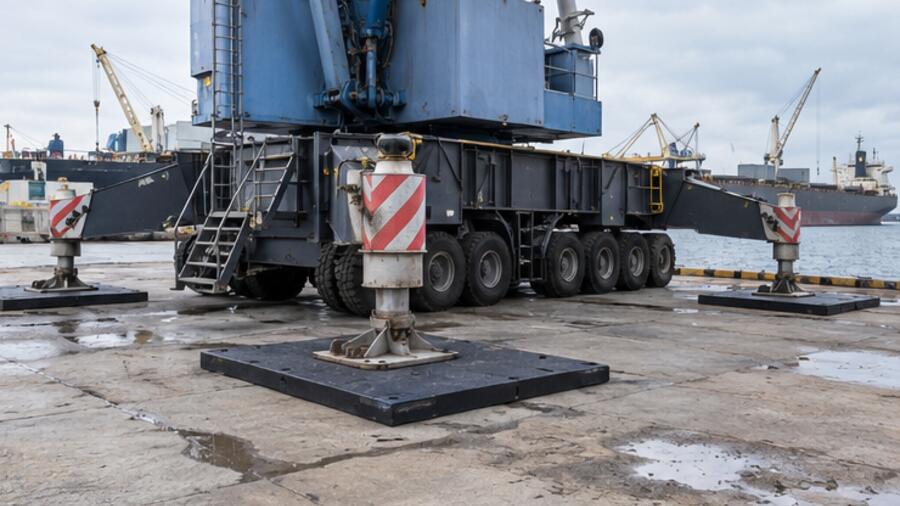
Pre-installation to remove sharp waste, loose rock and mobile mud, and to purge and level the ground. The plates were set up in the main direction and were sewd to avoid the deep path and to check the wells and legs. The turn and reverse areas are to be slightly wider and the connectors are to be locked as required. The site should also implement “the immediate decommissioning of mud when it is discovered that it is coming out of the seams” and include this requirement at the end of the shift and in the traffic organization chart.
Temporary roads cannot be paved for long. Vehicle brakes, loading overloading and water stowing can gradually change the support under the plate, and surfaces may appear flat and may have created gaps. The site should be checked before and after peak traffic, after cryogenic freezing and when the route changes. In the event of a sinking, the ground and drainage should be checked before deciding whether to change or replace the panels, so as to avoid covering up the problem by filling the panels.
Assuming an increase in traffic during the maintenance and repair phase of a relocation route of equipment that passes through the normal production area, managers can first freeze the change of route and then classify the problems into four categories: ground, plates, vehicles and movement control. Weak positions are reinforced, damage plates are replaced, vehicles are limited in speed, and one-way access is introduced for peak hours. The example does not correspond to the true customer but shows how to retain a clear exit route for night maintenance and how to convert the site judgement into a reusable list for the next project.
In the integrated site, different problems were solved by the pavement, leg mats and carboards. Vehicle traffic is supported by a continuous focus on the maximum retroactivity of the leg and the friction and adhesion of material from the surface of the vehicle. If MHMWPE skateboards are used, thermal stretches should be set aside and fixed systems checked; if relevant material is not available at the site, they should be removed from the list and the investment targeted.
The volume of the car, the type of material and the working temperature must appear in the request for quotations, otherwise it is likely that the different suppliers will calculate on different assumptions. The procurement staff shall also require the description of the effective size, weight, number of attachments, packing units, container load and delivery cycle of each plate. The evaluation will be based on technical conformity, installation efficiency and turnover. Where key payloads or ground data have not been confirmed, the quotations should be marked as preliminary and the review retained.
Need for further evaluation of the actual project?
Applications, sizes, quantities, site photographs or drawings and delivery destinations are sent, on which we can identify more suitable products and processing programmes.







