
For installation movements, access targets should be identified: continuous transport, short-term suspension, or temporary parking during peak periods. Equipment relocation workshops, production line retrofitting areas and factory entrances involve forklifts, traverse arms, hydraulic modular vehicles, equipment loaders and small cranes, while wheeling, metal belts, fallers and in situ shifts may cause injury to coatings, broken seams or permanent marks in vulnerable areas. When targets, vehicles and vulnerable locations are matched, the scope is not too large or missing critical points; the practical implementation principle is that the installation area is linked to the vehicle release plan and that it avoids connecting personnel to plates in unseparated traffic.
The project team could complete a joint pedal survey before the vehicle enters the site, focusing on refilling areas close to the building base, drainage lows, ramps and available car space. The retroactivity of the legs of the vehicle ' s axial load, the exterior dimensions, the minimum convective radius and the equipment for the suspension was then collected. Continuous rainfall may change the state of the grass-roots level, so measurements need to be date- and weather-specific. All parameters should be consolidated in the same version of the road map and equipment list.
Material parameters should serve the field rather than be propaganda figures. Appropriate pavements of surfaced roads can isolate tyres from the floor, and a calculator leg pad should be used below a crane or equipment jack. The project allows for the comparison of 20 mm and the adjacent specification of the single mass, rigidity, laying efficiency and number of containers, as well as for the reconciliation of the links to the surface. 50-80 tonnes are only primary sifts; ground-based and support designs should be completed first when an underground hole, weak shoulder or hanger overload exists.
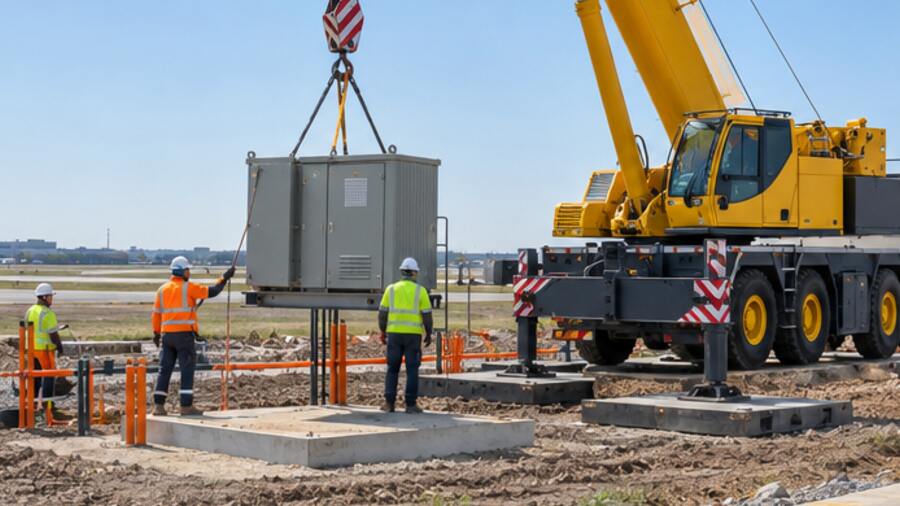
The construction staff should first seal the belts and confirm that no vehicles enter, then clear the floors and tablets. Do not leave the seams in the softest position, and do not let the edges remain open for long periods. Cleaning and installation of sandstones when the link is pierced, so that the connector is not fully in place. A low-speed test of access after a period of completion and the implementation of “pre-class confirmation of seams and connectors” before the next segment is opened.
Following the opening of access, the focus of the inspection was on the continued support under the plate. The first heavy vehicle passes by to check for high seams, peripheries, mudslides and planks; the shift is repeated after weather changes. The pressure of contact of the forklift ' s solid-heart wheel differs significantly from the concentrated static of the crane ' s legs, and anomalies should be detected first in isolation before being drained, evened or replaced, and the subsequent flow of the vehicle cannot continue to magnify the damage.
A reference scenario is a route for the relocation of equipment through normal production areas. During the installation phase of the project, a short-range test lay was made to record the relocation and deposition of the first vehicle after its adoption, and the route was gradually extended. The turn areas, parking areas and pick-up points are inspected separately and no result is used to replace the full condition. This is an example of a methodology rather than a statement of performance, and the intended management effect is to enable the receiving and inspection records to correspond to the site photographs and location maps; after completion, a comparison is also required between the original ground photographs, cleaning hours and the number of plates that can continue to be used.
The bulk material project will also examine car car stickers, impact and wear. The UHMWPE car skateboard can improve offloading when materials, temperature and car structure are appropriate, but it is necessary to confirm fixation, thermal condensation, the end door gap and cleaning methods; it is not a substitute for the safe offloading procedure. If the project does not involve a self-loading vehicle, the budget should be focused on physical access and support points and not add irrelevant configurations to complete product portfolios.
The demand for quotations must be based on the projected number of trips per day and the number of days spent, otherwise it is likely that the different vendors will calculate on different assumptions. The procurement staff shall also require the description of the effective size, weight, number of attachments, packing units, container load and delivery cycle of each plate. The evaluation will be based on technical conformity, installation efficiency and turnover. Where key payloads or ground data have not been confirmed, the quotations should be marked as preliminary and the review retained.
Need for further evaluation of the actual project?
Applications, sizes, quantities, site photographs or drawings and delivery destinations are sent, on which we can identify more suitable products and processing programmes.







