
The answer to how the ground protection of the plant workshop accounted for the volume of the purchase should start with the course of operation rather than with a fixed specification. Quantities are calculated on the basis of net coverage, staggered, convexed, back-up ratios and swing batches. Equipment relocation workshops, production line retrofitting areas and factory entrances are usually accompanied by forklifts, trajectories, hydraulic modular vehicles, equipment loaders and small cranes, with different pressures on tyres, axles and shifts. Wheel pressure, metal belts, fallers and in-situ shifts may cause injury to coats, crush stitches or leave permanent marks in vulnerable areas. The project team shall first delineate the main corridor, the waiting areas, the loading and unloading points and the emergency export, and then the boundary shall be confirmed jointly by the construction, logistics and security authorities.
The project team could complete a joint pedal survey before the vehicle enters the field, focusing on indoor floors, drainage lows, ramps and available car space for epoxy protection. The retroactivity of the legs of the vehicle ' s axial load, the exterior dimensions, the minimum convective radius and the equipment for the suspension was then collected. Low-temperature freezing may change the state at the grass-roots level, so measurement results need to be date- and weather-specific. All parameters should be consolidated in the same version of the road map and equipment list.
Where the route has both a mobile device and a fixed support point, the choice should be made between the pavement and the leg pad, respectively. Appropriate pavements of surfaced roads can isolate tyres from the floor, and a calculator leg pad should be used below a crane or equipment jack. The thickness can be screened from commonly used specifications such as 15, 20, 25, 30 mm, and the 25 mm appearing in this section does not constitute a direct recommendation. For information on ranges of 80 to 120 tons, the purchaser should also request a test method and give priority to the equipment description, construction programme and on-site validation.
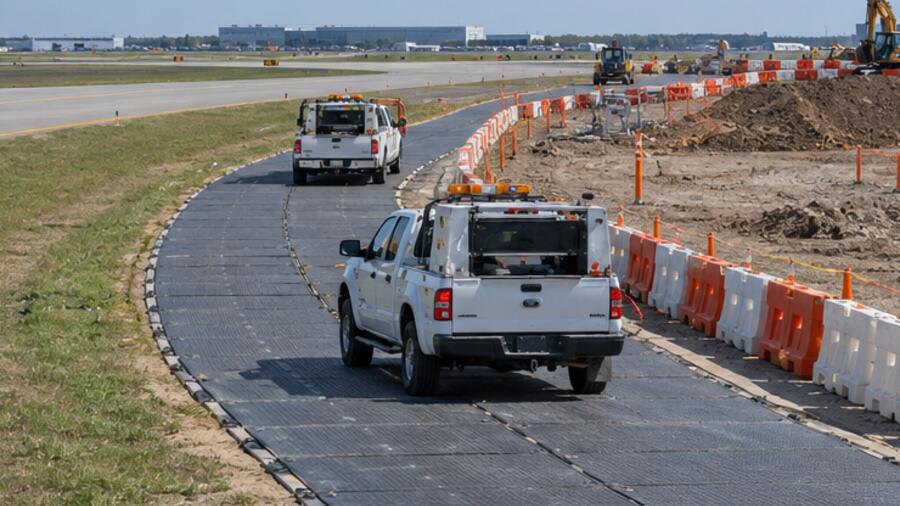
When the plates arrive at the site, the quantity, the connector and the crane are checked and the goods are discharged by route number. Upon completion of the grass-roots level, the vehicle entrance is prepared in sub-sections, and the level and edge support is checked at each stage of completion. The leg area of operation shall be separated from the area of passage. In the installation programme, insert the words “set up protections at the lower end of the ramp” to allow field personnel to convert abstract requirements into actionable.
Maintenance staff can divide the straight-line, turn-out, waiting areas and support points into different levels of inspection. The straight-line sections focus on the sutures and the tracks, turn around and look for lateral shifts, wait areas to see long-term static sinking, and support points to check whether the pads and the ground are sunk. Shorter check intervals after rain or when the traffic suddenly increases; any plate-side rise, loose connection or grass-roots plasma should trigger decommissioning.
In the case of a relocation route of equipment that passes through the normal production area, the site could be divided into five areas for entry, straight, turn, operation and recovery during maintenance and overhaul. The entry point is responsible for vehicle reconciliation, maintaining continuous coverage of the straight-line segment, increasing the outer width of the turn-band, separate validation of the operating segment and completion of clean bundles in the recovery area. This simulation programme is used to illustrate the methodology and is not a client-specific performance; it can help the project team to separate the main wheel tracks of heavy vehicles from the people ' s lanes and leave a record of the number of maintenances and the length of breaks.
Three products may be used in this category at the same time, but the boundaries of the use are clear: road-painted service vehicle routes, leg-past services are centrally supported, and carboard services are applied to bulk discharges. In particular, UHMWPE skateboards need to check the material particle size, water content rate, temperature, impact and car shape. No product could compensate for the error, and the configuration list should be deleted from the field mission.
It is best to complete small-scale technical confirmation before the next list. First, the maximum slope and discharge direction and complete field parameters are submitted, allowing the supplier to provide specifications, quantities and packaging advice; then the sample trails, links, dimensions and material documentation are checked; and finally, the container type, destination port, discharge method and batch identification are identified. The supplier recommended that it be used only as an input and that the project party remain responsible for the stabilization of the ground load, traffic organization and lifting.
Need for further evaluation of the actual project?
Applications, sizes, quantities, site photographs or drawings and delivery destinations are sent, on which we can identify more suitable products and processing programmes.







