
For the use of records, the site should first identify the target for access: whether it is a continuous transport, short-term suspension or a temporary stop during peak periods. Equipment relocation workshops, production line retrofitting areas and factory entrances involve forklifts, traverse arms, hydraulic modular vehicles, equipment loaders and small cranes, while wheeling, metal belts, fallers and in situ shifts may cause injury to coatings, broken seams or permanent marks in vulnerable areas. When targets, vehicles and vulnerable locations are matched, key points will not be overstretched or omitted; the implementation principle is to establish the numbering, location, pass volume, damage and maintenance records for each batch to facilitate turnover management.
The survey forms can be completed by the four columns of ground, equipment, route and time. Ground bars mark restricted loads above underground ditches and adjacent drains; equipment columns specify vehicle weights, cargo weights, axle numbers and tyre specifications; route bars take a clean width, slope and turn radius; timebar indicates continuous rainfall and shift arrangements. If a crane is present, it should be based on the retroactivity of the leg in the manufacturer ' s worksheet, and it cannot be rated as a ground load.
Product selection should be differentiated by stress. Appropriate pavements of surfaced roads can isolate tyres from the floor, and a calculator leg pad should be used below a crane or equipment jack. 15, 20, 25 and 30 mm are in the common thickness range and 30 mm can only serve as a starting point for comparison for this project; if there are holes or sediments at the grass-roots level, the increase in thickness is not a substitute for peace and reinforcement. The 120 to 160 tonnes in the product information should also be understood in conjunction with the test conditions, with the final specifications to be confirmed by the approved programme and field professionals.
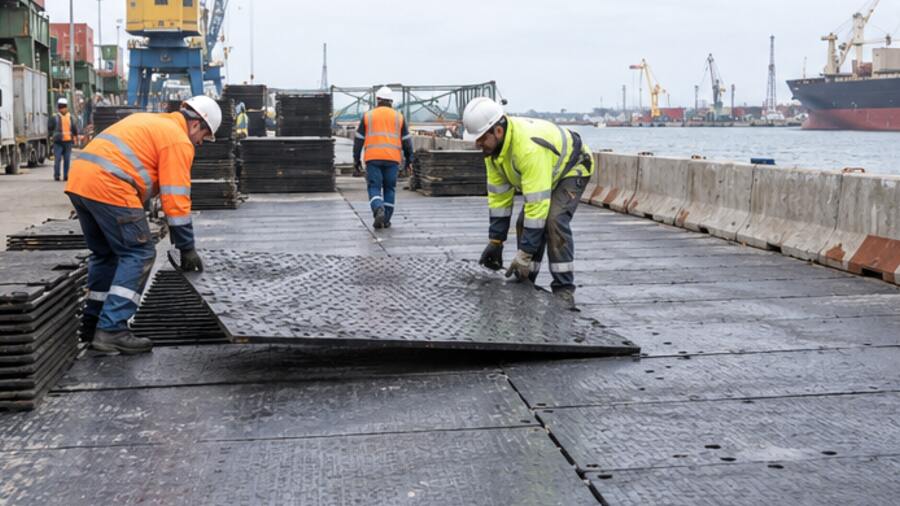
When the plates arrive at the site, the quantity, the connector and the crane are checked and the goods are discharged by route number. Upon completion of the grass-roots level, the vehicle entrance is prepared in sub-sections, and the level and edge support is checked at each stage of completion. The leg area of operation shall be separated from the area of passage. In the installation programme, insert "marking the location of each plate with a numbering chart" to allow field personnel to convert abstract requirements into actionable.
The day-to-day management will include vehicle behaviour in the inspection. Speed-limiting, prohibition of in-situ movement, fixed reverse routes and placement of commanders are often more effective than simply adding plates. The inspectors should touch or step on the suspicious seams, check the links and take photographs to locate them. Where there are repeated shifts, the width of the road, the turn radius and the grass-roots level should be re-evaluated, rather than the continuous consolidation of the same position.
In a simulation plan for the relocation of equipment through the normal production area, the installation phase of the equipment is being released by zonal area: the area that has completed grass-roots processing and the plate connection is open and the unaccepted area remains isolated. Each region designates a person responsible for the inspection and uses a number corresponding to the photograph. This example does not represent a specific project commitment, but allows the team to recycle the plates to the next stage. If the records show repeated maintenance at the same location, they should be re-analysed back to the ground and transport organization.
Three products may be used in this category at the same time, but the boundaries of the use are clear: road-painted service vehicle routes, leg-past services are centrally supported, and carboard services are applied to bulk discharges. In particular, UHMWPE skateboards need to check the material particle size, water content rate, temperature, impact and car shape. No product could compensate for the error, and the configuration list should be deleted from the field mission.
The procurement list should provide suppliers with a real picture of the situation, in which the type of container and the port of destination are data that need to be highlighted and supplemented. The remaining information includes vehicle and leg loads, ground photographs and sizes, projected number of vehicles, number of days of use, colour trails, destination port and desired period. A comparison of the quotations should be converted to a valid area coverage and complete connection system and not only a single block price; the acceptance and inspection criteria should also be included in the document before the next list.
Need for further evaluation of the actual project?
Applications, sizes, quantities, site photographs or drawings and delivery destinations are sent, on which we can identify more suitable products and processing programmes.







