
The answer to how airport construction and maintenance corridors set the frequency of daily inspections should start with the operational route and not with a fixed specification. The sews, sunk and contaminated should be checked after the first car is passed, before the shift is handed over and after heavy rainfall. The construction area on the side of the runway, the taxiway light spot and the airport cargo area are usually accompanied by engineering vehicles, light-maintenance vehicles, rescue guarantee vehicles, excavators and mobile cranes, with different pressures on tyres, axles and the mode of transition. The construction window is short, the vehicle route is controlled, and any loose parts, mud coming out or local sinking will affect safety and the re-entry rhythm. The project team shall first delineate the main corridor, the waiting areas, the loading and unloading points and the emergency export, and then the boundary shall be confirmed jointly by the construction, logistics and security authorities.
The degree of completeness of the input conditions determines the quality of the subsequent selection. First, the length and width of the old site, which has a clear upwelling and poorly drained direction, are measured, and then the maximum works of the engineering vehicle, the light maintenance vehicle, the rescue support vehicle, the excavator and the mobile crane are checked. In addition to the weight, the pressure of the tyre, the form of the belt, the position of the brake, the possibility of in situ transfer and the frequency of passage shall be recorded. In case of high temperatures, a ground review should be carried out; if data cannot be confirmed, unknown items should be listed as a restriction rather than being replaced by empirical values.
Material parameters should serve the field rather than be propaganda figures. Low-maintenance HDPE pavements can quickly form a recyclable route, while suspension operations require the retroactivity of legs. The project allows for a comparison of the 25 mm and the adjacent specifications of the single mass, rigidity, laying efficiency and number of containers, as well as a reconciliation of the links to the surface. 50-80 tonnes are only primary sifts; ground-based and support designs should be completed first when an underground hole, weak shoulder or hanger overload exists.
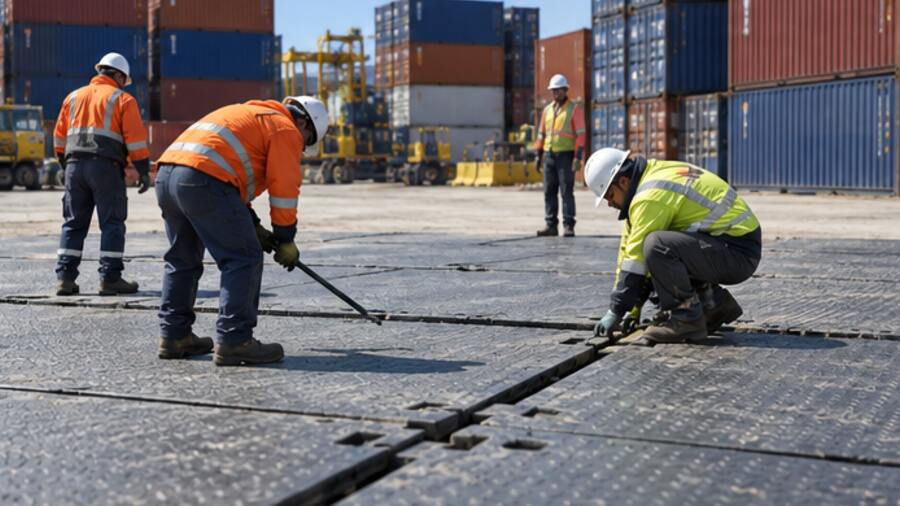
The fast-track installation still requires the retention of basic processes: drainage, debarment, peace-building, positioning, connection and trial passage. The plates remain continuous in line segments, leaving sufficient width at the intersections and outside areas; and they are to be removed from the rigid surface interface. Project leaders should arrange for “the addition of a column of sheeting to the outside of the turn” while clearly setting out the conditions for decommissioning, so as to prevent irregularity from being left to the next group during rush hours.
Temporary roads cannot be paved for long. Vehicle brakes, loading overloading and water stowing can gradually change the support under the plate, and surfaces may appear flat and may have created gaps. The site should be inspected before and after peak traffic, after high temperatures and when the route changes. In the event of a sinking, the ground and drainage should be checked before deciding whether to change or replace the panels, so as to avoid covering up the problem by filling the panels.
A reference scenario is an airfield light system maintenance project that was completed with a restricted night window. During the installation phase of the project, a short-range test lay was made to record the relocation and deposition of the first vehicle after its adoption, and the route was gradually extended. The turn areas, parking areas and pick-up points are inspected separately and no result is used to replace the full condition. This is an example of a method rather than a statement of performance, and the expected management effect is to reduce the probability of the floor being directly crushed by tires and legs; after completion, a comparison is also required between the original ground photographs, cleaning hours and the number of plates that can continue to be used.
The bulk material project will also examine car car stickers, impact and wear. The UHMWPE car skateboard can improve offloading when materials, temperature and car structure are appropriate, but it is necessary to confirm fixation, thermal condensation, the end door gap and cleaning methods; it is not a substitute for the safe offloading procedure. If the project does not involve a self-loading vehicle, the budget should be focused on physical access and support points and not add irrelevant configurations to complete product portfolios.
The request for quotations must be in the form of packaging and handling equipment, otherwise it is likely that different suppliers will calculate on different assumptions. The procurement staff shall also require the description of the effective size, weight, number of attachments, packing units, container load and delivery cycle of each plate. The evaluation will be based on technical conformity, installation efficiency and turnover. Where key payloads or ground data have not been confirmed, the quotations should be marked as preliminary and the review retained.
Need for further evaluation of the actual project?
Applications, sizes, quantities, site photographs or drawings and delivery destinations are sent, on which we can identify more suitable products and processing programmes.







