
The answer to how airport construction and maintenance corridors choose the thickness of the pavement should start with the operational route and not with a fixed specification. The thickness should not be limited to the total weight of the vehicle, but must be combined with axle load, tyre contact, grass-roots support and the number of passes. The construction area on the side of the runway, the taxiway light spot and the airport cargo area are usually accompanied by engineering vehicles, light-maintenance vehicles, rescue guarantee vehicles, excavators and mobile cranes, with different pressures on tyres, axles and the mode of transition. The construction window is short, the vehicle route is controlled, and any loose parts, mud coming out or local sinking will affect safety and the re-entry rhythm. The project team shall first delineate the main corridor, the waiting areas, the loading and unloading points and the emergency export, and then the boundary shall be confirmed jointly by the construction, logistics and security authorities.
In order to determine whether the thickness selection is to be implemented, the site should be set up, rather than taking only a few photographs. In particular, the refilling of the floors after the temporary excavation is reviewed, as the drying of the surface does not represent a continuous carrying of the lower part. Information on the project should also include the maximum daily traffic, the length of vehicle stay, the direction of handling and the drainage route during high-temperature tan. For troughs, inspection wells and underground facilities, the prohibited support or need to be reinforced should be indicated in the road map.
The selection is based on the calculation of the local pressure and the examination of whether the plate remains continuous at the grass-roots level. Low-maintenance HDPE pavements can quickly form a recyclable route, while suspension operations require the retroactivity of legs. The common thickness ranges from 15 mm to 30 mm, and this option can first assess 20 mm and then adjust it through trial preparation or project accounting. The so-called 160 to 200-ton carrier should have a clear test boundary and cannot be cited separately from the distance, temperature, payload distribution and safety factor.
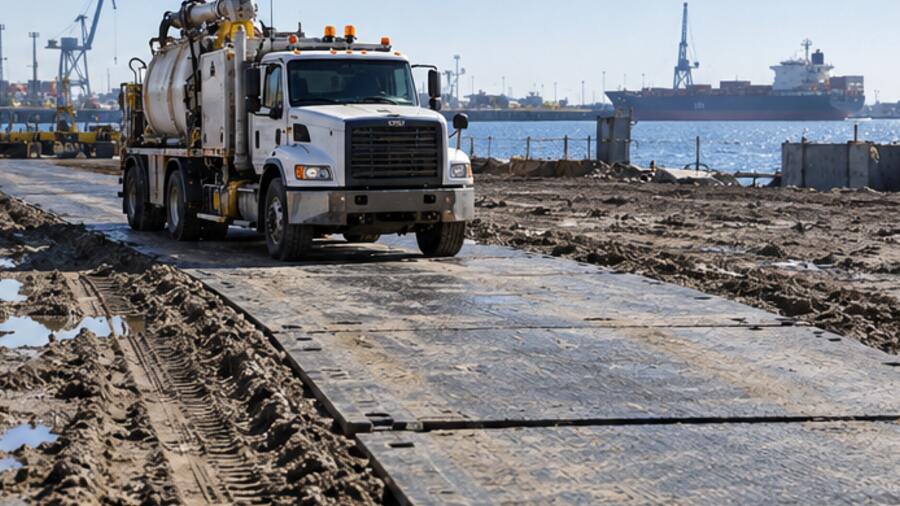
The construction staff should first seal the belts and confirm that no vehicles enter, then clear the floors and tablets. Do not leave the seams in the softest position, and do not let the edges remain open for long periods. Cleaning and installation of sandstones when the link is pierced, so that the connector is not fully in place. A low-speed test pass after a period has been completed and the following section will be opened only after it has been “marked with a numbered chart of the location of each plate”.
Maintenance staff can divide the straight-line, turn-out, waiting areas and support points into different levels of inspection. The straight-line sections focus on the sutures and the tracks, turn around and look for lateral shifts, wait areas to see long-term static sinking, and support points to check whether the pads and the ground are sunk. Shorter check intervals after rain or when the traffic suddenly increases; any plate-side rise, loose connection or grass-roots plasma should trigger decommissioning.
Assuming an increase in traffic during the installation phase of an airfield light system maintenance project, which was completed with a restricted night window, managers could first freeze the change of route and then classify the problems into four categories: ground, board, vehicle and movement control. Weak positions are reinforced, damage plates are replaced, vehicles are limited in speed, and one-way access is introduced for peak hours. The example does not correspond to the true customer but shows how to retain a clear exit route for night maintenance and how to convert the site judgement into a reusable list for the next project.
If the transport chain contains coal, ore, wet soil or food, self-release efficiency may be assessed as an independent subject. Car skateboards help to reduce the adhesiveness of certain materials, but prior to installation, the lining thickness, scalables, bolts or presses and tail door motion space should be confirmed. If there is no need for bulk discharges, there is no need to add the subparagraph; the procurement programme should be consistent with the use.
It is best to complete small-scale technical confirmation before the next list. First, the plate colour, texture and custom holes and complete field parameters were submitted to the supplier for specification, quantity and packaging advice; then the sample trail, connection holes, size differences and material documents were checked; and the container type, destination port, discharge method and batch identification were finally confirmed. The supplier recommended that it be used only as an input and that the project party remain responsible for the stabilization of the ground load, traffic organization and lifting.
Need for further evaluation of the actual project?
Applications, sizes, quantities, site photographs or drawings and delivery destinations are sent, on which we can identify more suitable products and processing programmes.







