
The quick resumption of traffic following the construction of the airport and maintenance of the passages cannot be answered using single-product parameters. Project leaders need to view both traffic organization, ground support and maintenance capabilities; first drain and close the softest sections, pending continuous support at the grass-roots level before they are laid out. When engineering vehicles, light maintenance vehicles, rescue guarantee vehicles, excavators and mobile cranes enter the construction area on the side of the runway, the taxiway lighting site and the airport cargo area, problems with turnovers, ramps, seams and waiting positions on the route may arise earlier than the normal straight-line segment and shall be individually marked on the drawings.
In order to determine whether or not to recover from the rain, the site should be equipped with a spot rather than a few photographs. In particular, the mixed surfaces in the humid salt fog environment of the port area will be reviewed, as the drying of the surface does not represent a continuous carrying of the lower part. The project information should also include the maximum daily traffic, the length of vehicle stay, the direction of handling and the drainage route during the wet salt fog. For troughs, inspection wells and underground facilities, the prohibited support or need to be reinforced should be indicated in the road map.
Product selection should be differentiated by stress. Low-maintenance HDPE pavements can quickly form a recyclable route, while suspension operations require the retroactivity of legs. 15, 20, 25 and 30 mm are in the common thickness range and 30 mm can only serve as a starting point for comparison for this project; if there are holes or sediments at the grass-roots level, the increase in thickness is not a substitute for peace and reinforcement. The 80 to 120 tonnes in the product information should also be understood in conjunction with the test conditions, with the final specifications to be confirmed by the approved programme and field professionals.
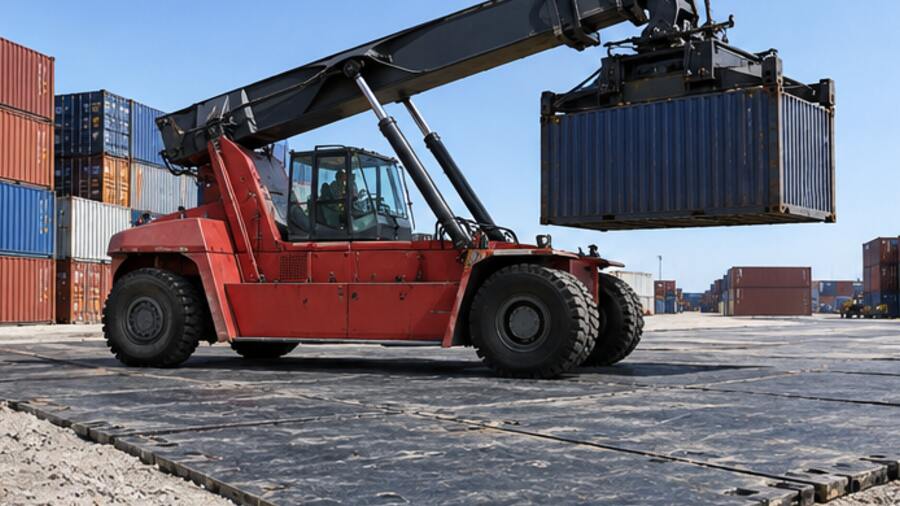
The fast-track installation still requires the retention of basic processes: drainage, debarment, peace-building, positioning, connection and trial passage. The plates remain continuous in line segments, leaving sufficient width at the intersections and outside areas; and they are to be removed from the rigid surface interface. The project leader should arrange for “dismantling the bulk and sharpness before removal”, while specifying the conditions for decommissioning to prevent irregularity from being left to the next group during rush hours.
The day-to-day management will include vehicle behaviour in the inspection. Speed-limiting, prohibition of in-situ movement, fixed reverse routes and placement of commanders are often more effective than simply adding plates. The inspectors should touch or step on the suspicious seams, check the links and take photographs to locate them. Where there are repeated shifts, the width of the road, the turn radius and the grass-roots level should be re-evaluated, rather than the continuous consolidation of the same position.
In the case of an airport light system maintenance project, which was completed with a restricted night window, the site could be divided into five areas at the entrance preparation stage, straight, turning, operating and recycling. The entry point is responsible for vehicle reconciliation, maintaining continuous coverage of the straight-line segment, increasing the outer width of the turn-band, separate validation of the operating segment and completion of clean bundles in the recovery area. The simulation programme is used to illustrate the methodology and is not a client-specific performance; it can help the project team to reduce vehicle mud into the hardened area and leave a record of the number of maintenances and the length of breaks.
The bulk material project will also examine car car stickers, impact and wear. The UHMWPE car skateboard can improve offloading when materials, temperature and car structure are appropriate, but it is necessary to confirm fixation, thermal condensation, the end door gap and cleaning methods; it is not a substitute for the safe offloading procedure. If the project does not involve a self-loading vehicle, the budget should be focused on physical access and support points and not add irrelevant configurations to complete product portfolios.
In addition to the total area, the request shall provide information on indoor and external temperature and chemical contamination, as well as information on the country, duration, conditions of handling, packing and port of destination. Compared suppliers can check the documentation, size difference, surface routing, connector, piece weight, effective area coverage, cabinet list and batch retroactive. The whole container shall be purchased in advance to confirm the discharge equipment. The final programme, which involves the safety of the ground, assembly or operation of the airport, must be approved by the project professional.
Need for further evaluation of the actual project?
Applications, sizes, quantities, site photographs or drawings and delivery destinations are sent, on which we can identify more suitable products and processing programmes.







