
In processing the cost of repairs, “where to go, what to go, how many times a day” is written as a verifiable on-site condition. The flow of vehicles in the construction area on the side of the runway, in the taxiway light spot and in the airport freight area often consists of engineering vehicles, light maintenance vehicles, rescue guarantee vehicles, excavators and mobile cranes, with the impact of tyre contact and low-speed turns being ignored only in view of the total tonnage. The more reliable conclusion is that the early protection of high-risk wheels and support points is usually more manageable than the after-action repair of coatings, grass-roots and drainage facilities, followed by a decision on the combination of pavement boards, leg pads or local grass-roots treatment.
The degree of completeness of the input conditions determines the quality of the subsequent selection. First, the length and width of the refilled areas close to the building base are measured, and then the maximum performance of engineering vehicles, light maintenance vehicles, rescue guarantee vehicles, excavators and mobile cranes is checked. In addition to the weight, the pressure of the tyre, the form of the belt, the position of the brake, the possibility of in situ transfer and the frequency of passage shall be recorded. In case of continuous rainfall, a ground review should be carried out; if the data cannot be confirmed, the unknown item should be included as a restriction rather than replaced by an empirical value.
Where the route has both a mobile device and a fixed support point, the choice should be made between the pavement and the leg pad, respectively. Low-maintenance HDPE pavements can quickly form a recyclable route, while suspension operations require the retroactivity of legs. The thickness can be screened from commonly used specifications such as 15, 20, 25 and 30 mm, and the 30 mm appearing in this section does not constitute a direct recommendation. For information on ranges of 80 to 120 tons, the purchaser should also request a test method and give priority to the equipment description, construction programme and on-site validation.
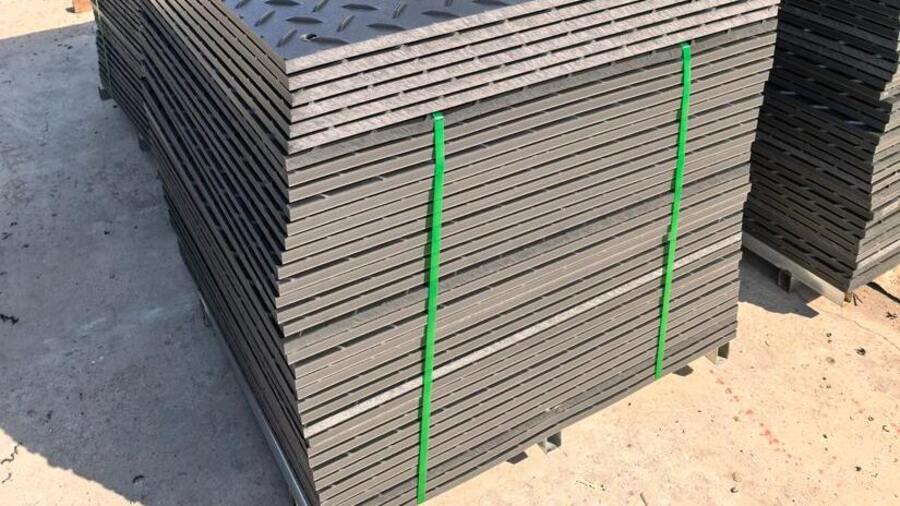
Pre-installation to remove sharp waste, loose rock and mobile mud, and to purge and level the ground. The plates were set up in the main direction and were sewd to avoid the deep path and to check the wells and legs. The turn and reverse areas are to be slightly wider and the connectors are to be locked as required. The site should also implement “the identification of people's accesses with a clear target” and include this requirement at the end of the class and in the traffic organization chart.
The day-to-day management will include vehicle behaviour in the inspection. Speed-limiting, prohibition of in-situ movement, fixed reverse routes and placement of commanders are often more effective than simply adding plates. The inspectors should touch or step on the suspicious seams, check the links and take photographs to locate them. Where there are repeated shifts, the width of the road, the turn radius and the grass-roots level should be re-evaluated, rather than the continuous consolidation of the same position.
In the case of an airfield light system maintenance project, which was completed with a restricted night window, the site could be divided into five areas for entry, straight, turn, operation and recovery during maintenance repairs. The entry point is responsible for vehicle reconciliation, maintaining continuous coverage of the straight-line segment, increasing the outer width of the turn-band, separate validation of the operating segment and completion of clean bundles in the recovery area. This simulation programme is used to describe the methodology and is not a client-specific performance; it can help the project team to position the problem sheets by number and leave a record of the number of maintenances and interruptions.
Three products may be used in this category at the same time, but the boundaries of the use are clear: road-painted service vehicle routes, leg-past services are centrally supported, and carboard services are applied to bulk discharges. In particular, UHMWPE skateboards need to check the material particle size, water content rate, temperature, impact and car shape. No product could compensate for the error, and the configuration list should be deleted from the field mission.
It is best to complete small-scale technical confirmation before the next list. First, the container type and destination port and complete field parameters are submitted to the supplier for specification, quantity and packaging advice; then the sample trails, connections, dimensions and material documents are checked; and finally, the container type, destination port, discharge method and batch identification are identified. The supplier recommended that it be used only as an input and that the project party remain responsible for the stabilization of the ground load, traffic organization and lifting.
Need for further evaluation of the actual project?
Applications, sizes, quantities, site photographs or drawings and delivery destinations are sent, on which we can identify more suitable products and processing programmes.







