
For the width of the route, the site should first determine the target for access: whether it is a continuous transport, short-term suspension or a temporary stop during peak periods. The construction area on the side of the runway, the taxiway light spot and the airport cargo area involve engineering vehicles, light maintenance vehicles, rescue and security vehicles, excavators and mobile cranes, while the construction window is short, the vehicle route is controlled, and any loose parts, mud strips or partial sinking affect safety and the re-entry rhythm. When targets, vehicles and vulnerable positions are matched, the scope is not too large or missing key points; the implementation principle is that the width should cover both the wheel, the rotation, car demand and the side safety residual.
In order to determine whether or not the width of the channel is to be implemented, the site should be equipped with a test point rather than taking only a few photographs. In particular, the ramps in which the warehouse entrance is permanently flushed by water are reviewed, as the drying of the surface does not mean a continuous carrying of the next. The project information shall also include the maximum daily traffic, the duration of the vehicle ' s stay, the direction of loading and unloading, and the drainage route during short and heavy rainfall. For troughs, inspection wells and underground facilities, the prohibited support or need to be reinforced should be indicated in the road map.
Road-paving boards are responsible for spreading wheel pressure and leg mats for expanding static support areas, which cannot be replaced by one another. For this scenario, low-maintenance HDPE pavements can quickly form a recyclable route, while the suspension operation requires the retroactivity of the legs with a leg cushion. 15 mm could be included as an option and compared with other thickness, provided that the size of the plate, the connection structure, the base level and the number of passages were verified. The labelling of 120 to 160 tons of products does not mean that all the same vehicles are available on the ground, and ground conditions remain the determining factor.
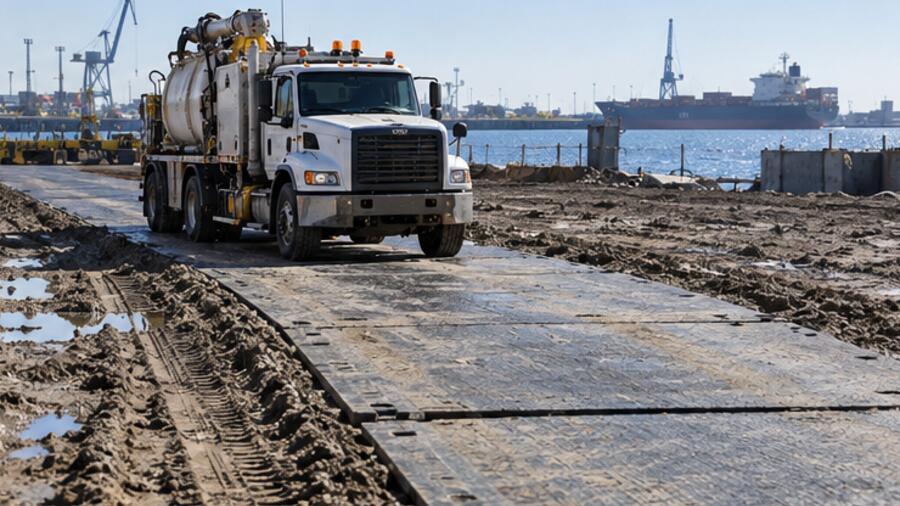
Pre-installation to remove sharp waste, loose rock and mobile mud, and to purge and level the ground. The plates were set up in the main direction and were sewd to avoid the deep path and to check the wells and legs. The turn and reverse areas are to be slightly wider and the connectors are to be locked as required. The site should also implement the “separation of damaged plates” and include this requirement in the pre-class and traffic organization charts.
Following the opening of access, the focus of the inspection was on the continued support under the plate. The first heavy vehicle passes by to check for high seams, peripheries, mudslides and planks; the shift is repeated after weather changes. The pressure of contact of the forklift ' s solid-heart wheel differs significantly from the concentrated static of the crane ' s legs, and anomalies should be detected first in isolation before being drained, evened or replaced, and the subsequent flow of the vehicle cannot continue to magnify the damage.
For an airport light system maintenance project that is limited to night windows, the peak transport phase could be established as an independent inspection node. On-site identification of vehicle lists and weather is followed by a check of drainage, connections and borders; if any conditions change, release is suspended and the road map updated. This scenario is used only to illustrate the way in which the project was organized, with a focus on maintaining a steady parking of vehicles while they are being handled. It should also record the number of inputs, the time of laying, the time of stoppage, the location of maintenance and the condition of the ground after the evacuation site.
Three products may be used in this category at the same time, but the boundaries of the use are clear: road-painted service vehicle routes, leg-past services are centrally supported, and carboard services are applied to bulk discharges. In particular, UHMWPE skateboards need to check the material particle size, water content rate, temperature, impact and car shape. No product could compensate for the error, and the configuration list should be deleted from the field mission.
There must be a connection and a need for tools in the request for quotations, otherwise different suppliers are likely to calculate on different assumptions. The procurement staff shall also require the description of the effective size, weight, number of attachments, packing units, container load and delivery cycle of each plate. The evaluation will be based on technical conformity, installation efficiency and turnover. Where key payloads or ground data have not been confirmed, the quotations should be marked as preliminary and the review retained.
Need for further evaluation of the actual project?
Applications, sizes, quantities, site photographs or drawings and delivery destinations are sent, on which we can identify more suitable products and processing programmes.







