
The manner in which airfield construction and maintenance corridors are organized for installation and vehicle movement cannot be answered with single-product parameters. Project leaders need to view the flow organization, ground support and maintenance capabilities at the same time; the installation area needs to be linked to the vehicle release plan to avoid connecting personnel to the plates in unseparated traffic. When engineering vehicles, light maintenance vehicles, rescue guarantee vehicles, excavators and mobile cranes enter the construction area on the side of the runway, the taxiway lighting site and the airport cargo area, problems with turnovers, ramps, seams and waiting positions on the route may arise earlier than the normal straight-line segment and shall be individually marked on the drawings.
The degree of completeness of the input conditions determines the quality of the subsequent selection. The length and width of the transition between the grassland and the hardened road are first measured, and the maximum works of the engineering vehicle, the light maintenance vehicle, the rescue support vehicle, the excavator and the mobile crane are checked. In addition to the weight, the pressure of the tyre, the form of the belt, the position of the brake, the possibility of in situ transfer and the frequency of passage shall be recorded. In case of damp salt fog, a ground review should be carried out; if the data cannot be confirmed, the unknown item should be classified as a restriction and not replaced by an empirical value.
Road-paving boards are responsible for spreading wheel pressure and leg mats for expanding static support areas, which cannot be replaced by one another. For this scenario, low-maintenance HDPE pavements can quickly form a recyclable route, while the suspension operation requires the retroactivity of the legs with a leg cushion. 15 mm could be included as an option and compared with other thickness, provided that the size of the plate, the connection structure, the base level and the number of passages were verified. The labelling of 120 to 160 tons of products does not mean that all the same vehicles are available on the ground, and ground conditions remain the determining factor.
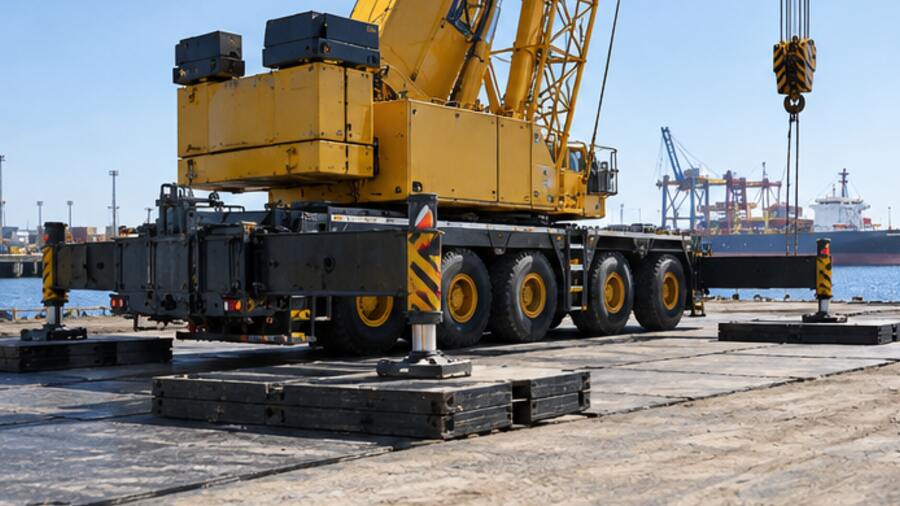
When the plates arrive at the site, the quantity, the connector and the crane are checked and the goods are discharged by route number. Upon completion of the grass-roots level, the vehicle entrance is prepared in sub-sections, and the level and edge support is checked at each stage of completion. The leg area of operation shall be separated from the area of passage. The inclusion in the installation programme of the words “set a one-way pass and check the total weight of the vehicle at the entrance” would allow the field personnel to convert abstract requirements into actionable.
Maintenance staff can divide the straight-line, turn-out, waiting areas and support points into different levels of inspection. The straight-line sections focus on the sutures and the tracks, turn around and look for lateral shifts, wait areas to see long-term static sinking, and support points to check whether the pads and the ground are sunk. Shorter check intervals after rain or when the traffic suddenly increases; any plate-side rise, loose connection or grass-roots plasma should trigger decommissioning.
Assuming that an airfield light system maintenance project, which was completed with a restricted night window, experienced an increase in traffic during the entry phase, managers could first freeze the change of route and then divide the problems into four categories: ground, board, vehicle and movement control. Weak positions are reinforced, damage plates are replaced, vehicles are limited in speed, and one-way access is introduced for peak hours. The example does not correspond to the true customer, but shows how to maintain access without expanding the permanent sclerosis area and how to convert the on-site judgement into a reusable list for the next project.
Auxiliary equipment also affects the overall programme. A leg pad is required to accompany a vehicle, a forklift is required to focus on tyre contact, and a bulk vehicle may require a slab. The suitability of the UHMWPE liner depends on the work temperature, the chemical environment, the material impact and the car structure, and the manufacturer provides the installation requirements. Each product should be matched to specific equipment in the project form to avoid the use of the same parameter across uses.
The procurement list should allow suppliers to see the real situation, in which the project phasing and slab rotation plan is the data that needs to be highlighted for this section. The remaining information includes vehicle and leg loads, ground photographs and sizes, projected number of vehicles, number of days of use, colour trails, destination port and desired period. A comparison of the quotations should be converted to a valid area coverage and complete connection system and not only a single block price; the acceptance and inspection criteria should also be included in the document before the next list.
Need for further evaluation of the actual project?
Applications, sizes, quantities, site photographs or drawings and delivery destinations are sent, on which we can identify more suitable products and processing programmes.







