
For quantitative purposes, the site should first determine the target of access: whether it is a continuous transport, short-term suspension or a temporary stop during peak periods. The construction area on the side of the runway, the taxiway light spot and the airport cargo area involve engineering vehicles, light maintenance vehicles, rescue and security vehicles, excavators and mobile cranes, while the construction window is short, the vehicle route is controlled, and any loose parts, mud strips or partial sinking affect safety and the re-entry rhythm. When targets, vehicles and weak positions are matched, the scope is not too large or missing; the implementation principle is to calculate the quantity by net area coverage, staggering, turn-widening, back-up ratio and turnaround batches.
The degree of completeness of the input conditions determines the quality of the subsequent selection. First, the length and width of a narrow courtyard with insufficient convection radius is measured and the maximum performance of the engineering vehicle, light maintenance vehicle, rescue support vehicle, excavator and mobile crane is checked. In addition to the weight, the pressure of the tyre, the form of the belt, the position of the brake, the possibility of in situ transfer and the frequency of passage shall be recorded. Short and heavy rainfall should be supplemented by a ground review; if data cannot be confirmed, unknown items should be included as a limitation rather than replaced by empirical values.
The selection is based on the calculation of the local pressure and the examination of whether the plate remains continuous at the grass-roots level. Low-maintenance HDPE pavements can quickly form a recyclable route, while suspension operations require the retroactivity of legs. The common thickness ranges from 15 mm to 30 mm, and this option can first assess 20 mm and then adjust it through trial preparation or project accounting. The so-called 160 to 200-ton carrier should have a clear test boundary and cannot be cited separately from the distance, temperature, payload distribution and safety factor.
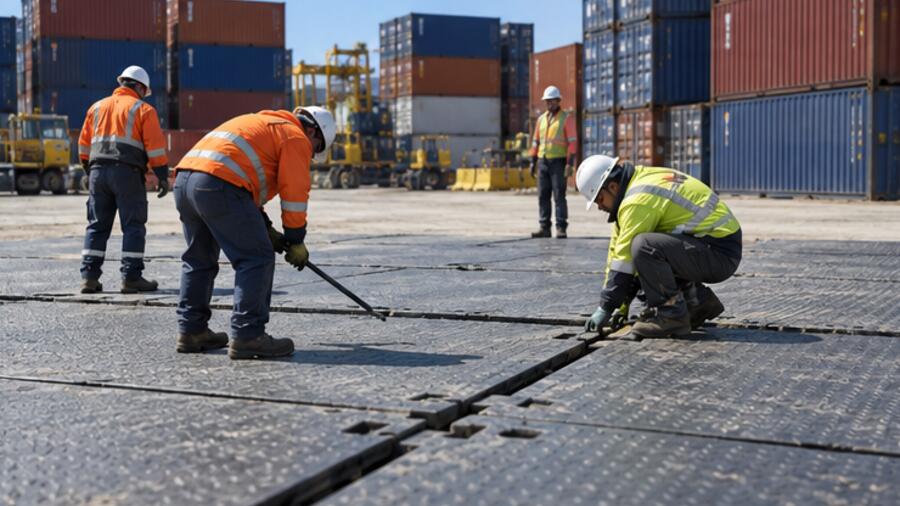
The sequence of laying would allow for the advance from the stable entrance to the area of operations. First, water and high differentials are processed, then the first plate is located; the subsequent plate is consistent in the direction of the texture and check if the seams form the steps. The ramp, turn and brake points shall increase the horizontal constraints or the width of the coverage. For this item, “limitation of speed and prohibition of in situ movement of vehicles” could be a key action, with completion time and the results of the re-examination recorded by a dedicated person.
Operating records include at least open hours, traffic through vehicles, unusual locations and disposal results. The first group of vehicles shall travel at a low speed to observe whether the plates are moving with the tyres; the second class shall then adjust the speed limits and frequency of the inspection to the records. Forklifts with frequent and rapid turnovers should check for surface wear and, if the crane changes the condition, re-check the retroactivity of the leg. Once maintenance is completed, access will be restored to the designated person.
In a simulation plan for the maintenance of the airport light system, which was completed with a restricted night window, the peak transport phase involved the zonal release of the area that had completed the grass-roots processing and plate connection, with the unaccepted area remaining isolated. Each region designates a person responsible for the inspection and uses a number corresponding to the photograph. This example does not represent a specific project commitment, but allows the team to recycle the plates to the next stage. If the records show repeated maintenance at the same location, they should be re-analysed back to the ground and transport organization.
In the integrated site, different problems were solved by the pavement, leg mats and carboards. Vehicle traffic is supported by a continuous focus on the maximum retroactivity of the leg and the friction and adhesion of material from the surface of the vehicle. If MHMWPE skateboards are used, thermal stretches should be set aside and fixed systems checked; if relevant material is not available at the site, they should be removed from the list and the investment targeted.
The request for quotations shall provide, in addition to the total area, a back-up ratio and on-site maintenance conditions, with an indication of the country, duration, conditions of handling, packing and port of destination. Compared suppliers can check the documentation, size difference, surface routing, connector, piece weight, effective area coverage, cabinet list and batch retroactive. The whole container shall be purchased in advance to confirm the discharge equipment. The final programme, which involves the safety of the ground, assembly or operation of the airport, must be approved by the project professional.
Need for further evaluation of the actual project?
Applications, sizes, quantities, site photographs or drawings and delivery destinations are sent, on which we can identify more suitable products and processing programmes.







