
While the construction window for the oil, gas and pipeline works is usually relatively tight, a complete business cycle analysis is still required on how wetland and meadow construction works are to be performed. In the case of the construction of pipelines on marshes, grasslands, river banks and high-water-bearing soils, the focus on this topic is on “how wetland and meadow line construction will be prepared and operated”, for example, and the conditions of control are not the same when the vehicle is empty, fully loaded, or when the equipment is parked for long periods of time. The site should first locate the area where the connection is loose, drainage congestion or pollution is expected to occur and then decide on the use of pavements, leg pads or approved combinations.
The product configuration cannot be determined by area or thickness alone. The project should verify wetland water levels, topsoil thickness, vegetation protection boundaries, vehicle axial loads, corridor width, drainage permits, cross-drive position and restoration criteria, and then convert the connection to a loose, drainage congestion or pollution reduction in actual use to drainage, carrying, stabilization, surface pull and restoration requirements. In accounting for the minimum effective area of the leg pads on the basis of maximum retroactivity and durability, the handling tools, manual weights, back-up quantities, cleaning and back-stacking are also considered. With regard to “how wetland and meadow line construction is to be prepared and run”, the information review should also distinguish vehicles by axle-load and tyre, not replacing all inputs with the total weight, and include missing information as an item to be confirmed in the quotation and construction programme.
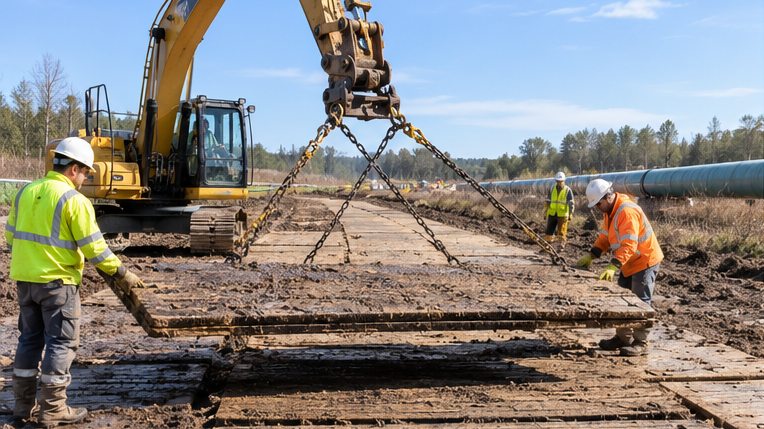
Figure: Pipeline construction in marshes, meadows, river banks and high-water-bearing soils, with a focus on “How construction of wetlands and meadows will be prepared and run”
Pre-implementation should be preceded by the containment of routes, the removal of sharp stones, stakes and miscellaneous items that may form a spot load, the repair of deep-pit tracks and the removal of horizontal drainage. The construction of wetlands should prioritize the maintenance of water flow lanes and continuous support to avoid repeated deviations by vehicles to expand the disturbance area. The plates should be prepared continuously at the stabilization end, with the bends, reverses and parking areas being expanded as appropriate; the leg mats should be flat, intermediated and in full contact, and it should not be allowed to be filled with random stacking. The trial-pail record of the “how wetland and meadow line works are to be done” should indicate the starting and ending location, vehicle status and release conclusion, to facilitate review as the construction conditions change.
The inspection cycle can be shortened at an early stage of use and then stabilized before adjusting to vehicle cycles and weather. The maintenance staff focused on the underwater flow of the plate, deposition, pumping mud, peripheries, vegetation pressure, connectors, spill positions and restoration boundaries, and observed the driver ' s compliance with speed limits and diversion requirements. Any unconfirmed sub-board support, edge instability or foot contact should first be disabled. With regard to the “how wetland and meadow line works are to be prepared for trial and run”, the inspection forms are to be shown in a separate column linking changes in the actual state of use that have been reduced by looseness, drainage congestion or pollution, and to indicate the time of re-examination and re-entry.
The impact assessment cannot be based solely on the movement of vehicles on the same day. The project compares vehicle waiting, trapping, maintenance hours, cleaning time, loss of connection, site restoration area and evacuation cycle, and records weather and traffic simultaneously. Once data have been created around loose connections, drainage congestion or pollution to reduce actual use, it will be possible to determine whether this option is suitable for replication in the next hydrocarbon project. It should also answer whether the “how wetland and meadow line works are to be prepared and run” has been demonstrated as an improvement by accounting for the lowest effective area of the leg pads on the basis of maximum retroactivity and endurance, avoiding a subjective description of the closing item.
This topic can be summarized as first confirming the boundary of the work, then configure the appropriate product, and then validate it with test run, inspection and project data. The formal programme should identify those responsible, the restrictions, the criteria for decommissioning, the means of recovery and the emergency route, so as to avoid the loss of critical information following changes in the class or contractor.
The following special verifications should be carried out in conjunction with the construction of pipelines on marshes, meadows, river banks and high-water-bearing soils for “drying and commissioning of wetland and meadows”: the test pavements should select the softest floors and representative heavy vehicles to record the vehicle's state, velocity, wheel, sew change and post-rain rains. The test operation is not considered to be permanent and will still need to be revalidated after the vehicle has become heavy, its route has changed or the weather has deteriorated.
Recommendation on on-site implementation: Test-run records should indicate temperature, weather, ground state, vehicle load, tyre pressure and speed. When the subsequent conditions go beyond the scope of the test, the original conclusion automatically lapses, requiring a further inspection or approval of the change by the project technical staff.
Need for further evaluation of the actual project?
Applications, sizes, quantities, site photographs or drawings and delivery destinations are sent, on which we can identify more suitable products and processing programmes.







