
The objective of wetland and meadow pipeline construction to avoid vehicle pressure outside the plate is to allow construction vehicles to move within the controlled route, while avoiding turning ground protection issues into equipment stabilization problems. Construction of pipelines around marshes, meadows, river banks and high-water-bearing soils, with a focus on how “wetland and meadows can be constructed in such a way as to avoid vehicles being pushed outside the plate”, should, inter alia, check for repeated vehicle traffic to create deep lines and damage the grass-roots level. Where there is a gutter, backfilling area, slope or unknown underground facility on the route, the treatment must first be confirmed by the responsible party of the project.
The focus of the topic is not on the choice of the thickest or the most heavy products, but on the establishment of a match. The amount of coverage, connection and back-up is then calculated on the basis of wetland water levels, top soil thickness, vegetation protection boundaries, vehicle axial charges, route width, drainage permits, cross-drive positions and restoration of standard identification control conditions, and by calculating the line segments, turn areas, docking positions and operating surfaces, respectively. In the case of products requiring cross-project turnaround, the numbering, loss rate, cleaning time and volume of transport should also be included in the total cost. The information review should also measure the number of vehicle cycles and track the location of duplicate wheel formations, and include missing information as items to be confirmed for quotations and construction programmes.
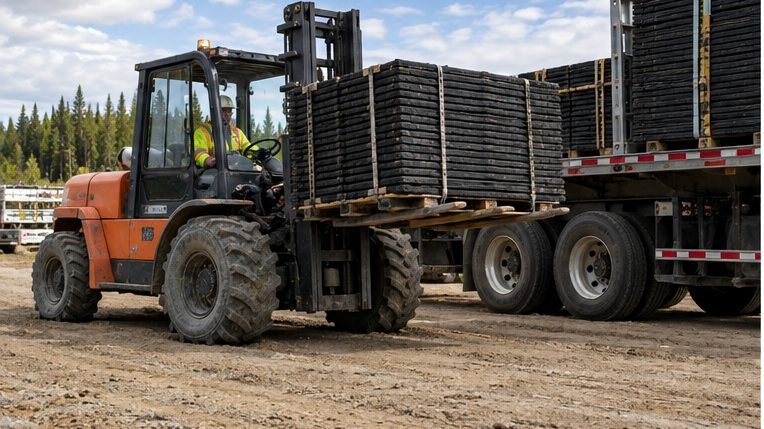
Figure: Construction of pipelines on marshes, meadows, river banks and high-water-bearing soils, with a focus on “How to avoid vehicle pressure on wetlands and meadows”
Pre-implementation should be preceded by the containment of routes, the removal of sharp stones, stakes and miscellaneous items that may form a spot load, the repair of deep-pit tracks and the removal of horizontal drainage. The construction of wetlands should prioritize the maintenance of water flow lanes and continuous support to avoid repeated deviations by vehicles to expand the disturbance area. The plates should be prepared continuously at the stabilization end, with the bends, reverses and parking areas being expanded as appropriate; the leg mats should be flat, intermediated and in full contact, and it should not be allowed to be filled with random stacking. The test-pail record of “how to avoid vehicle pressure outside the plate” for the construction of the wetlands and the meadows should indicate the starting and ending position, condition of the vehicle and the conclusion of release, so as to facilitate a review following a change in construction conditions.
Multi-shift or lease items may be used to record the underwater flow, deposition, pump mud, edge flushing, vegetation pressure, connectors, spill position and restoration line, and to link road maps and product numbers. Continuous anomalies should trigger a review of the project, rather than a mere surface. Visible permanent deformation, deep mouth or postpoint damage to the leg cushions shall be judged by standard manufacturer ' s isolation. In the area of how “wetland and meadow line construction avoids vehicle pressure outside the plate”, the patrol forms require that separate vehicle traffic be repeated in order to create a deep path and to disrupt changes at the grass-roots level, and to indicate the time of return and re-entry.
It is recommended that a key route or a feeder of equipment be selected for controlled validation, with observation cycles and exit conditions. The record should cover normal and most unfavourable conditions, with particular attention to the re-routing of vehicles and the destruction of the grass roots. A further expansion after the trial could reduce one-time procurement or full-line errors, while providing the same basis for vendor comparison. It should also answer whether the “how wetland and meadow line construction avoids vehicle pressure outside the plate” has been validated for improvement by calculating the straight-line segment, the turn-off area, the docking position and the surface, respectively, to avoid a subjective description of the conclusion.
The construction, equipment, HSE and logistics team should confirm the use of the same version of data before the procurement is issued. The common dimensions, thickness or reference load range referred to in this paper are not on-site commitments and actual performance is influenced by materials, temperature, foundations, connections and installation patterns, and the recommended results should indicate assumptions and no application.
The following special verifications should be carried out in conjunction with the construction of pipelines on marshes, grasslands, riverine beaches and high-water-bearing soils on how “wetland and meadow line construction avoids vehicle overboard”, which requires clear entry directions, continuous boundary marking, speed limits and specialized command. Retroreflective markings should be added to night work or low-visibility conditions; once the wheel is moved, release and rerouting should be stopped, rather than continuing to rely on driver experience.
On-site implementation of recommendation: The vehicle entrance should be equipped with a straight segment that allows the wheel to be fully aligned. The commanding officer's position should avoid the vehicle's path and edge and, if it is discovered that the driver is unable to see the border, increase the wireless command or adjust the markings, rather than reluctantly moving by gesture.
Need for further evaluation of the actual project?
Applications, sizes, quantities, site photographs or drawings and delivery destinations are sent, on which we can identify more suitable products and processing programmes.







