
The planning for the construction of the wetlands and the meadows should be based on the most unfavourable rather than average conditions. In the case of the construction of pipelines on marshes, grasslands, river banks and high-water-bearing soils, the focus is on how “wetland and meadow line construction should be planned” which may be affected by heavy vehicle cycle, rainfall and working-time compression at the same time, and the physical use of loose connections, drainage congestion or reduced pollution increases with traffic. It would be clearer for on-site execution to first determine the conditions for allowing deposition, decommissioning and those responsible, and then select product specifications.
If the project needs to be accompanied by a pavement and a mat, an optional table should be established. The former are dominated by continuous support on the route, axle and the grass-roots level, while the latter are dominated by maximum reversibility of the legs and allowing for ground bearing. A combination of wetland water levels, top soil thickness, vegetation protection boundaries, vehicle axial loads, corridor width, drainage permits, cross-drive position and restoration criteria to account for the lowest effective area of the leg pads on the basis of maximum reversibility and local durability avoids the use of both products as alternative components. The information review should also check the endpoint of the main route, the softest section and the location of the emergency rerouting, and include missing information as an item to be confirmed in the quotation and construction programme.
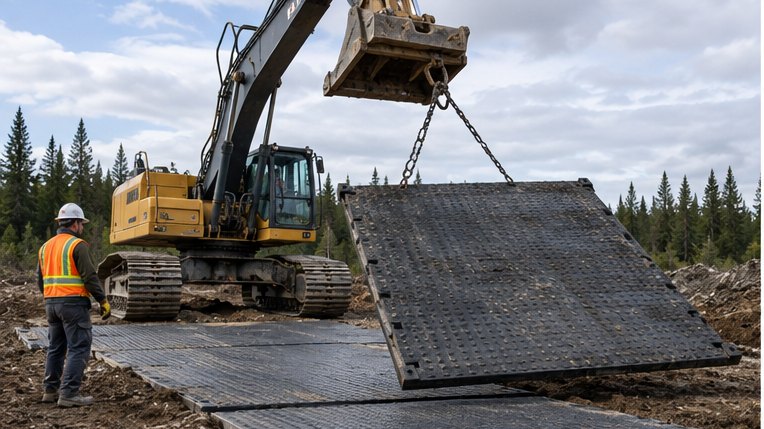
Figure: Construction of pipelines on marshes, meadows, river banks and high-water-bearing soils, with a focus on “How construction of wetlands and meadows should be planned”
In the absence of space on the ground, work cannot be undertaken by reducing the necessary cover or moving legs to the shoulder of the road. The vehicle station position should be reordered in order to provide sufficient space for the “lowest effective area of the leg pads based on maximum retroactivity and ground durability”. The construction of wetlands should prioritize the maintenance of water flow lanes and continuous support to avoid repeated deviations by vehicles to expand the disturbance area. Any forced overlays of holes, temporary mats or uncounted should be returned to the technical manager for evaluation. The test-pail record of “how the construction of the wetland and meadow line should be planned” should indicate the starting and ending position, vehicle status and release conclusions, so as to facilitate review as the construction conditions change.
The switchover requires reporting changes in the water flow, deposition, pumping mud, edge wash, vegetation pressure, connectors, spill position and restoration boundary, rather than a description of the appearance. The sutures, shoulders or sub-points repaired in the previous class are reviewed in the next class. In the event that the connection is loose, drainage congestion or pollution reduces the actual operational condition as traffic increases, the project shall immediately limit, reroute or suspend the equipment until the re-examination passes. With regard to “how to plan for the construction of the wetland/grassian pipe”, the inspection forms are to list separately changes in the physical condition of use associated with looseness, drainage congestion or pollution, and to indicate the time taken by the inspector and his/her return.
The impact assessment cannot be based solely on the movement of vehicles on the same day. The project compares vehicle waiting, trapping, maintenance hours, cleaning time, loss of connection, site restoration area and evacuation cycle, and records weather and traffic simultaneously. Once data have been created around loose connections, drainage congestion or pollution to reduce actual use, it will be possible to determine whether this option is suitable for replication in the next hydrocarbon project. It should also answer whether the “how wetland and meadow line construction should be planned” has been certified as an improvement by accounting for the minimum effective area of the leg pads on the basis of maximum retroactivity and durability, avoiding a subjective description of the closing item.
Progress pressure cannot reduce the security floor. In the event of a loose connection, drainage congestion or pollution that reduces the physical condition of use, the decision should be made to repair, reroute or replace the product after isolation and identification of the cause. Any measures should avoid introducing new risks of slide, overloading, tripping, electric area intrusion or human-car conflict.
The following special verifications should be carried out in connection with the construction of pipelines on marshes, grasslands, river banks and high-water soils: during the planning phase, the main route, the car area, the equipment stand-by, the emergency exit and the final exit route should be presented on the same map and the most extensive vehicles should be identified at the actual ratio. Once the route has changed, the soft spots, drainage and coverage should be re-examined and the old version should not be used.
On-site implementation of the recommendation: The route can be subject to a hard transition, ordinary soft ground, extremely soft points, turnovers and operational segments, each with different release and maintenance requirements. This would allow for accurate containment and repair, even if partial failure, without the need to disable the entire passage.
Need for further evaluation of the actual project?
Applications, sizes, quantities, site photographs or drawings and delivery destinations are sent, on which we can identify more suitable products and processing programmes.







