
The treatment of drainage and sub-board pumping mud in the construction of wetlands and medows begins with the separation of vehicle traffic, stationing of equipment from the support of the crane. In the case of the construction of pipes on marshes, meadows, river banks and high-water-bearing soils, the focus is on how “wetland and meadows can be treated with drainage and subsurface pumping mud” which usually follows multiple stages of entry, construction, overhaul and evacuation, and changes in ground water content and traffic. The most easily overlooked aspect of this topic is the increase in secondary crushing and restoration costs caused by the error in the sequence of the evacuation yard. The problem of grass-roots and drainage may have expanded if only ad hoc slabs were added after a vehicle has been trapped.
A one-time collection of wetland water levels, topsoil thickness, vegetation protection boundaries, vehicle axle loads, route width, drainage permits, cross-grenade position and restoration standards was recommended before the design and request was made. The topic could begin with a programme of “Verification panels, floors and vehicle operating space through representative trial workshops”. The standard 15, 20, 25 and 30 mm specifications for paving boards can only be used as the starting point for communication, with the actual selection being combined with materials, size, thickness, single weight, texture, connection, grass-roots support and supplier testing conditions. The information review should also confirm when the operational equipment docked, the location of the feeder and the area of separation of personnel, and include missing information as an item to be confirmed in the quotation and construction programme.
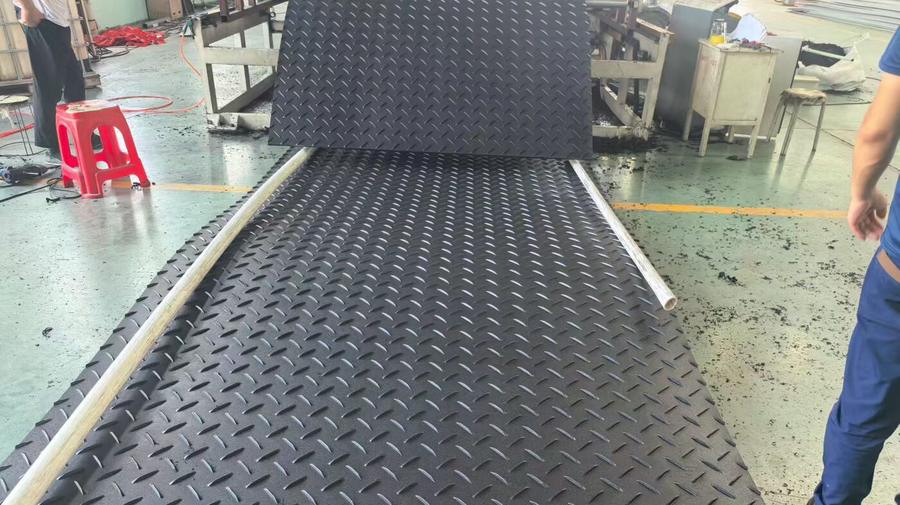
Figure: Construction of pipelines on marshes, meadows, river banks and high-water-bearing soils, with a focus on “How wetland and meadows can be treated with drainage and subboard pump mud” (Putting material on plastics network)
The site installation should be located with an approved drawing number, and the level, seam, edge and drainage should be inspected at each stage of completion. The construction of wetlands should prioritize the maintenance of water flow lanes and continuous support to avoid repeated deviations by vehicles to expand the disturbance area. The test operation can first be carried out using a low-risk vehicle with a slow-speed straight-line and then gradually verify the turnover, parking and full-loading; it should be discontinued as soon as it is discovered that it continues to sink under the plate, pump mud or branch position. The trial-padging records for “the treatment of drainage and subboard pump mud in the construction of wetland and meadows” should indicate the starting point, vehicle status and release conclusions to facilitate review following changes in construction conditions.
It is recommended that the pavements and the mats be included in the asset desk account, numbering the relevant specifications, batches, pavements and hours of use. The scope of the inspection included surface currents, depositions, pumping muds, peripheries flushing, vegetation pressure, connectors, spill position and restoration boundary. The removed components are to be cleaned, dried, flattened and placed in subdivisions that are qualified, subject to assessment, to repair and to end-of-life status, to prevent the re-entry of unqualified products. With regard to the treatment of drainage and sub-board pumping mud in the context of the construction of wetland and grassland pipelines, the inspection form is to be marked by an error in the order of the separate discharge field, resulting in a change in the secondary crushing and recovery costs, as well as a reference to the inspector and the time of return.
Construction, logistics, HSE, equipment, site and procurement could be jointly evaluated before the planned expansion. The parties identified conditions for passage, suspension, inspection, restoration and delivery, respectively, to verify whether the sutures, ground floors and vehicle operating space were truly enforceable through representative trial workshops. The results of the review should be included in the programme rather than in oral communication. It should also answer whether “wetland and straw pipe construction how to handle drainage and subboard pump mud” has been certified for improvement by means of representative trial bunks that certify sutures, ground floors and vehicle operating space and avoid a subjective description of the end item.
The ultimate goal is to allow the construction of pipes on marshes, pastures, river banks and high-water-bearing soils, with a focus on how “wetland and grassland pipeline construction will handle drainage and sub-board pumping mud” to operate with clear limits and acceptable risks and to successfully restore the ground after the completion of the work. By connecting the design, product, operation, inspection and evacuation sites, the secondary crushing and restoration costs will not be repeated during the rush phase as a result of a chronology error.
The following special verifications should be carried out in conjunction with the construction of pipes on marshes, grasslands, river banks and high-water-bearing soils on how to treat drainage and sub-board-pump mud in the construction of wetlands and meadows: the drainage design should identify where the water enters, where it passes and where it is eventually discharged. Scrutinization usually indicates that fine particles and water are squeezed repeatedly by vehicles, and that simply cleaning the surface cannot solve the cause, requiring post-encumbering treatment soft spots, filters or approved floors.
On-site implementation of recommendations: The sew and flow direction of the slurry position can be marked, and the loss of grass-roots particles is compared with the normal part of the adjacent area after the plate is removed. Upon completion of the repairs, the same vehicle and velocity should be used to re-establish that the problem did not migrate to both ends.
Need for further evaluation of the actual project?
Applications, sizes, quantities, site photographs or drawings and delivery destinations are sent, on which we can identify more suitable products and processing programmes.







