
The width and turning areas of the temporary road for the construction of pipelines should be determined from the most unfavourable rather than the average. Transport, welding, ditching and backfilling operations in long-range pipeline corridors concern that “the width of the temporary road for pipeline construction and the determination of the turning area” may be affected by heavy vehicle cycles, rainfall and time compression at the same time, and that the level of reticulation of the equipment by overloading or uneven deposition at the branch points may increase with traffic. It would be clearer for on-site execution to first determine the conditions for allowing deposition, decommissioning and those responsible, and then select product specifications.
The procurement staff shall submit the site map, vehicle watch and pipeline by, the total weight and axle charge of the maximum vehicle, the length and width of the route, the slope, the position of the gutter, the water content of the soil, the direction of the drainage and the construction window to the request for quotations, and shall indicate the location where it may be possible to alter the level of the equipment by overloading or uneven deposition at the point of payment. The programme could be based on the setting of speed limits, the prohibition of in situ rounding and the placement of dedicated commands for heavy vehicles. For the whole container procurement, the quantity of the container, the pallet or bundle, the offloading equipment, the destination port and the conditions of storage at the site should also be confirmed in advance. For “how to determine the width and turning areas of the temporary road for the construction of the pipeline”, the information review should also draw out the protection and restoration of the boundary of topsoil, cropping layer or grassland and include missing information as an item to be confirmed in the quotation and construction programme.
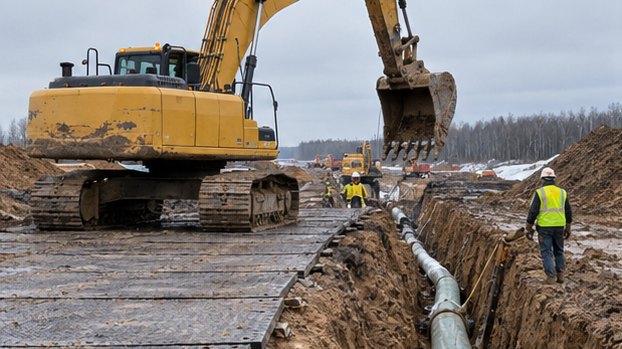
Figure: Transport, welding, ditches and backfilling operations in long-range pipeline corridors, with a focus on “how to determine the width and turn area of the temporary road for pipeline construction”
A smooth transition should be put in place at the different ground crossings to avoid the sudden impact of vehicles on temporary circuits from hard roads. The internal and external wheels and brake positions of the most heavy vehicles will also be reviewed after the installation of a speed limit, a ban on in-situ wheeling and a exclusive command for heavy vehicles has been completed. First, a continuous channel is formed by a complete transport trajectory, then the edge of the ditch, the welding area, the lower point and the car section are expanded to cover them separately. Physical segregation and clear rules for release are required in the vicinity of public areas. The test-padging records for “how wide and convection areas are determined” for the construction of the temporary road should identify the starting and ending position, vehicle condition and release conclusions to facilitate review as construction conditions change.
It is recommended that the pavements and the mats be included in the asset desk account, numbering the relevant specifications, batches, pavements and hours of use. The scope of the inspection included sutures, connections, edges of trenches, shoulders, tracks, drainage exits, vehicle tracks and alert borders. The removed components are to be cleaned, dried, flattened and placed in subdivisions that are qualified, subject to assessment, to repair and to end-of-life status, to prevent the re-entry of unqualified products. The inspection form is to vary the level of the equipment by a single column or even deposition, and to indicate the time of the repeater and the resumption of traffic.
The impact assessment cannot be based solely on the movement of vehicles on the same day. The project compares vehicle waiting, trapping, maintenance hours, cleaning time, loss of connection, site restoration area and evacuation cycle, and records weather and traffic simultaneously. The question of whether this option is suitable for replication at the next hydrocarbon project is determined by the creation of data around a change in the level of the equipment by overloading or uneven deposition of the branch. It should also answer “how much is the width and turning area of the temporary road for the construction of the pipeline determined” whether the improvement could be verified by setting speed limits, prohibiting in situ wheeling and arranging exclusive command for heavy vehicles, so as to avoid a subjective description of the final item.
This paper could serve as a technical discussion list for the hydrocarbon project, but not as a separate construction permit. The project will also require a written programme of transport organization, temporary structures, electrical safety, fire protection, weather emergencies and site restoration systems, and a review of key carrying and stabilization conditions by authorized personnel.
The following special verifications should also be carried out in connection with the transport, welding, ditching and backfilling of the long-range pipeline corridor: the width of the road should cover the full wheel of the vehicle and not only the exterior. The turn zone should be expanded on the basis of internal vehicle differentials, trailer swings, face-to-face vehicular and command positions; it should also retain an observed and sustainable safety residual at the edge to avoid long-term pressure on the side.
On-site implementation of the recommendation: it would be useful to use vehicle trajectories to verify the difference between internal and external wheels and to retain a positive distance at the exit. For long-barrel transport vehicles, account is also taken of trailer swings and road ramps and, where necessary, one-way discharges are used to reduce exposure risks.
Need for further evaluation of the actual project?
Applications, sizes, quantities, site photographs or drawings and delivery destinations are sent, on which we can identify more suitable products and processing programmes.







