
Test-painting and commissioning of the temporary road for the construction of the pipeline begins with the separation of vehicle traffic, stationing of equipment from the support of the crane. Transport, welding, ditching and backfilling of long-range pipeline corridors, this topic focuses on “how the temporary road for the construction of the pipeline is to be paved and run for trial”, which usually follows multiple stages of entry, construction, overhaul and evacuation, and changes in ground water content and traffic. What is most likely to be overlooked on this topic is that the repeated traffic of vehicles forms a deep path and destroys the grass roots. The problem of grass-roots and drainage may have expanded if only ad hoc slabs were added after a vehicle has been trapped.
The one-time collection line is proposed to be by, maximum vehicle total weight and axle charge, length and width of the channel, slope, position of the gutter, soil water content rate, drainage direction and construction window before design and request for price. The topic could begin with a programme of “continuing coverage according to the most adverse vehicle, complete wheel and weather change planning”. The standard 15, 20, 25 and 30 mm specifications for paving boards can only be used as the starting point for communication, with the actual selection being combined with materials, size, thickness, single weight, texture, connection, grass-roots support and supplier testing conditions. The information review should also distinguish between vehicles by axle-load and tyre, not replacing the total load for all inputs, and include missing information as an item to be confirmed for the quotation and construction programme.
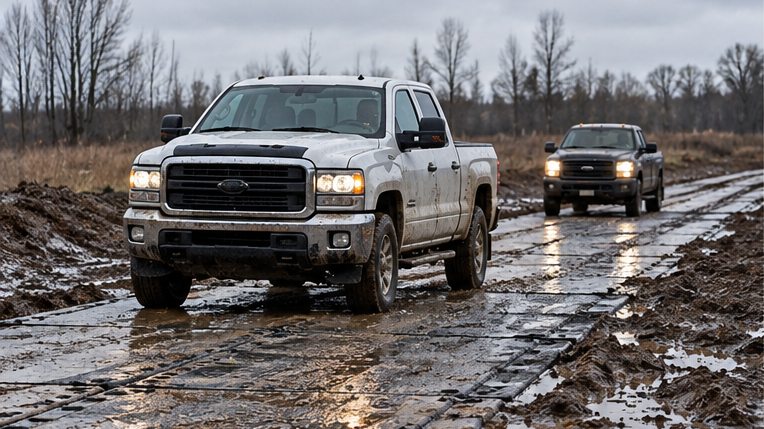
Figure: Transport, welding, ditches and backfilling operations in long-range pipeline corridors, with a focus on “how to test and run temporary road construction”
A smooth transition should be put in place at the different ground crossings to avoid the sudden impact of vehicles on temporary circuits from hard roads. The internal and external wheels and brake locations of the most heavy vehicles will be reviewed after successive coverage has been completed in accordance with the most unfavourable vehicle, complete wheel and weather change planning. First, a continuous channel is formed by a complete transport trajectory, then the edge of the ditch, the welding area, the lower point and the car section are expanded to cover them separately. Physical segregation and clear rules for release are required in the vicinity of public areas. Test-painted records of “how to carry out the test-painting and commissioning of the temporary road for the construction of the pipeline” should indicate the starting-point location, vehicle condition and release conclusions to facilitate review as construction conditions change.
Special inspections should be added after extreme weather, equipment anomalies or route adjustments. The use of position markings and fixed view photographs for sutures, connectors, edges of trenches, shoulders, tracks, drainage exits, vehicle wheels and guard borders facilitates comparison of deposition and shift. Cleaning the surface of polymers avoids fire, sharp shovels and violent knocks, creating new cracks and stress concentrations. The inspection forms, which revolve around “how the temporary road for the construction of the pipeline is to be paved and operated on a trial basis”, require that the repeated traffic of a single vehicle create a deep path and disrupt changes at the grass-roots level, as well as a reference to the inspector and the time of return.
It is recommended that a key route or a feeder of equipment be selected for controlled validation, with observation cycles and exit conditions. The record should cover normal and most unfavourable conditions, with particular attention to the re-routing of vehicles and the destruction of the grass roots. A further expansion after the trial could reduce one-time procurement or full-line errors, while providing the same basis for vendor comparison. It should also answer whether the “how to pave and run the pipeline construction temporary road” has been improved by the continuous coverage of the most disadvantaged vehicles, complete wheels and weather changes to avoid a subjective description of the closing item.
This paper could serve as a technical discussion list for the hydrocarbon project, but not as a separate construction permit. The project will also require a written programme of transport organization, temporary structures, electrical safety, fire protection, weather emergencies and site restoration systems, and a review of key carrying and stabilization conditions by authorized personnel.
The following special verifications should be carried out in conjunction with the transport, welding, ditching and backfilling operations of the long-range pipeline corridor for the “test pavement” of the temporary road for the construction of the pipeline: the test pavement should select the softest ground and representative heavy vehicles, and record the vehicle's state, speed, wheel, plate change and post-rain. The test operation is not considered to be permanent and will still need to be revalidated after the vehicle has become heavy, its route has changed or the weather has deteriorated.
Recommendation on on-site implementation: Test-run records should indicate temperature, weather, ground state, vehicle load, tyre pressure and speed. When the subsequent conditions go beyond the scope of the test, the original conclusion automatically lapses, requiring a further inspection or approval of the change by the project technical staff.
Need for further evaluation of the actual project?
Applications, sizes, quantities, site photographs or drawings and delivery destinations are sent, on which we can identify more suitable products and processing programmes.







