
The response to the fixed number of spare panels that would have been required for the construction of the temporary road along the line was not removed from the site. Transport, welding, ditches and backfilling operations in long-range pipeline corridors concern that “the number of spare plates to be prepared for the construction of temporary pipelines” are affected by weather, topography, vehicle and organizational patterns, and that temporary changes in the construction route have only resulted in vehicles entering unprotected areas. The project should mark the soft spots, slopes, drainage, underground facilities and vehicle tracks on a single map to bring technology, construction, HSE and procurement data into line.
Four school-specific topics are available at sites, equipment, products and operations. The site and equipment column records the total weight and axle load of the maximum vehicle, the length and width of the route, the slope, the location of the groove, the soil water content, the discharge direction and the construction window. The product column lists the size, thickness, texture, connection and batch, and the operating column indicates the reverse removal and retention of the emergency route in the order in which the equipment exits. Any one still relies on empirical speculation and may result in temporary changes in the construction route leading to the re-emergence of vehicles entering unprotected areas at the peak of construction. The information review should also incorporate snow, ice, sand and tyre state in tow management as well as the missing information as items to be confirmed in the quotation and construction programme.
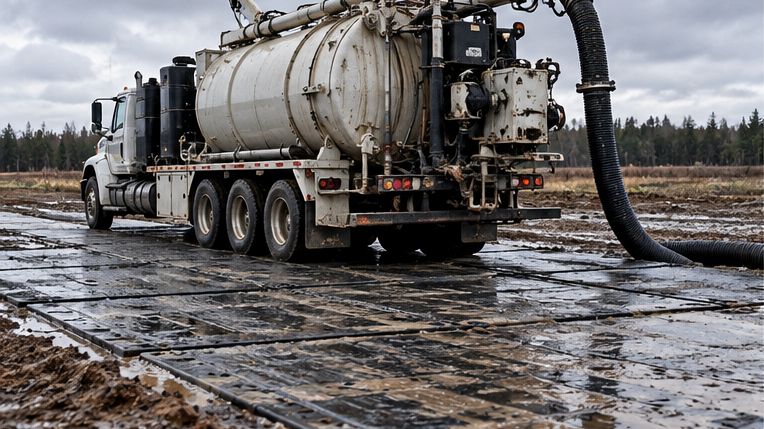
Figure: Transport, welding, ditches and backfilling operations in long-range pipeline corridors, with a focus on “How many spare plates will be required for the construction of temporary pipeline roads”
Pre-implementation should be preceded by the containment of routes, the removal of sharp stones, stakes and miscellaneous items that may form a spot load, the repair of deep-pit tracks and the removal of horizontal drainage. First, a continuous channel is formed by a complete transport trajectory, then the edge of the ditch, the welding area, the lower point and the car section are expanded to cover them separately. The plates should be prepared continuously at the stabilization end, with the bends, reverses and parking areas being expanded as appropriate; the leg mats should be flat, intermediated and in full contact, and it should not be allowed to be filled with random stacking. The test-pail record of “the number of spare panels to be prepared for the construction of the temporary road line” should indicate the starting and ending position, vehicle status and release conclusions to facilitate review as the construction conditions change.
Multi-shift or lease items may be used for electronic worksheet sutures, connectors, groove edges, shoulders, dots, drainage exits, vehicle rotations and perimeters, and to link road maps and product numbers. Continuous anomalies should trigger a review of the project, rather than a mere surface. Visible permanent deformation, deep mouth or postpoint damage to the leg cushions shall be judged by standard manufacturer ' s isolation. The inspection forms need to list, on a stand-by basis, the temporary changes in the construction route surrounding the construction of the temporary roads around the line, changes in the vehicle's access to the unprotected area, as well as an indication of the repeater and the time of return.
A reset is to distinguish between product problems and changes in condition. The original programme may no longer be appropriate if the vehicle is heavy, routed, rainfall increases or cover periods are extended. These changes are recorded with the reverse removal of the equipment in the order of withdrawal and the retention of the emergency route until the final results of the implementation, and the next time it is known whether the thickness, width, quantity or construction organization should be adjusted. It should also answer whether “the number of spare panels to be prepared for the construction of the temporary road along the pipeline” is improved by the reverse removal and retention of the emergency route in the order in which the equipment was withdrawn, and at the end of the day, by avoiding a subjective description.
This paper provides a selection and management approach and does not replace the equipment instructions, the suspension programme, ground-based evaluation or local regulations. Work involving lifting support, underground facilities, electrical areas, the edges of trenches and the entry of persons into dangerous areas shall be reviewed by persons with appropriate qualifications. The above parameters may be provided in the request for quotations to obtain recommendations for size, thickness, quantity, packaging and shipment.
The following special verifications should be carried out in connection with the transport, welding, ditching and backfilling operations of the long-range pipeline corridor in respect of “the number of spare panels required for the construction of the temporary roads of the pipeline”, which should be calculated in conjunction with the length of the route, the key nodes, the projected rate of damage, the cleaning lead time and the replenishment distance. Remote projects cannot be purchased on a net-painted basis only, and authorized stocks should be reserved for soft-point expansion, loss of connections and temporary rerouting.
On-site implementation of the recommendation: The back-up plate should be close to key soft points without access to emergency routes and counted with connectors, tractors and cleaning materials. The inventory should distinguish between quantities that can be used immediately, that are to be cleaned, that are to be assessed and that are scrapped.
Need for further evaluation of the actual project?
Applications, sizes, quantities, site photographs or drawings and delivery destinations are sent, on which we can identify more suitable products and processing programmes.







