
As the oil and gas project often places transport, parking and cranes in adjacent areas, it is necessary to identify the design boundaries of each category of area as to how the temporary road for the construction of pipelines avoids being pushed off board. Transport, welding, ditching and backfilling operations in long-range pipeline corridors focus on “how temporary road construction of pipelines avoids vehicle overboard” and, if quoted in terms of total area only, can easily be left out of the curves, legs landing points and recycling routes. A temporary change in the construction route would result in vehicles entering unprotected areas, as well as the failure of otherwise sufficient direct sections at peak.
If the project needs to be accompanied by a pavement and a mat, an optional table should be established. The former are dominated by continuous support on the route, axle and the grass-roots level, while the latter are dominated by maximum reversibility of the legs and allowing for ground bearing. A combination of piped lines, the total weight and axle load of the most heavy vehicle, the length and width of the tunnel, the slope, the location of the gutter, the water content of the soil, the direction of drainage and the construction window are to be carried out in reverse and the emergency route is to be removed in the order in which the equipment is withdrawn, and, lastly, the two products are to be avoided as alternative components. The information review should also measure the number of vehicle cycles and track the location of duplicate wheel formations, and include missing information as an item for confirmation of quotations and construction programme.
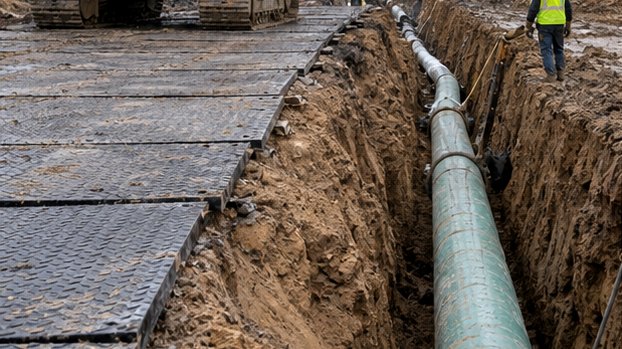
Figure: Transport, welding, ditches and backfilling operations in long-range pipeline corridors, with a focus on “How temporary road construction of pipelines avoids vehicle overboard”
The site installation should be located with an approved drawing number, and the level, seam, edge and drainage should be inspected at each stage of completion. First, a continuous channel is formed by a complete transport trajectory, then the edge of the ditch, the welding area, the lower point and the car section are expanded to cover them separately. The test operation can first be carried out using a low-risk vehicle with a slow-speed straight-line and then gradually verify the turnover, parking and full-loading; it should be discontinued as soon as it is discovered that it continues to sink under the plate, pump mud or branch position. The test-pail record of “how to avoid vehicle pressure outside the plate” should indicate the starting and ending position, vehicle condition and release conclusions to facilitate review as the construction conditions change.
The inspection cycle can be shortened at an early stage of use and then stabilized before adjusting to vehicle cycles and weather. The maintenance staff focused on sutures, connections, edges of trenches, shoulders, tracks, drainage exits, vehicle rotations and guard borders, as well as on the driver ' s compliance with speed limits and diversion requirements. Any unconfirmed sub-board support, edge instability or foot contact should first be disabled. With regard to the “how to avoid vehicle pressure outside the plate” around the construction of the temporary road along the pipeline, the patrol forms need to list, on a separate basis, the temporary changes in the construction route that would allow the vehicle to enter the unprotected area and indicate the time taken by the inspector and the resumption of traffic.
It is recommended that a key route or a feeder of equipment be selected for controlled validation, with observation cycles and exit conditions. The records were to cover normal and most unfavourable conditions, with particular attention to temporary changes in the construction route that allowed vehicles to enter unprotected areas. A further expansion after the trial could reduce one-time procurement or full-line errors, while providing the same basis for vendor comparison. This retrodiscussion should also answer whether “how the temporary road for the construction of the pipeline avoids being pushed off the plate” is improved by the reverse removal and retention of the emergency route in the order in which the equipment was withdrawn and, at the end of the day, by avoiding a subjective description only.
Road-painting and foot mats can only function in the approved construction system and cannot be a substitute for unsatisfactory foundations, damaged equipment or irregularities. Any unknown underground facility, unstable edges, legwork beyond the equipment manual or failure to isolate persons should be suspended and upgraded.
Special verification should also be carried out in conjunction with long-range pipeline corridors for transport, welding, ditching and backfilling of temporary roads to prevent vehicles from pressing out of the plate, requiring clear entry directions, continuous border marking, speed limits and specialized command. Retroreflective markings should be added to night work or low-visibility conditions; once the wheel is moved, release and rerouting should be stopped, rather than continuing to rely on driver experience.
On-site implementation of recommendation: The vehicle entrance should be equipped with a straight segment that allows the wheel to be fully aligned. The commanding officer's position should avoid the vehicle's path and edge and, if it is discovered that the driver is unable to see the border, increase the wireless command or adjust the markings, rather than reluctantly moving by gesture.
Need for further evaluation of the actual project?
Applications, sizes, quantities, site photographs or drawings and delivery destinations are sent, on which we can identify more suitable products and processing programmes.







