
The purpose of the temporary road for the construction of the pipeline is to allow the construction vehicles to move within the controlled route, while avoiding the conversion of ground protection problems into equipment stabilization problems. For transport, welding, ditches and backfilling operations around long-range pipeline corridors, the topic is concerned with “the choice of thick pavements for the construction of temporary roads for pipelines”, which should be checked, inter alia, for lack of information leading to a mismatch of specifications and quantities with field conditions. Where there is a gutter, backfilling area, slope or unknown underground facility on the route, the treatment must first be confirmed by the responsible party of the project.
The input information can be organized by the four columns of equipment, ground, route and time, with a focus on the route by which the pipe is routed, the total weight and axle load of the most heavy vehicle, the length and width of the channel, the slope, the position of the gutter, the water content of the soil, the direction of drainage and the construction window. In response to the lack of information, which resulted in a mismatch between specifications and quantities and field conditions, it was suggested that drainage and soft spots should be addressed before being laid and piloted from the stabilization end. In the case of leg pads, the maximum repulsive force of the leg provided by the plant must be obtained, and in the case of passage roads, the total weight of the vehicle, the axle, the tyre and the complete turn track should be used. In the case of “the choice of thick pavements for the construction of temporary roads for pipelines”, the information review should also set fixed observation points on the outside side of the shoulder, slope and turn and include missing information as an item to be confirmed in the quotation and construction programme.
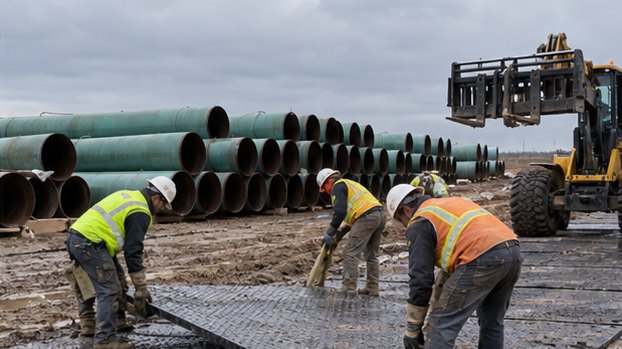
Figure: Transport, welding, ditching and backfilling of long-range pipeline corridors, with a focus on “how thick a pavement is required for the construction of temporary roads for the pipeline”.
The installation should leave a photo, location and measurement record. First, ground-level levelling, drainage and underground facilities are identified, and the complete contact, connection, edge and transition of the pavement is checked, or the size, location and centering of the leg pads are checked. First, a continuous channel is formed by a complete transport trajectory, then the edge of the ditch, the welding area, the lower point and the car section are expanded to cover them separately. Areas not eligible for acceptance should not be replaced by speed-limit signs alone. The test-pail record of “the temporary road for the construction of the pipeline will require the selection of thick pavements” should indicate the starting and ending position, vehicle status and release conclusions to facilitate review as the construction conditions change.
Special inspections should be added after extreme weather, equipment anomalies or route adjustments. The use of position markings and fixed view photographs for sutures, connectors, edges of trenches, shoulders, tracks, drainage exits, vehicle wheels and guard borders facilitates comparison of deposition and shift. Cleaning the surface of polymers avoids fire, sharp shovels and violent knocks, creating new cracks and stress concentrations. For the construction of temporary roads around the line, which require the choice of thick pavements, the inspection forms need to be separated by insufficient information, resulting in variations in specifications, quantities that do not match the situation on the ground, and a reference to the inspector and the time of return.
It is recommended that a key route or a feeder of equipment be selected for controlled validation, with observation cycles and exit conditions. The records are to cover normal and most unfavourable conditions, with particular attention to the fact that insufficient information leads to a mismatch between specifications and quantities on-site. A further expansion after the trial could reduce one-time procurement or full-line errors, while providing the same basis for vendor comparison. It should also answer whether “the choice of thick pavements for the construction of temporary roads for pipelines” has been improved by first processing drainage and soft points and then from the preparation and trial operation of the stabilization end, so as to avoid the closure of items by subjective descriptions.
The construction, equipment, HSE and logistics team should confirm the use of the same version of data before the procurement is issued. The common dimensions, thickness or reference load range referred to in this paper are not on-site commitments and actual performance is influenced by materials, temperature, foundations, connections and installation patterns, and the recommended results should indicate assumptions and no application.
The following special verifications should be carried out in conjunction with long-range pipeline corridors for transport, welding, ditches and backfilling: the thickness selection takes into account both materials, panel structure, dimensions, continuing support at the grass-roots level, temperature, type of vehicle and mode of connection. 15, 20, 25 or 30 mm may be used as an option for quotations, provided that the final recommendation indicates the assumptions, the basis of the test and the circumstances of the work not applicable.
On-site implementation of the recommendation: The same thickness may be different under different dimensions, material formulations, texture and supporting conditions. The sample assessment should measure the actual thickness and weight and require suppliers to explain the test method, allow deformation and product use limits.
Need for further evaluation of the actual project?
Applications, sizes, quantities, site photographs or drawings and delivery destinations are sent, on which we can identify more suitable products and processing programmes.







