
The treatment of drainage and subboard pumping mud on the temporary road for the construction of pipelines should start from the most unfavourable rather than the average. Transport, welding, ditches and backfilling operations in long-range pipeline corridors concern that “the treatment of drainage and subboard pump mud on temporary road construction” may be affected by heavy vehicle cycles, rainfall and time compression at the same time, and that the physical use of connections may be exacerbated by looseness, drainage congestion or reduced pollution. It would be clearer for on-site execution to first determine the conditions for allowing deposition, decommissioning and those responsible, and then select product specifications.
The input information can be organized by the four columns of equipment, ground, route and time, with a focus on the route by which the pipe is routed, the total weight and axle load of the most heavy vehicle, the length and width of the channel, the slope, the position of the gutter, the water content of the soil, the direction of drainage and the construction window. It is recommended that direct-line sections, turn areas, docking positions and surfaces be counted separately for loose connections, drainage congestion or pollution to reduce actual usage. In the case of leg pads, the maximum repulsive force of the leg provided by the plant must be obtained, and in the case of passage roads, the total weight of the vehicle, the axle, the tyre and the complete turn track should be used. The information review should also confirm the operational equipment stopover time, the location of feeder points and the area of separation of personnel, and include missing information as an item to be confirmed in the quotation and construction programme.
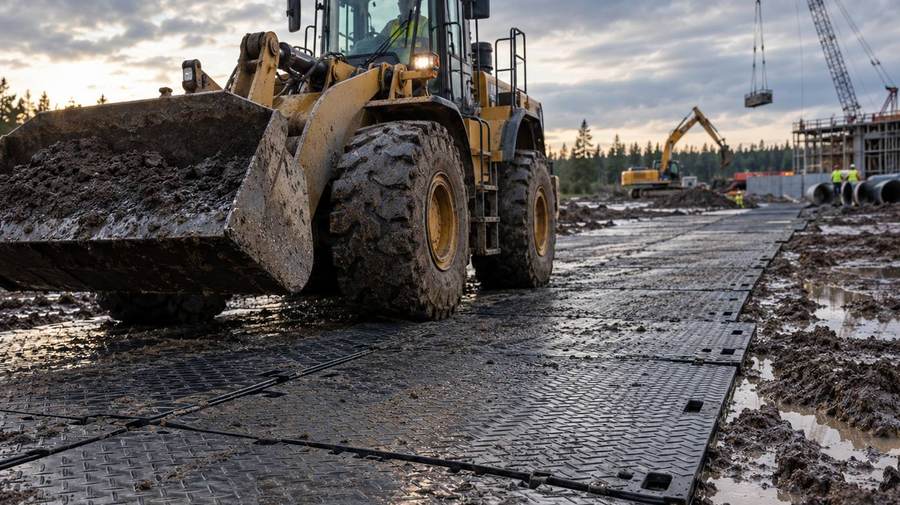
Figure: Transport, welding, ditching and backfilling of long-range pipeline corridors, with a focus on “How to handle drainage and sub-pumping mud on temporary road construction of pipelines” (inventory material for creating a plastic network)
Pre-implementation should be preceded by the containment of routes, the removal of sharp stones, stakes and miscellaneous items that may form a spot load, the repair of deep-pit tracks and the removal of horizontal drainage. First, a continuous channel is formed by a complete transport trajectory, then the edge of the ditch, the welding area, the lower point and the car section are expanded to cover them separately. The plates should be prepared continuously at the stabilization end, with the bends, reverses and parking areas being expanded as appropriate; the leg mats should be flat, intermediated and in full contact, and it should not be allowed to be filled with random stacking. The trial-pail record of “the treatment of drainage and subboard pump mud on the temporary road for the construction of the pipeline” should indicate the starting and ending position, vehicle status and release conclusions to facilitate review as the construction conditions change.
The inspection cycle can be shortened at an early stage of use and then stabilized before adjusting to vehicle cycles and weather. The maintenance staff focused on sutures, connections, edges of trenches, shoulders, tracks, drainage exits, vehicle rotations and guard borders, as well as on the driver ' s compliance with speed limits and diversion requirements. Any unconfirmed sub-board support, edge instability or foot contact should first be disabled. The inspection form, which covers “the treatment of drainage and sub-board pumping mud on the construction of temporary roads along the pipelines”, is to show changes in the actual operational status of the connection by a separate line of looseness, drainage congestion or pollution, as well as a reference to the inspector and the time of return.
The receiving and inspection information shall be maintained in the form of maps, product numbers, photographs of entry and exit sites, initial ground conditions, abnormal worksheets and demolition records. In the event of a ground or equipment dispute, the information may distinguish between pre-existing soft spots, changes in use and damage to the evacuation site, and also quantify the impact of loose connections, drainage congestion or pollution on the cost of the project. It should also answer whether “the treatment of drainage and sub-board pump mud on the temporary road for the construction of the pipeline” has been proven to be improved by calculating the straight-line segment, the turning area, the docking position and the surface, so as to avoid a subjective description of the closing item.
The construction, equipment, HSE and logistics team should confirm the use of the same version of data before the procurement is issued. The common dimensions, thickness or reference load range referred to in this paper are not on-site commitments and actual performance is influenced by materials, temperature, foundations, connections and installation patterns, and the recommended results should indicate assumptions and no application.
The following special verifications should also be carried out in conjunction with long-range pipeline corridor transport, welding, ditches and backfilling operations for “the treatment of drainage and sub-boarding mud on the temporary road for pipeline construction”: the drainage design should identify where the water enters, where it passes and where it is eventually discharged. Scrutinization usually indicates that fine particles and water are squeezed repeatedly by vehicles, and that simply cleaning the surface cannot solve the cause, requiring post-encumbering treatment soft spots, filters or approved floors.
On-site implementation of recommendations: The sew and flow direction of the slurry position can be marked, and the loss of grass-roots particles is compared with the normal part of the adjacent area after the plate is removed. Upon completion of the repairs, the same vehicle and velocity should be used to re-establish that the problem did not migrate to both ends.
Need for further evaluation of the actual project?
Applications, sizes, quantities, site photographs or drawings and delivery destinations are sent, on which we can identify more suitable products and processing programmes.







