
While the construction window for the oil, gas and pipeline works is usually tight, the response of the temporary road for the pipeline construction to the cryogenic ice still requires a full operational cycle analysis. In the case of transport, welding, ditches and backfilling operations in long-range pipeline corridors, the issue is concerned with “how temporary road construction of the pipeline will respond to cold ice” and the conditions of control when the vehicle enters, is loaded or the equipment is parked for long periods of time vary. The site should first locate the areas where the lack of support on the edge of the road leads to the bending and crushing of the sheet, and then decide on the use of pavements, leg pads or approved combinations.
The focus of the topic is not on the choice of the thickest or the most heavy products, but on the establishment of a match. The coverage, connection and back-up quantities are determined by the description of the work, the basis of the test and the conditions of the test in the request and acceptance documents, on the basis of the control conditions of the pipeline by the total weight and axle load of the most heavy vehicle, the length and width of the channel, the slope, the location of the groove, the water content of the soil, the direction of discharge and the construction window. In the case of products requiring cross-project turnaround, the numbering, loss rate, cleaning time and volume of transport should also be included in the total cost. The information review should also limit long-term static, in situ wheeling and unplanned queuing of vehicles and include missing information as items to be confirmed for quotations and construction programmes.
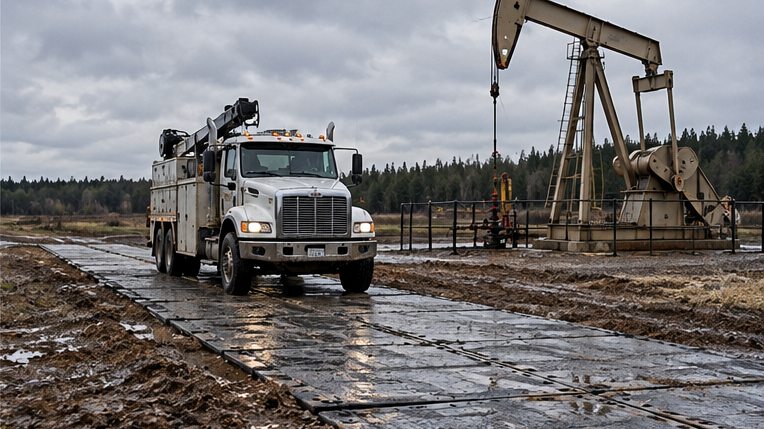
Figure: Transport, welding, ditches and backfilling operations in long-range pipeline corridors, with a focus on “how to deal with cold-temperature ice freezes on temporary road construction”
A representative route or a feeder may be selected for a controlled trial pavement to cover the softest floor and the most heavy equipment condition. First, a continuous channel is formed by a complete transport trajectory, then the edge of the ditch, the welding area, the lower point and the car section are expanded to cover them separately. The decision to increase width, improve drainage or reorient traffic is then taken by means of experimental observation of grass-roots, sewn, tyre tracks and operating space. Test-painted records of “how to respond to cold-temperature ice construction” should identify starting and ending locations, vehicle condition and release conclusions to facilitate review as construction conditions change.
The inspection cycle can be shortened at an early stage of use and then stabilized before adjusting to vehicle cycles and weather. The maintenance staff focused on sutures, connections, edges of trenches, shoulders, tracks, drainage exits, vehicle rotations and guard borders, as well as on the driver ' s compliance with speed limits and diversion requirements. Any unconfirmed sub-board support, edge instability or foot contact should first be disabled. The “how to respond to cold-temperature ice on the construction of temporary roads around pipelines”, the patrol forms need to show a lack of support on the edges of the separate road, leading to changes in the bending and crushing of the sheet, as well as a reference to the repeater and the time taken to resume passage.
A reset is to distinguish between product problems and changes in condition. The original programme may no longer be appropriate if the vehicle is heavy, routed, rainfall increases or cover periods are extended. These changes are recorded with the results of the implementation of the request for proposals and acceptance documents, the basis of the tests and the restrictions, and it is not until the next time that it is known whether the thickness, width, quantity or construction organization should be adjusted. It should also answer whether the “how to respond to cryogenic ice-freezing on the temporary road for pipeline construction” has been demonstrated to be improved by identifying the conditions, test basis and restrictions in the request for and acceptance documents, avoiding a subjective description of the closing item.
The construction, equipment, HSE and logistics team should confirm the use of the same version of data before the procurement is issued. The common dimensions, thickness or reference load range referred to in this paper are not on-site commitments and actual performance is influenced by materials, temperature, foundations, connections and installation patterns, and the recommended results should indicate assumptions and no application.
The following special verifications should be carried out in conjunction with long-range pipeline corridors for transport, welding, ditches and backfilling: cryogenic management should also check surface ice, snow pressure, connection status, tyre conditions and changes at the grass-roots level after freezing. Ice should be cleared in such a way as to avoid fire and sharp shocks, and in the event of an increase in water content after melting, the speed limit and decommissioning thresholds should be reassessed.
On-site implementation of the recommendations: The winter road must not only look for snow, but also identify transparent thin ice and freeze at night after daytime melting. The applicability of salts or melters should be determined in conjunction with material compatibility, environmental requirements and on-site approval procedures.
Need for further evaluation of the actual project?
Applications, sizes, quantities, site photographs or drawings and delivery destinations are sent, on which we can identify more suitable products and processing programmes.







