
The construction window for the oil, gas and pipeline works is usually tight, but the piping and equipment support how to set up temporary parking and stand-by areas still requires a full operational cycle analysis. For example, in the case of piping for steel pipes, valves, compressors modules and site equipment, this topic concerns “how to set up temporary parking and stand-by areas for piping and equipment support”, the conditions of control are not the same for empty vehicle entry, full load exit or long stoppage of equipment. The site should first locate the area where static, brake and turn would significantly increase the potential for local pressure and then decide on the use of pavements, leg pads or approved combinations.
The product configuration cannot be determined by area or thickness alone. The project shall verify the crane type, maximum retroactivity of legs, leg spacing, suspension radius, ground-based allowance for pressure, distance of the ditch to the edge, underground pipeline and post-raining state, and then convert the static, brake and turnover to a significant increase in local pressure into drainage, load, stabilization, surface pull and restoration requirements. The timely containment and repair of unusual areas around the retention of back-up panels and connectors also takes into account handling tools, manual weights, back-up quantities, cleaning and back-to-back storage. For “how to set up temporary parking and stand-by areas for piping and equipment support”, the information review should also calculate the area covered by the line, turn, meeting and reverse areas, respectively, and include missing information as an item to be confirmed for the quotation and construction programme.
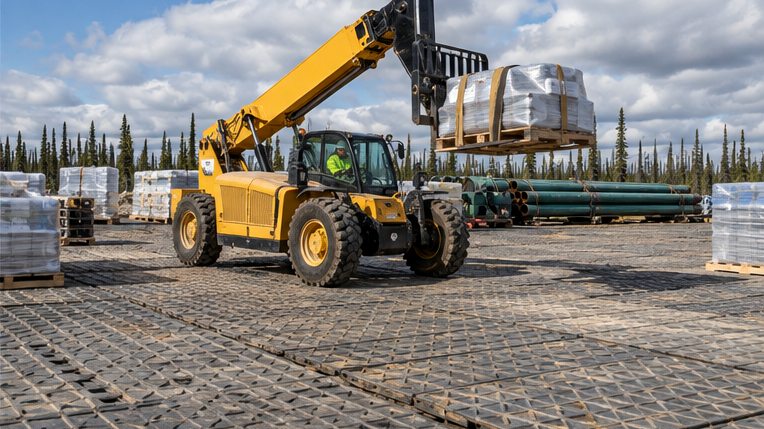
Figure: Pipe-loading of steel pipes, valves, compressors modules and site equipment, with a focus on “How to set up temporary parking and stand-by areas for piping and equipment support”
Pre-implementation should be preceded by the containment of routes, the removal of sharp stones, stakes and miscellaneous items that may form a spot load, the repair of deep-pit tracks and the removal of horizontal drainage. The area of the leg pads is determined by the retroactivity of the equipment and the confirmed base load, and no pavement board automatically replaces the approved hanger operating platform. The plates should be prepared continuously at the stabilization end, with the bends, reverses and parking areas being expanded as appropriate; the leg mats should be flat, intermediated and in full contact, and it should not be allowed to be filled with random stacking. Test-painting records for “plugging and equipment to support the setting up of temporary parking and stand-by areas” should indicate starting and ending locations, vehicle status and release conclusions to facilitate review as construction conditions change.
Multiple shifts or lease items may be used to record the middle, full exposure, de-loading, mat deformation, deposition, horizontal, edge fragmentation and isolation of persons, and to link road maps and product numbers. Continuous anomalies should trigger a review of the project, rather than a mere surface. Visible permanent deformation, deep mouth or postpoint damage to the leg cushions shall be judged by standard manufacturer ' s isolation. With regard to the “how to set up temporary parking and stand-by areas for piping and equipment support”, the patrol forms need to show a separate column of static, brake and turn-over changes that significantly increase local stress and indicate the inspector's time to return.
It is recommended that a key route or a feeder of equipment be selected for controlled validation, with observation cycles and exit conditions. The records cover normal and most unfavourable conditions, with particular attention to static, brakes and turnovers, which significantly increase local stress. A further expansion after the trial could reduce one-time procurement or full-line errors, while providing the same basis for vendor comparison. This retrodiscussion should also answer whether the “how to set up temporary parking and stand-by areas for piping and equipment support” can be verified for improvement in the timely restoration of sealing controls in abnormal areas by retaining back-up panels and connectors, and avoid a subjective description of the end of the item.
This paper could serve as a technical discussion list for the hydrocarbon project, but not as a separate construction permit. The project will also require a written programme of transport organization, temporary structures, electrical safety, fire protection, weather emergencies and site restoration systems, and a review of key carrying and stabilization conditions by authorized personnel.
With regard to “how to set up temporary parking and stand-by areas for piping and equipment support”, the following special checks should be carried out in conjunction with the piping operation of steel pipes, valves, compressors modules and site equipment: parking and stand-by areas usually have longer static loads than normal corridors, and may also have a back-up, shift and queue. This should be designed to separate docking positions, access points, fire clearance, personnel passages and possible leakage controls, and to expand overall coverage as necessary.
On-site implementation of the recommendation: the stand-by area should avoid concentrating the maximum payload on a single board for long periods of time. Vehicles can be lined up in a decentralized manner and are prohibited from moving in situ; oil or mud vehicles should also be equipped with approved leak collection and cleaning measures.
Need for further evaluation of the actual project?
Applications, sizes, quantities, site photographs or drawings and delivery destinations are sent, on which we can identify more suitable products and processing programmes.







