
The oil and gas projects often place transport, parking and cranes in adjacent areas, so how the piping and equipment support should be planned requires a clear design boundary for each category. Pipe-loading of steel pipes, valves, compressors modules and site equipment, with a focus on how “pipe-capture and equipment support should be planned” when quoted only for the total area, can easily be left out of the convection, foot drop and recovery route. The lack of support on the edge of the road leads to the bending and crushing of the plate and to the failure of otherwise sufficient direct sections at peaks.
If the project needs to be accompanied by a pavement and a mat, an optional table should be established. The former are dominated by continuous support on the route, axle and the grass-roots level, while the latter are dominated by maximum reversibility of the legs and allowing for ground bearing. The implementation of approved road map, numbering and inspection log changes in conjunction with crane models, maximum retroactivity of legs, leg spacing, suspension radius, ground-based allowance for pressure, groove distance to edge, underground pipelines and post-rainfall state can avoid using both products as alternative components. The information review should also check the endpoint of the main route, the softest sections and the location of the emergency rerouting, and include missing information as an item to be confirmed for the quotation and construction programme.
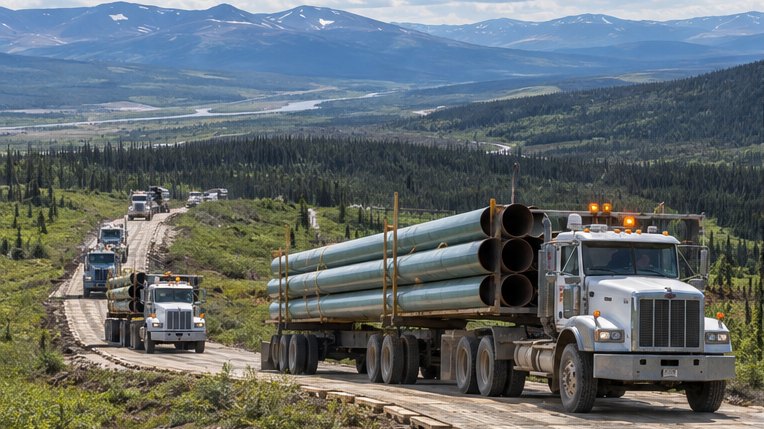
Figure: Pipe-loading operations for tubes, valves, compressors modules and site equipment, with a focus on “How to plan for pipe-capturing and equipment support”
The drainage direction, soft spots and support under the plate should be compared before and after the rainfall, and the water should not be enclosed under the plate. The area of the leg pads is determined by the retroactivity of the equipment and the confirmed base load, and no pavement board automatically replaces the approved hanger operating platform. If the lack of support on the edge of the road leads to the appearance of a bending and crushing of the sheet, it is important to first seal the area, lift the floor and drain, and then re-connect it; the reasons are usually not eliminated by simply cleaning the surface or adding a single sheet. The trial-pail record of “how to plan for the lifting of pipes and equipment support” should identify the starting point, vehicle condition and release conclusions to facilitate review as construction conditions change.
During the operation period, the legs shall be checked for middle, full contact, overload, mat deformation, deposition, horizontal, edge fractures and isolation of persons, before class, after peak traffic and after rainfall. Each record shall contain the date, location, vehicle, weather, unusual photographs and processing results. If the lack of support at the edge of the road in the same area leads to the bending and crushing of the sheet, it should return to the grass-roots, drainage, transport organization and specification re-analysing, rather than replacing only surface components. The "how to plan " around " piping and equipment support " , the patrol forms are to show a lack of support on the edges of the separate road, leading to changes in the bending and crushing of the sheet, and to indicate the time of the inspector ' s retrogression and re-entry.
The full life-cycle costs include procurement or leasing, shipping, unloading, laying, inspection, cleaning, maintenance, warehousing and ground restoration. The project should compare the implementation costs of managing on-site changes with approved road maps, serial numbers and inspection logs with the costs of stoppage or repair resulting from lack of support on the edges of the road, resulting in the bending and crushing of the sheet, and not be determined solely on the basis of single-block product prices. It should also answer whether the “how to plan for the piping and equipment support” can be verified for improvement by managing on-site changes using approved road maps, numbers and inspection records to avoid a subjective description of the end of the item.
This paper provides a selection and management approach and does not replace the equipment instructions, the suspension programme, ground-based evaluation or local regulations. Work involving lifting support, underground facilities, electrical areas, the edges of trenches and the entry of persons into dangerous areas shall be reviewed by persons with appropriate qualifications. The above parameters may be provided in the request for quotations to obtain recommendations for size, thickness, quantity, packaging and shipment.
The following special verifications should be carried out with regard to the “how to plan for piping and equipment support”, in conjunction with the piping operation of steel pipes, valves, compressor modules and site equipment: the main route, car area, equipment stand-by, emergency exit and final exit route should be drawn on the same map at the planning stage, and the most extensive vehicles should be identified at the actual ratio. Once the route has changed, the soft spots, drainage and coverage should be re-examined and the old version should not be used.
On-site implementation of the recommendation: The route can be subject to a hard transition, ordinary soft ground, extremely soft points, turnovers and operational segments, each with different release and maintenance requirements. This would allow for accurate containment and repair, even if partial failure, without the need to disable the entire passage.
Need for further evaluation of the actual project?
Applications, sizes, quantities, site photographs or drawings and delivery destinations are sent, on which we can identify more suitable products and processing programmes.







