
The purpose of the installation sequences supported by plumbing and equipment is to allow construction vehicles to travel within the controlled route, while avoiding turning ground protection issues into equipment stabilization problems. The main focus of this topic is “How to sequence the piped and the equipment supported by the pipes, valves, compressor modules and site equipment”, which should, inter alia, check the decrease in ground-based loads and the emergence of pump mud or faults following rainfall. Where there is a gutter, backfilling area, slope or unknown underground facility on the route, the treatment must first be confirmed by the responsible party of the project.
The focus of the topic is not on the choice of the thickest or the most heavy products, but on the establishment of a match. The coverage, connection and back-up quantity is determined by continuous coverage according to the least-favourable vehicle, complete wheel and weather change planning, based on the crane type, maximum retroactivity of the leg, leg spacing, suspension radius, ground-based allowance for pressure, distance of the gutter from the edge, underground pipe and post-raining state. In the case of products requiring cross-project turnaround, the numbering, loss rate, cleaning time and volume of transport should also be included in the total cost. The information review also applied to the "how to sequence the installation of the piping and equipment support " , and included the missing information as an item pending confirmation of the offer and the construction programme, using representative vehicle test thickness, connection and ground matching.
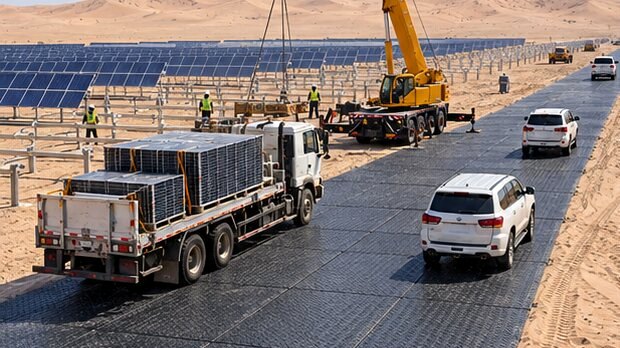
Figure: Pipe-stuffing of steel pipes, valves, compressors modules and site equipment, with a focus on “How to sequence the pipe-stuffing and equipment support” (contributions to plastics network)
The installation should leave a photo, location and measurement record. First, ground-level levelling, drainage and underground facilities are identified, and the complete contact, connection, edge and transition of the pavement is checked, or the size, location and centering of the leg pads are checked. The area of the leg pads is determined by the retroactivity of the equipment and the confirmed base load, and no pavement board automatically replaces the approved hanger operating platform. Areas not eligible for acceptance should not be replaced by speed-limit signs alone. The test-painting record of the "how to sequence the fitting of the plumbing and equipment support" should indicate the starting and ending position, the vehicle's condition and the release conclusion to facilitate review as the construction conditions change.
The inspection cycle can be shortened at an early stage of use and then stabilized before adjusting to vehicle cycles and weather. The maintenance staff focused on the mid-legged, full exposure, de-loading, mat deformation, deposition, horizontality, fragmentation of the edges and separation of personnel, as well as on the driver ' s compliance with speed limits and diversion requirements. Any unconfirmed sub-board support, edge instability or foot contact should first be disabled. With regard to the sequence of installation around " Pipe-stuffing and equipment support " , the inspection forms are to show a single line of surface-based load drops after rainfall and changes in pump mud or wrong table, with an indication of the inspector and the time of return.
The offers from different suppliers should be compared under the same size, material, connection, packaging, delivery and test basis. Supplementation should be requested if the maximum load is given without a description of the ground, distance and load. The oil and gas project should also focus on batch consistency, removal efficiency, repairability and container loading. It should also answer whether the sequence of installation of the “plugging and equipment support” was improved by a continuous coverage according to the most unfavourable vehicle, complete wheel and weather change planning to avoid a subjective description only.
The ultimate goal is to get the piped up operation for steel pipes, valves, compressor modules and site equipment, with a focus on how “piped lifting and equipment support sequenced” continues to operate with clear limits and acceptable risks and to successfully restore the ground after completion of the work. It is only when the design, product, operation, inspection and evacuation sites are linked that the ground-based load drops after the rainfall and the pump mud or the wrong table is present that does not recur during the rush phase.
The following special verification should also be carried out with regard to the "how to sequence the installation of the piping and equipment support " , in conjunction with the piping operation of steel pipes, valves, compressor modules and site equipment: the installation order should start at a stable and accessible end, with the main line being laid before the turn, car encounter and operating surface. The level, connection and drainage are checked at each stage of completion to avoid further entry at the front end of the vehicle while the back end is still being forced to point the hole or adjust the plate.
On-site implementation of the recommendation: The installation team should first check the panel numbers, connectors and handling tools and then proceed by drawing. In the event of a lack of poaching, roasting or violent pull, it should be checked whether the ground level, the direction of the plate and the specifications are mixed.
Need for further evaluation of the actual project?
Applications, sizes, quantities, site photographs or drawings and delivery destinations are sent, on which we can identify more suitable products and processing programmes.







