
When discussing how to deal with the continuous rainfall of the piping and equipment support, the project manager could not ask only how many tons the pavement could bear. The suspension of pipes for tubes, valves, compressors modules and site equipment, with a focus on the effects of the presence of tyres on the ground, axle-loads, turns, brakes and static bearings in “plugging and equipment support with continuous rainfall”, often at the most unfavourable position when vehicles enter unprotected areas due to temporary changes in construction routes. Reasonable coverage can be determined only if the routes, terminals and emergency exits must be secured.
The input information can be organized according to the four columns of equipment, ground, route and time, with emphasis on the crane type, maximum retroactivity of the leg, spacing of the leg, suspension radius, ground-based allowed pressure, distance of the gutter to the edge, underground pipeline and post-raining state. In response to temporary changes in the construction route, which resulted in vehicles entering unprotected areas, it is proposed to calculate the line segments, turn areas, docking positions and operating surfaces separately. In the case of leg pads, the maximum repulsive force of the leg provided by the plant must be obtained, and in the case of passage roads, the total weight of the vehicle, the axle, the tyre and the complete turn track should be used. The information review should also include the broadest vehicle profile, internal wheel differentials and side safety residuals in the core and include missing information as an item to be confirmed in the quotation and construction programme.
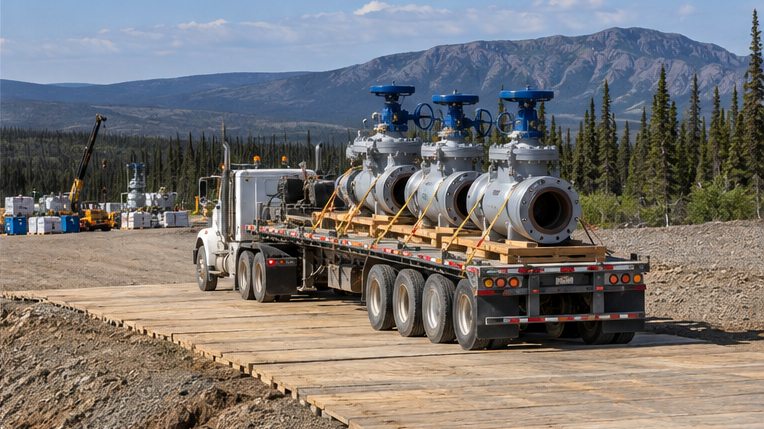
Figure: Pipe-stuffing operations for pipes, valves, compressors modules and site equipment, with a focus on “What if there is continuous rainfall in the pipe-stuffing and equipment support”
In the absence of space on the ground, work cannot be undertaken by reducing the necessary cover or moving legs to the shoulder of the road. Stations and construction should be reordered to provide sufficient space for “counting the line segments, turn areas, docking positions and surfaces, respectively”. The area of the leg pads is determined by the retroactivity of the equipment and the confirmed base load, and no pavement board automatically replaces the approved hanger operating platform. Any forced overlays of holes, temporary mats or uncounted should be returned to the technical manager for evaluation. The trial-pail record of “what to do with the lifting of pipes and equipment to support continuous rainfall” should indicate the starting and ending position, vehicle condition and release conclusions to facilitate review as construction conditions change.
Special inspections should be added after extreme weather, equipment anomalies or route adjustments. The use of position markings and fixed view photographs for mid-legs, full exposure, de-drive, mat deformation, deposition, horizontality, cleavage and isolation of persons facilitates comparison of deposition and shift. Cleaning the surface of polymers avoids fire, sharp shovels and violent knocks, creating new cracks and stress concentrations. In the area around “continuing rainfall on the lifting of pipes and equipment support”, the patrol forms need to list, on a separate basis, the temporary changes in the construction route that allow the vehicle to enter the unprotected area, as well as an indication of the repeater and the time of return.
It is recommended that a key route or a feeder of equipment be selected for controlled validation, with observation cycles and exit conditions. The records were to cover normal and most unfavourable conditions, with particular attention to temporary changes in the construction route that allowed vehicles to enter unprotected areas. A further expansion after the trial could reduce one-time procurement or full-line errors, while providing the same basis for vendor comparison. It should also answer the question of whether “how to conduct continuous rainfall with the piping and equipment support” is improved by calculating the line segment, turn area, docking position and surface separately, avoiding a subjective description of the final item.
Progress pressure cannot reduce the security floor. When a temporary change in the construction route results in a vehicle entering an unprotected area, it should first isolate and identify the reasons before deciding on the repair, rerouting or replacement of the product. Any measures should avoid introducing new risks of slide, overloading, tripping, electric area intrusion or human-car conflict.
The following special verifications should be carried out for the "continuous rainfall when the piping and equipment support are encountered" in conjunction with the piping of steel pipes, valves, compressor modules and stationary equipment: consecutive rainfall changes the substrate of the plate without necessarily immediately changing the surface of the plate. The site needs to have observation points in place before the rain, where traffic is restricted and when the rain is lifted to the representative position; if pump mud, fall down or water is empty, the grass-roots level should be repaired before movement is restored.
On-site implementation of recommendations: Rain-day management can set up three levels of early warning, restriction and decommissioning, with triggers written into pre-class meetings. Once the conditions for decommissioning have been met, no catch-up requirement can be a substitute for a re-examination; prior to the resumption of access, there should be a clear signatory.
Need for further evaluation of the actual project?
Applications, sizes, quantities, site photographs or drawings and delivery destinations are sent, on which we can identify more suitable products and processing programmes.







