
The establishment of temporary parking and stand-by areas in the mudholes of the oil and gas fields should be judged first and foremost by the separation of vehicle traffic, equipment stop-over and support for the crane. In the muddy area between oil wells, gas wells, distribution stations and service vehicles, the topic is concerned with “how the mudholes of oil fields and gas fields are equipped with temporary parking and stand-by areas” which usually undergo multiple stages of entry, construction, overhaul and evacuation, with variations in ground water content and traffic. The issue is most easily ignored when the test conditions differ and the nominal tonnage is directly compared to the miscalculated. The problem of grass-roots and drainage may have expanded if only ad hoc slabs were added after a vehicle has been trapped.
The focus of the topic is not on the choice of the thickest or the most heavy products, but on the establishment of a match. The coverage, connection and back-up quantities are determined by setting speed limits, prohibiting in-situ wheeling and arranging for the exclusive command of heavy vehicles, depending on the location of the oil or gas wells, the type of service vehicle, the full axle load, the soft points of roads, rainfall, traffic frequency, operational shifts, pollution control and emergency routes. In the case of products requiring cross-project turnaround, the numbering, loss rate, cleaning time and volume of transport should also be included in the total cost. For the “how to set up temporary parking and stand-by areas in the mudholes of the oil and gas fields”, the information review should also calculate the area covered by the line, the bend, the meeting and the reverse areas, respectively, and include missing information as an item for confirmation of the quotation and the construction programme.
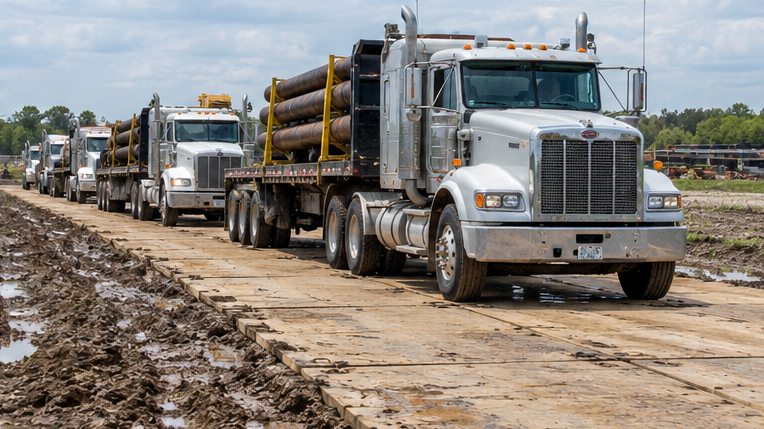
Figure: Mud areas between oil wells, gas wells, distribution stations and service vehicles, with a focus on “how to set up temporary parking and stand-by areas in the mudholes of oil and gas fields”
The drainage direction, soft spots and support under the plate should be compared before and after the rainfall, and the water should not be enclosed under the plate. The muddy oil and gas field road should first cut the drain and repair the deep-drive tracks, and then use the continuous laying of dispersed wheels, so that the plates cannot be thrown directly into the flow of thin mud. If the test conditions are different but the miscalculation caused by the nominal tonnage is already present, the area should first be sealed, the lifting plate should be connected to the drain and then the repositioning; the reason cannot normally be eliminated by simply cleaning the surface or adding a sheet. Test-painting records for the “how to set up temporary parking and stand-by areas in the mudholes of oil and gas fields” should identify the starting and ending locations, vehicle status and release conclusions to facilitate review as construction conditions change.
Inspections should not be “normal” only, but should be identified around pumping mud, water stubling, sliding, loose connection, contaminants, shoulder deposition and vehicle congestion, with anomalies classified into three levels of observation, restriction and decommissioning. A fixed photo angle and measurement benchmark should be established for key points that are designed to set speed limits, prohibit in situ wheeling and place a person in command for heavy vehicles. A loose connection, a permanent deformation, a breach through or a deviation of a branch shall be immediately isolated. With regard to the “how to set up temporary parking and stand-by areas in the mudholes of the oil and gas fields”, the inspection forms are to be presented in separate columns with different test conditions, but directly compared with the nominal tonnage, resulting in changes in miscalculation and a reference to the inspector and the time of return.
The offers from different suppliers should be compared under the same size, material, connection, packaging, delivery and test basis. Supplementation should be requested if the maximum load is given without a description of the ground, distance and load. The oil and gas project should also focus on batch consistency, removal efficiency, repairability and container loading. It should also answer whether the “how to set up temporary parking and stand-by areas in the mudholes of oil and gas fields” has been certified as improved by setting speed limits, prohibiting in situ cycling and arranging for exclusive command for heavy vehicles, and avoiding a subjective description of the end of the item.
The construction, equipment, HSE and logistics team should confirm the use of the same version of data before the procurement is issued. The common dimensions, thickness or reference load range referred to in this paper are not on-site commitments and actual performance is influenced by materials, temperature, foundations, connections and installation patterns, and the recommended results should indicate assumptions and no application.
With regard to “how to set up temporary parking and stand-by areas for mudholes in oil and gas fields”, the following specific verification should be carried out in conjunction with the mud-crossing areas between wells, gas wells, distribution stations and service vehicles: parking and stand-by areas usually take longer time than normal corridors, with the possibility of reverses, shifts and queuing of vehicles. This should be designed to separate docking positions, access points, fire clearance, personnel passages and possible leakage controls, and to expand overall coverage as necessary.
On-site implementation of the recommendation: the stand-by area should avoid concentrating the maximum payload on a single board for long periods of time. Vehicles can be lined up in a decentralized manner and are prohibited from moving in situ; oil or mud vehicles should also be equipped with approved leak collection and cleaning measures.
Need for further evaluation of the actual project?
Applications, sizes, quantities, site photographs or drawings and delivery destinations are sent, on which we can identify more suitable products and processing programmes.







