
When discussing the availability of spare panels for the mudslides in the oil and gas fields, the project leader could not ask only how many tons the pavement could bear. In the muddy area between oil wells, gas wells, distribution stations and service vehicles, the issue is concerned with the different effects of tyre landings, axle loads, turnovers, brakes and static bearings in the “how many back-up plates are needed for the oil fields and gas fields mud lanes”, and the lack of information leads to a lack of conformity between specifications, quantities and field conditions, often at the most unfavourable positions. Reasonable coverage can be determined only if the routes, terminals and emergency exits must be secured.
The input information can be organized by equipment, ground, route and time column, with emphasis on the position of the oil or gas well, the service vehicle type, the full axle load, the soft point of the road, rainfall, traffic frequency, operational shifts, pollution control and emergency response routes. In response to the lack of information, which resulted in a mismatch between specifications and quantities and field conditions, it was suggested that a description of the work, the basis for testing and the limitations be included in the request for and acceptance documents. In the case of leg pads, the maximum repulsive force of the leg provided by the plant must be obtained, and in the case of passage roads, the total weight of the vehicle, the axle, the tyre and the complete turn track should be used. The information review should also include snow, ice, sand and tyre state in towed management as well as the missing information as a pending item in the quotation and construction programme for “the availability of back-up panels for the mud lanes of oil and gas fields”.
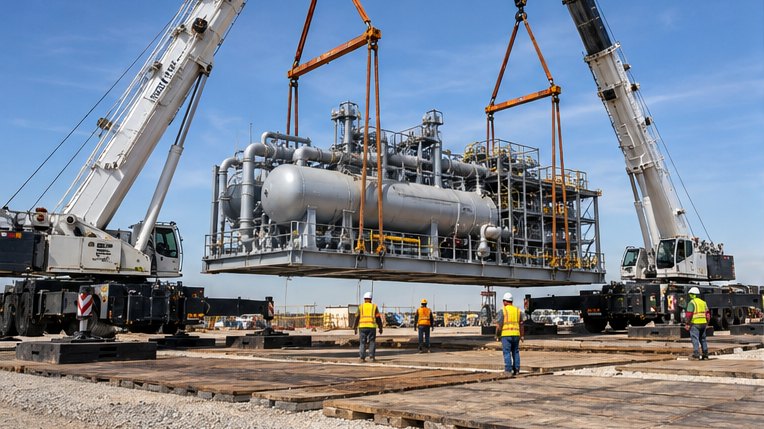
Figure: Mud passage areas between oil wells, gas wells, distribution stations and service vehicles, with a focus on “How many back-up plates are needed for mud paths to oil fields and gas fields”
The installation should leave a photo, location and measurement record. First, ground-level levelling, drainage and underground facilities are identified, and the complete contact, connection, edge and transition of the pavement is checked, or the size, location and centering of the leg pads are checked. The muddy oil and gas field road should first cut the drain and repair the deep-drive tracks, and then use the continuous laying of dispersed wheels, so that the plates cannot be thrown directly into the flow of thin mud. Areas not eligible for acceptance should not be replaced by speed-limit signs alone. The trial-pail record of “how many spare plates will be prepared for the mudslides of the oil and gas fields” should indicate the starting and ending position, vehicle condition and release conclusions to facilitate review as the construction conditions change.
The shift involves reporting changes in pumping mud, water accumulation, pressure edges, slides, loose connections, pollutants, shoulder deposition and vehicle congestion, rather than just describing the appearance. The sutures, shoulders or sub-points repaired in the previous class are reviewed in the next class. In the event that insufficient information leads to a mismatch between specifications, quantities and field conditions, and traffic increases, the project should immediately limit, reroute or suspend the equipment until such time as the re-examination passes. In the case of “the availability of back-up panels for the mudslides of the oil and gas fields”, the inspection forms need to be separate and insufficiently documented, resulting in variations in specifications, quantities that do not match the situation on the ground, and to indicate the inspector and the time of return.
The receiving and inspection information shall be maintained in the form of maps, product numbers, photographs of entry and exit sites, initial ground conditions, abnormal worksheets and demolition records. In the event of a ground or equipment dispute, the information can distinguish between the original soft spot, the use of changes and the removal site damage, and it can also quantify the impact on the cost of the project of insufficient information resulting in a mismatch between specifications and quantities and field conditions. This retrodiscussion should also answer whether “the number of back-up panels to be prepared for the mudslides of the oil fields and the gas fields” has been demonstrated to be improved by identifying the conditions of work, the basis of testing and the conditions of limitation in the request for and acceptance documents, and to avoid a subjective description of the closing item.
This paper could serve as a technical discussion list for the hydrocarbon project, but not as a separate construction permit. The project will also require a written programme of transport organization, temporary structures, electrical safety, fire protection, weather emergencies and site restoration systems, and a review of key carrying and stabilization conditions by authorized personnel.
The following specific verification should be carried out in relation to the “replacement panels required for the muddy passages of the oil and gas fields”, in conjunction with the muddy areas between the wells, gas wells, the distribution station and the service vehicles: the reserve quantity should be calculated in conjunction with the length of the route, the key nodes, the estimated rate of damage, the cleaning lead time and the replenishment distance. Remote projects cannot be purchased on a net-painted basis only, and authorized stocks should be reserved for soft-point expansion, loss of connections and temporary rerouting.
On-site implementation of the recommendation: The back-up plate should be close to key soft points without access to emergency routes and counted with connectors, tractors and cleaning materials. The inventory should distinguish between quantities that can be used immediately, that are to be cleaned, that are to be assessed and that are scrapped.
Need for further evaluation of the actual project?
Applications, sizes, quantities, site photographs or drawings and delivery destinations are sent, on which we can identify more suitable products and processing programmes.







