
The way in which the mudholes in the oil and gas fields have reduced the cost of ground rehabilitation should start from the most unfavourable rather than the average. In the muddy area between oil wells, gas wells, distribution stations and service vehicles, the topic is concerned that “how the mudholes of oil fields and gas fields can reduce the cost of ground recovery” may be affected by heavy vehicle cycles, rainfall and time compression at the same time, and that changes in the level of equipment overload or even deposition at the branch point may increase with traffic. It would be clearer for on-site execution to first determine the conditions for allowing deposition, decommissioning and those responsible, and then select product specifications.
The input information can be organized by equipment, ground, route and time column, with emphasis on the position of the oil or gas well, the service vehicle type, the full axle load, the soft point of the road, rainfall, traffic frequency, operational shifts, pollution control and emergency response routes. To change the level of equipment in terms of overloading or uneven deposition at the nodal points, it is proposed to manage on-site changes using approved road maps, numbering and inspection records. In the case of leg pads, the maximum repulsive force of the leg provided by the plant must be obtained, and in the case of passage roads, the total weight of the vehicle, the axle, the tyre and the complete turn track should be used. The information review should also approve the passage of vehicles after the map of the underground facilities is consistent with the site markings and include the missing information as an item pending confirmation of the quotation and the construction programme.
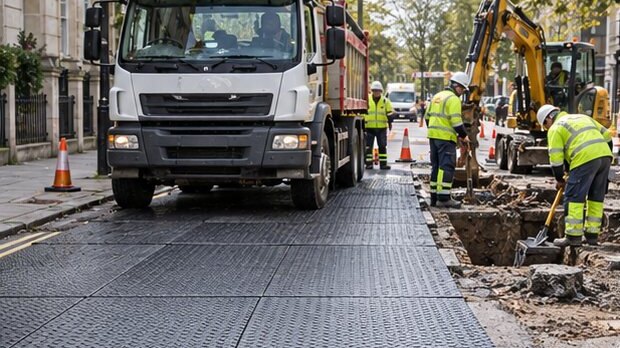
Figure: Mud area between oil wells, gas wells, distribution stations and service vehicles, with a focus on “How oil fields and gas fields mud lanes can reduce ground recovery costs” (inventory material for the Creative Plastics Executive Network)
The installation should leave a photo, location and measurement record. First, ground-level levelling, drainage and underground facilities are identified, and the complete contact, connection, edge and transition of the pavement is checked, or the size, location and centering of the leg pads are checked. The muddy oil and gas field road should first cut the drain and repair the deep-drive tracks, and then use the continuous laying of dispersed wheels, so that the plates cannot be thrown directly into the flow of thin mud. Areas not eligible for acceptance should not be replaced by speed-limit signs alone. The trial-pail record of “how the mudholes of the oil and gas fields have reduced the cost of ground restoration” should indicate the starting point, vehicle status and release conclusions to facilitate review as the construction conditions change.
It is recommended that the pavements and the mats be included in the asset desk account, numbering the relevant specifications, batches, pavements and hours of use. The scope of the inspection included pumping mud, water accumulation, pressure edges, slides, loose connections, pollutants, shoulder deposition and vehicle congestion. The removed components are to be cleaned, dried, flattened and placed in subdivisions that are qualified, subject to assessment, to repair and to end-of-life status, to prevent the re-entry of unqualified products. The inspection forms, which revolve around “how the mudholes of the oil fields and the gas fields reduce the cost of ground restoration”, are to vary the level of the equipment by overloading or uneven deposition at a single branch point, and to indicate the repeater and the time of return.
The impact assessment cannot be based solely on the movement of vehicles on the same day. The project compares vehicle waiting, trapping, maintenance hours, cleaning time, loss of connection, site restoration area and evacuation cycle, and records weather and traffic simultaneously. The question of whether this option is suitable for replication at the next hydrocarbon project is determined by the creation of data around a change in the level of the equipment by overloading or uneven deposition of the branch. This retrodiscussion should also answer whether the “how the mudholes of the oil fields and the gas fields reduce the costs of ground rehabilitation” have been certified as improved by managing on-site changes using approved road maps, numbers and inspection logs, so as to avoid a subjective description of the end of the item.
Road-painting and foot mats can only function in the approved construction system and cannot be a substitute for unsatisfactory foundations, damaged equipment or irregularities. Any unknown underground facility, unstable edges, legwork beyond the equipment manual or failure to isolate persons should be suspended and upgraded.
The following specific verification should also be carried out in relation to the “how the mudholes of the oil and gas fields reduce the cost of ground restoration” in conjunction with the muddy areas between the wells, gas wells, distribution stations and service vehicles: the cost of restoration can be accounted for in three parts, from the pre-entry baseline, from time-use disturbances and from the evacuation site. Original photographs, coverage, vehicle cycle, abnormal worksheets and demolition records are maintained to determine whether the costs are derived from existing soft spots, construction changes or operational deviations.
On-site implementation of the recommendation: Ground recovery should set a fixed sample point along the original route, comparing the depth of the tracks, topsoil thickness, drainage and vegetation. The restoration should be carried out on the basis of a contract and at the request of the competent authority and could not be justified by the use of the pavement.
Need for further evaluation of the actual project?
Applications, sizes, quantities, site photographs or drawings and delivery destinations are sent, on which we can identify more suitable products and processing programmes.







