
How oil and gas fields should be planned should be based on the most unfavourable rather than average conditions. In the muddy areas between oil wells, gas wells, distribution stations and service vehicles, the topic is concerned that the “how the oil fields and gas fields mudholes should be planned” may be affected by heavy vehicle cycles, rainfall and time compression at the same time, with static, brakes and turnovers resulting in a significant increase in local pressure as traffic increases. It would be clearer for on-site execution to first determine the conditions for allowing deposition, decommissioning and those responsible, and then select product specifications.
The technical communication shall first identify the location of the oil or gas wells, the type of service vehicle, the full axle charge, the soft point of the road, the rainfall, the frequency of traffic, the work shift, the pollution control and the design of the control of the emergency route. It was suggested that drainage and soft spots should be addressed before being laid and piloted from the end of the stabilization segment, and that suppliers should be asked to describe the materials, the finished goods, the test methods, the basis of application and the restrictions. Reference data such as nominal 50 to 200 tonnes cannot be directly compared horizontally without the same test basis. The information review should also check the endpoints of the main route, the softest sections and the location of the emergency rerouting, and include missing information as an item to be confirmed in the quotation and construction programme.
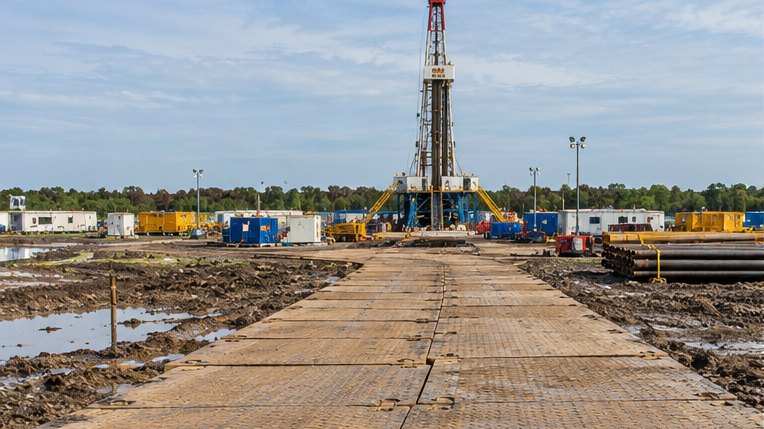
Figure: Mud areas between oil wells, gas wells, distribution stations and service vehicles, with a focus on “How the mud lanes of oil fields and gas fields should be planned”
Pre-implementation should be preceded by the containment of routes, the removal of sharp stones, stakes and miscellaneous items that may form a spot load, the repair of deep-pit tracks and the removal of horizontal drainage. The muddy oil and gas field road should first cut the drain and repair the deep-drive tracks, and then use the continuous laying of dispersed wheels, so that the plates cannot be thrown directly into the flow of thin mud. The plates should be prepared continuously at the stabilization end, with the bends, reverses and parking areas being expanded as appropriate; the leg mats should be flat, intermediated and in full contact, and it should not be allowed to be filled with random stacking. A test-pail record of “how shall be planned for the mudslides of the oil and gas fields” should identify the starting point, vehicle status and release conclusions to facilitate review as construction conditions change.
Inspections should not be “normal” only, but should be identified around pumping mud, water stubling, sliding, loose connection, contaminants, shoulder deposition and vehicle congestion, with anomalies classified into three levels of observation, restriction and decommissioning. For the first treatment of drainage and soft points, and then for the key points created from the steady end segment and from the pilot operation, a fixed photo angle and a measurement baseline should be set. A loose connection, a permanent deformation, a breach through or a deviation of a branch shall be immediately isolated. The inspection forms, which revolve around “how shall be planned for the mudslides of oil and gas fields”, contain a separate column of changes in static, brakes and turnovers that significantly increase the local pressure and indicate the time taken by the inspector and his/her return.
For oil and gas projects that are ongoing or duplicated, a baseline can be established for each square metre of work-hours, vehicle cycle, cleaning time, damage rate and restoration costs. This would make it easier to identify whether the next offer and inventory planning, which is no longer based solely on experience, is repeated in a given season due to the apparent increase in static, brake and turnover pressure. It should also answer whether the “how shall be planned for the mudholes of oil and gas fields” has been improved by first processing drainage and soft spots and then by laying and piloting the stable end, avoiding a subjective description of the final item.
This paper could serve as a technical discussion list for the hydrocarbon project, but not as a separate construction permit. The project will also require a written programme of transport organization, temporary structures, electrical safety, fire protection, weather emergencies and site restoration systems, and a review of key carrying and stabilization conditions by authorized personnel.
The following special verification should be carried out in the context of the mud zone between oil wells, gas wells, distribution stations and service vehicles: at the planning stage, the main corridor, car exchange area, equipment stand-by, emergency exit and final evacuation route should be drawn together on the same map, and the widest number of vehicles should be identified at the actual ratio. Once the route has changed, the soft spots, drainage and coverage should be re-examined and the old version should not be used.
On-site implementation of the recommendation: The route can be subject to a hard transition, ordinary soft ground, extremely soft points, turnovers and operational segments, each with different release and maintenance requirements. This would allow for accurate containment and repair, even if partial failure, without the need to disable the entire passage.
Need for further evaluation of the actual project?
Applications, sizes, quantities, site photographs or drawings and delivery destinations are sent, on which we can identify more suitable products and processing programmes.







