
The purpose of the installation sequences of the oil and gas fields mud lanes is to allow construction vehicles to travel within the controlled route, while avoiding turning ground protection into equipment stabilization. With regard to the mudslides between oil wells, gas wells, distribution stations and service vehicles, the topic is concerned with “how the mudslides of oil fields and gas fields can be sequenced”, in particular by checking how the traffic is repeated to form deep roads and damage the grass-roots level. Where there is a gutter, backfilling area, slope or unknown underground facility on the route, the treatment must first be confirmed by the responsible party of the project.
Procurement staff should submit field maps, vehicle watches and the location of oil or gas wells, service vehicle types, full-load axle loads, road soft points, rainfall, traffic frequency, operating shifts, pollution control and emergency response routes along with the request for quotations, and point out the repeated traffic of vehicles to create deep traffic patterns and damage potential locations at the grass-roots level. The programme could be based on the reverse removal of the equipment in the order in which it was withdrawn and the retention of the emergency route to the end of the zoning. For the whole container procurement, the quantity of the container, the pallet or bundle, the offloading equipment, the destination port and the conditions of storage at the site should also be confirmed in advance. The information review also applied to the “how to sequence the installation of mud paths in the oil and gas fields” and applied to a representative vehicle test thickness, connection and match state at the grass-roots level, and included missing information as an item to be confirmed in the quotation and construction programme.
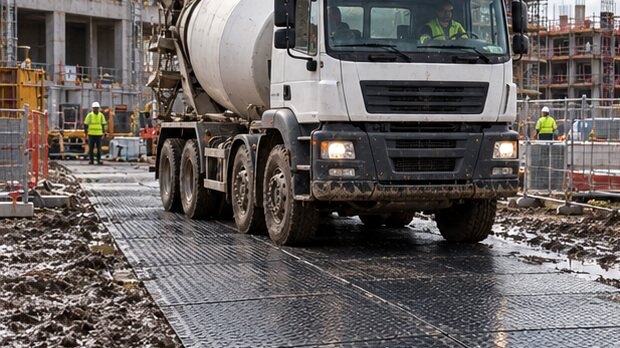
Figure: Mud area between oil wells, gas wells, distribution stations and service vehicles, with a focus on “How the mud lanes of oil fields and gas fields are sequenced” (initiative material for the plastic network).
The construction organization is as important as the product specifications. Operators should use means of moving a single load, with the vehicle being directed by a commander, without brakes, in situ wheeling or constant pressure. The muddy oil and gas field road should first cut the drain and repair the deep-drive tracks, and then use the continuous laying of dispersed wheels, so that the plates cannot be thrown directly into the flow of thin mud. Changes in traffic routes, repositioning of equipment or heavy rainfall are followed by a re-examination of the continued applicability of the original programme. The trial-pail record of “how to sequence the installation of the oil and gas fields mud lanes” should indicate the starting and ending position, vehicle condition and release conclusions to facilitate review as the construction conditions change.
It is recommended that the pavements and the mats be included in the asset desk account, numbering the relevant specifications, batches, pavements and hours of use. The scope of the inspection included pumping mud, water accumulation, pressure edges, slides, loose connections, pollutants, shoulder deposition and vehicle congestion. The removed components are to be cleaned, dried, flattened and placed in subdivisions that are qualified, subject to assessment, to repair and to end-of-life status, to prevent the re-entry of unqualified products. Around “how to sequence the installation of the oil and gas fields mudslides”, the inspection forms are designed to allow for the repeated movement of single-line vehicles to form deep lines and to disrupt changes at the grass-roots level, and to indicate the time taken by the inspectors and their return.
Construction, logistics, HSE, equipment, site and procurement could be jointly evaluated before the planned expansion. The parties confirmed the conditions of passage, suspension, inspection, restoration and delivery, respectively, to verify whether the reverse removal of the equipment in the order in which the equipment was withdrawn and the retention of the emergency route were truly enforceable. The results of the review should be included in the programme rather than in oral communication. This retrodiscussion should also answer whether “the sequence of installation of the oil field and gas fields mudslides” is improved by the reverse removal and retention of the emergency route in the order in which the equipment was withdrawn, so as to avoid a subjective description alone.
The ultimate goal is to allow muddy areas between oil wells, gas wells, distribution stations and service vehicles, with a focus on “how the oil fields and gas fields mudholes are sequenced in order” to continue to operate with clear limits and acceptable risks and to successfully restore the ground after the completion of work. It is only by connecting the design, product, operation, inspection and evacuation sites that vehicle traffic is repeated into deep space and the ground is destroyed.
The following special verification should be carried out in connection with the “how to sequence the installation of the mudslides of the oil and gas fields”, in conjunction with the mudslides between the wells, gas wells, the fusion station and the service vehicles: the sequence of installation should start at a stable and accessible end, with the main line being laid before the turnover, the meeting car and the operating surface. The level, connection and drainage are checked at each stage of completion to avoid further entry at the front end of the vehicle while the back end is still being forced to point the hole or adjust the plate.
On-site implementation of the recommendation: The installation team should first check the panel numbers, connectors and handling tools and then proceed by drawing. In the event of a lack of poaching, roasting or violent pull, it should be checked whether the ground level, the direction of the plate and the specifications are mixed.
Need for further evaluation of the actual project?
Applications, sizes, quantities, site photographs or drawings and delivery destinations are sent, on which we can identify more suitable products and processing programmes.







