
Oil and gas fields would need to choose how thick the pavements would be, starting with the separation of vehicle traffic, stationing of equipment from the support of cranes. In the muddy areas between oil wells, gas wells, distribution stations and service vehicles, the topic is concerned with “the need to choose the thick pavements of the oilfields and gas fields' mudslides” which usually undergo multiple stages of entry, construction, overhaul and evacuation, with variations in ground water content and traffic. The most easily overlooked aspect of this topic is the increase in secondary crushing and restoration costs caused by the error in the sequence of the evacuation yard. The problem of grass-roots and drainage may have expanded if only ad hoc slabs were added after a vehicle has been trapped.
The focus of the topic is not on the choice of the thickest or the most heavy products, but on the establishment of a match. The amount of coverage, connection and back-up is determined by calculating the direct-line segment, the turn-off area, the docking position and the operational surface, depending on the location of the oil or gas well, the service vehicle type, the full-load axle charge, the soft point of the road, rainfall, traffic frequency, operational shifts, pollution control and emergency route identification control conditions. In the case of products requiring cross-project turnaround, the numbering, loss rate, cleaning time and volume of transport should also be included in the total cost. In the case of “oil and gas fields mudslides requiring the choice of thick pavements”, the information review should also set fixed observation points on the outside side of the shoulder, slope and turn and include missing information as an item for confirmation of quotations and construction programmes.
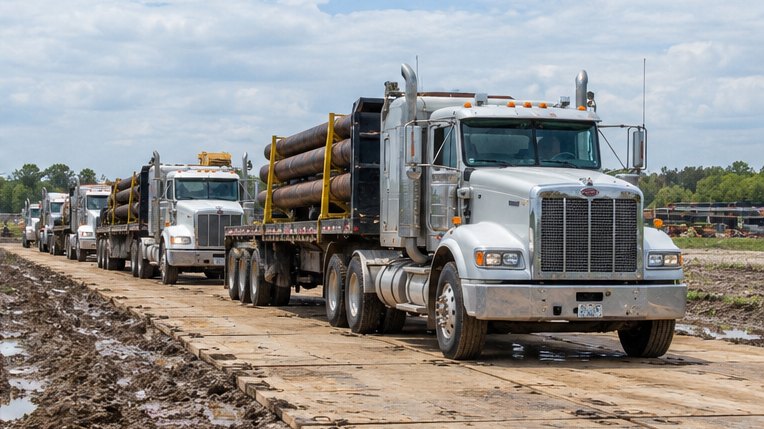
Figure: Mud areas between oil wells, gas wells, distribution stations and service vehicles, with a focus on “How thick a pavement should be chosen for the oil fields and gas fields.”
A smooth transition should be put in place at the different ground crossings to avoid the sudden impact of vehicles on temporary circuits from hard roads. Once the laying has been completed, the inside and outside of the most heavy vehicles and the brake position will be reviewed on the basis of separate calculations of the line segments, turn areas, docking positions and operating surfaces. The muddy oil and gas field road should first cut the drain and repair the deep-drive tracks, and then use the continuous laying of dispersed wheels, so that the plates cannot be thrown directly into the flow of thin mud. Physical segregation and clear rules for release are required in the vicinity of public areas. The trial-pave record of the “oil and gas fields mud lanes requiring the selection of thick pavements” should indicate the starting and ending position, vehicle condition and release conclusions to facilitate review following changes in construction conditions.
Multi-shift or leasing projects can record pump mud, water stubs, sideways, slides, loose connections, pollutants, shoulder depositions and vehicle congestion, and link road maps and product numbers. Continuous anomalies should trigger a review of the project, rather than a mere surface. Visible permanent deformation, deep mouth or postpoint damage to the leg cushions shall be judged by standard manufacturer ' s isolation. The inspection form, which revolves around the “oil and gas fields mudslides requiring the selection of thick pavements”, is to be accompanied by a ceremonial error in the order of the separate field, resulting in a change in the secondary crushing and recovery costs, and an indication of the inspector and the time of return.
The impact assessment cannot be based solely on the movement of vehicles on the same day. The project compares vehicle waiting, trapping, maintenance hours, cleaning time, loss of connection, site restoration area and evacuation cycle, and records weather and traffic simultaneously. The question of whether this option is suitable for replication at the next hydrocarbon project is determined only after data is created around secondary crushing and restoration costs due to an error in the sequencing of the divestiture. It should also answer whether “the oilfield and gas field mudslides require the choice of thick pavements” have been proven to be improved by calculating the straight-line segment, the turn-off area, the docking position and the surface, so as to avoid a subjective description of the closing item.
The construction, equipment, HSE and logistics team should confirm the use of the same version of data before the procurement is issued. The common dimensions, thickness or reference load range referred to in this paper are not on-site commitments and actual performance is influenced by materials, temperature, foundations, connections and installation patterns, and the recommended results should indicate assumptions and no application.
The following special verifications should be carried out in relation to “the choice of thick pavements for the mudslides of oil and gas fields”, in conjunction with the mudslides between oil wells, gas wells, and distribution stations and service vehicles: the thickness selection shall take into account both materials, panel structure, size, continuous support at the grass-roots level, temperature, type of vehicle and connection mode. 15, 20, 25 or 30 mm may be used as an option for quotations, provided that the final recommendation indicates the assumptions, the basis of the test and the circumstances of the work not applicable.
On-site implementation of the recommendation: The same thickness may be different under different dimensions, material formulations, texture and supporting conditions. The sample assessment should measure the actual thickness and weight and require suppliers to explain the test method, allow deformation and product use limits.
Need for further evaluation of the actual project?
Applications, sizes, quantities, site photographs or drawings and delivery destinations are sent, on which we can identify more suitable products and processing programmes.







