
The treatment of drainage and sub-board pumping mud in the mud-dwelling channels in the oil and gas fields is judged first and foremost by the separation of vehicle traffic, stationing of equipment from the support of the crane. In the muddy areas between oil wells, gas wells, distribution stations and service vehicles, the topic is concerned with “how oilfields and gas fields mudholes handle drainage and subsurface pump muds”, which usually go through multiple stages of entry, construction, overhaul and evacuation, with variations in ground water content rates and traffic. The most easily overlooked aspect of this topic is the lopsided or uneven deposition of points to change the level of equipment. The problem of grass-roots and drainage may have expanded if only ad hoc slabs were added after a vehicle has been trapped.
The input information can be organized by equipment, ground, route and time column, with emphasis on the position of the oil or gas well, the service vehicle type, the full axle load, the soft point of the road, rainfall, traffic frequency, operational shifts, pollution control and emergency response routes. To change the level of equipment in terms of overloading or uneven deposition at the nodal points, it is proposed to manage on-site changes using approved road maps, numbering and inspection records. In the case of leg pads, the maximum repulsive force of the leg provided by the plant must be obtained, and in the case of passage roads, the total weight of the vehicle, the axle, the tyre and the complete turn track should be used. The information review should also confirm the operational equipment stoppage time, the location of feeder points and the area of separation of personnel, and include missing information as an item to be confirmed for quotations and construction programmes.
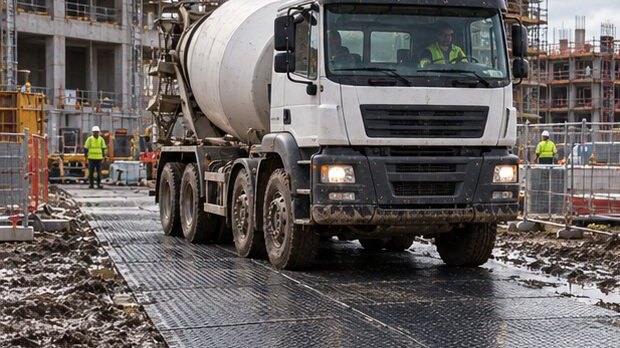
Figure: Mud areas between oil wells, gas wells, distribution stations and service vehicles, with a focus on “How to handle drainage and subsurface pumping of mud in oilfields and gas fields” (integrated material for the plastic network)
Pre-implementation should be preceded by the containment of routes, the removal of sharp stones, stakes and miscellaneous items that may form a spot load, the repair of deep-pit tracks and the removal of horizontal drainage. The muddy oil and gas field road should first cut the drain and repair the deep-drive tracks, and then use the continuous laying of dispersed wheels, so that the plates cannot be thrown directly into the flow of thin mud. The plates should be prepared continuously at the stabilization end, with the bends, reverses and parking areas being expanded as appropriate; the leg mats should be flat, intermediated and in full contact, and it should not be allowed to be filled with random stacking. The trial-pail record of “the treatment of drainage and subboard pump mud in the oil and gas fields mud lanes” should indicate the starting point, vehicle status and release conclusions to facilitate review following changes in construction conditions.
Multi-shift or leasing projects can record pump mud, water stubs, sideways, slides, loose connections, pollutants, shoulder depositions and vehicle congestion, and link road maps and product numbers. Continuous anomalies should trigger a review of the project, rather than a mere surface. Visible permanent deformation, deep mouth or postpoint damage to the leg cushions shall be judged by standard manufacturer ' s isolation. The inspection forms for the treatment of drainage and sub-board pumping mud around the “oil and gas field mudslides” are to vary the level of the equipment by a single column or by an uneven deposition, and to indicate the time taken by the inspector and the resumption of traffic.
The offers from different suppliers should be compared under the same size, material, connection, packaging, delivery and test basis. Supplementation should be requested if the maximum load is given without a description of the ground, distance and load. The oil and gas project should also focus on batch consistency, removal efficiency, repairability and container loading. It should also answer whether “the treatment of drainage and sub-board pumping mud in the fields and gas fields' mudslides” has been demonstrated to be improved by managing on-site changes using approved road maps, numbers and inspection logs, so as to avoid a subjective description of the final item.
Road-painting and foot mats can only function in the approved construction system and cannot be a substitute for unsatisfactory foundations, damaged equipment or irregularities. Any unknown underground facility, unstable edges, legwork beyond the equipment manual or failure to isolate persons should be suspended and upgraded.
The following special verification should be carried out with regard to “the treatment of drainage and sub-board pumping of mud in the mudslides of oil and gas fields”, in conjunction with the mudslide areas between wells, gas wells, distribution stations and service vehicles: the drainage design should specify where the water enters, where it passes and where it is eventually discharged. Scrutinization usually indicates that fine particles and water are squeezed repeatedly by vehicles, and that simply cleaning the surface cannot solve the cause, requiring post-encumbering treatment soft spots, filters or approved floors.
On-site implementation of recommendations: The sew and flow direction of the slurry position can be marked, and the loss of grass-roots particles is compared with the normal part of the adjacent area after the plate is removed. Upon completion of the repairs, the same vehicle and velocity should be used to re-establish that the problem did not migrate to both ends.
Need for further evaluation of the actual project?
Applications, sizes, quantities, site photographs or drawings and delivery destinations are sent, on which we can identify more suitable products and processing programmes.







