
In the muddy areas between oil wells, gas wells, distribution stations and service vehicles, the focus of the topic is “What if there is continuous rainfall in the mudholes of oil fields and gas fields” and the appearance of flatness does not mean that there is a continuous burden under the plate. In response to the continuous rainfall of the mudslides of the oil and gas fields, the condition of the ground, the weather and the most heavy vehicle condition should be recorded before entering the field, as a loose connection, drainage congestion or reduced actual use of pollution may occur only after repeated traffic. The establishment of baseline photographs and measurement points will facilitate follow-up inspections and recovery of acceptances.
If the project needs to be accompanied by a pavement and a mat, an optional table should be established. The former are dominated by continuous support on the route, axle and the grass-roots level, while the latter are dominated by maximum reversibility of the legs and allowing for ground bearing. In combination with the location of oil or gas wells, the service vehicle type, the full-load axle charge, the soft points of roads, rainfall, traffic frequency, operating shifts, pollution control and emergency routes, continuous coverage by the most disadvantaged vehicles, complete wheels and weather changes can be avoided as alternative components. The information review should also include the broadest vehicle profile, internal wheel differentials and side safety residuals in the core and include missing information as an item to be confirmed in the quotation and construction programme.
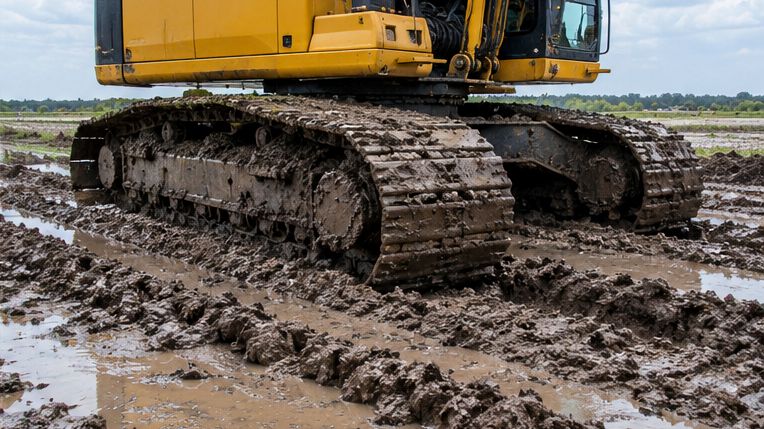
Figure: Mud areas between oil wells, gas wells, distribution stations and service vehicles, with a focus on “What if there is continuous rainfall in the mud lanes of oil fields and gas fields”
The installation should leave a photo, location and measurement record. First, ground-level levelling, drainage and underground facilities are identified, and the complete contact, connection, edge and transition of the pavement is checked, or the size, location and centering of the leg pads are checked. The muddy oil and gas field road should first cut the drain and repair the deep-drive tracks, and then use the continuous laying of dispersed wheels, so that the plates cannot be thrown directly into the flow of thin mud. Areas not eligible for acceptance should not be replaced by speed-limit signs alone. The test-pail record “What to do with continuous rainfall in the mudslides of the oil and gas fields” should indicate the starting point, the vehicle's condition and the release conclusion, to facilitate review as the construction conditions change.
The maintenance plan should include responsibility for key sections and feeder points, frequency checks, decommissioning thresholds and spare parts locations. Continuous coverage around the most disadvantaged vehicles, complete wheels and weather change planning exercises can be timely in detecting loose connections, drainage congestion or pollution to reduce actual usage. Backup panels, connectors and handling tools are also synchronized to avoid mismatches in specifications on site. In the case of “continuing rainfall in the mudslides of the oil and gas fields”, the inspection forms need to list changes in the actual operational status of the connection that are loosed, drained or contaminated, and to indicate the time taken by the inspector and his/her return.
The offers from different suppliers should be compared under the same size, material, connection, packaging, delivery and test basis. Supplementation should be requested if the maximum load is given without a description of the ground, distance and load. The oil and gas project should also focus on batch consistency, removal efficiency, repairability and container loading. It should also answer whether the “continuing rainfall in the mudholes of oilfields and gas fields” has been demonstrated as an improvement through continuous coverage according to the most adverse vehicle, complete wheel and weather change, avoiding a subjective description of the final item.
This topic can be summarized as first confirming the boundary of the work, then configure the appropriate product, and then validate it with test run, inspection and project data. The formal programme should identify those responsible, the restrictions, the criteria for decommissioning, the means of recovery and the emergency route, so as to avoid the loss of critical information following changes in the class or contractor.
The following special verifications should be carried out in relation to the “continuing rainfall in the mudholes of the oil and gas fields”, in conjunction with the mud-crossing areas between the wells, gas wells, distribution stations and service vehicles: the continuous rainfall will alter the sub-plain without necessarily immediately changing the surface. The site needs to have observation points in place before the rain, where traffic is restricted and when the rain is lifted to the representative position; if pump mud, fall down or water is empty, the grass-roots level should be repaired before movement is restored.
On-site implementation of recommendations: Rain-day management can set up three levels of early warning, restriction and decommissioning, with triggers written into pre-class meetings. Once the conditions for decommissioning have been met, no catch-up requirement can be a substitute for a re-examination; prior to the resumption of access, there should be a clear signatory.
Need for further evaluation of the actual project?
Applications, sizes, quantities, site photographs or drawings and delivery destinations are sent, on which we can identify more suitable products and processing programmes.







